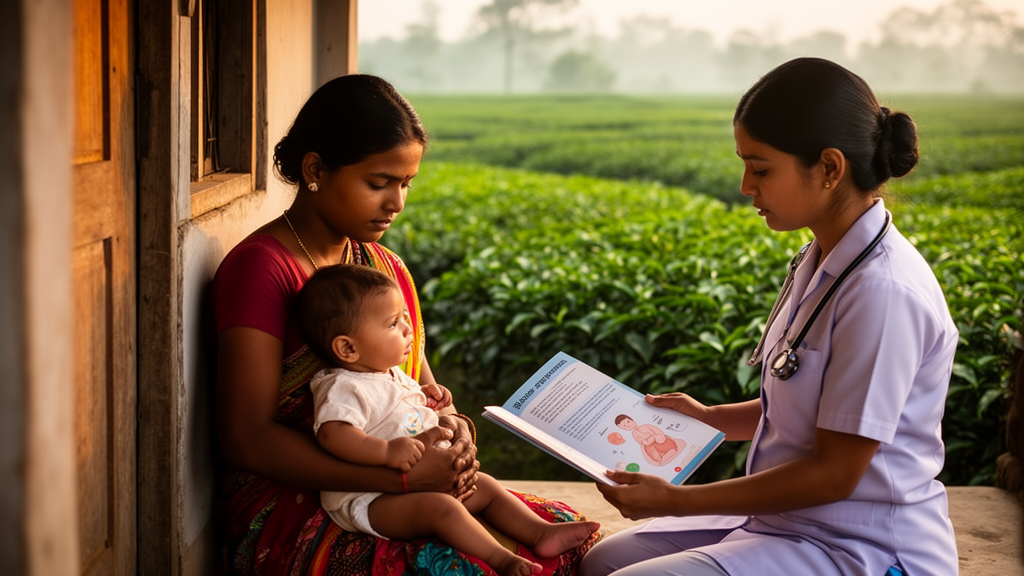
Deep in the tea belt of Assam, where emerald plantations stretch across five districts of northeastern India, a quiet demographic study has produced one of the clearest pictures yet of why babies die in one of the country’s most historically marginalized working communities. Researchers from Dibrugarh University surveyed 1,308 households across Dibrugarh, Tinsukia, Sivasagar, Jorhat and Sonitpur, the heartland of Assam’s tea industry, and found an average infant mortality rate of 33.14 deaths per 1,000 live births between 2019 and 2023. That figure sits above the trajectory India’s national health planners have long hoped to achieve, and the new analysis, published in BMC Public Health, identifies with unusual statistical precision exactly which factors push a family toward that loss.
The study, led by economists Anindita Chakravarty and Nayanmoni Borgohain Baruah, is notable for its empirical design in a setting where reliable vital statistics are scarce. Using multistage random sampling, the team interviewed women of reproductive age, between 15 and 49 years, in households scattered across the tea-growing districts. Because tea garden labourers descend from populations brought to Assam during the colonial era and have lived in plantation enclaves with distinct socio-cultural and livelihood conditions for generations, national and state-level surveys routinely miss the specific dynamics of this community. The researchers filled that gap with primary data rather than extrapolating from broader datasets, a methodological choice that matters when the goal is to design interventions for a specific population.
To disentangle the web of possible influences on infant survival, the team turned to binary logistic regression, a statistical technique that models the probability of a binary outcome, in this case whether an infant died or survived the first year of life, as a function of multiple explanatory variables simultaneously. The approach allows each factor’s independent effect to be estimated while holding the others constant, which is essential in a field like this where potential determinants, from household income to sanitation, cluster tightly together. The regression yielded a strikingly clear hierarchy of significance, with three variables standing out at the most stringent threshold of p < 0.001.
Maternal education emerged as the single most powerful predictor. Women with more years of schooling were substantially less likely to lose an infant, a relationship that public health researchers have documented across many settings but that carries particular weight here. Education shapes how mothers understand danger signs during pregnancy, how they navigate health services, and how they respond to medical advice. In a community where formal schooling has historically lagged, the finding suggests that investments in girls’ education could ripple directly into infant survival rates decades later.
Pre-maturity at the time of birth was the second dominant determinant. Babies born before full term face elevated risks of respiratory distress, neonatal sepsis, and necrotizing enterocolitis, conditions the article’s own subject classifications flag as relevant. Prematurity management requires skilled birth attendance, neonatal intensive care capacity, and timely referral systems, all of which are unevenly distributed across Assam’s plantation landscape. The third pillar, antenatal care during pregnancy, operates upstream of birth itself: regular check-ups allow clinicians to detect complications, manage anemia and hypertension, and prepare mothers for safe delivery. That all three of these factors cleared the p < 0.001 threshold signals that the study’s core findings are unlikely to be statistical noise.
Two additional variables showed marginal but real effects. Sanitation facility, significant at p < 0.05, reflects the well-established link between household hygiene and infant infections, particularly diarrheal disease, which remains a leading cause of post-neonatal death in low-resource settings. The sex of the child, significant at p < 0.10, hints at possible biological or care-seeking differences, though the weaker threshold suggests a more tentative relationship. Together, these secondary findings reinforce the picture that infant mortality in this community is not a single-cause problem but a layered one, spanning clinical care, household environment, and social dynamics.
Perhaps the most provocative results are the ones that did not reach significance. Monthly household income, mother’s age at birth, birth order of the infant, and access to safe drinking water all failed to show statistically significant impacts on infant mortality once other factors were controlled. In many developing-country contexts, income is treated as a proxy for overall living standards and health access, so its absence here is telling. It suggests that within this community, the differences between families that lose babies and those that do not are not primarily about how much money comes into the household, but about education, clinical care during pregnancy, and the circumstances of birth itself. Safe drinking water, often assumed to be a protective factor, likewise did not emerge as significant, pointing to the possibility that other environmental and behavioral pathways dominate in this specific setting.
The study’s authors emphasize that these findings provide context-specific insights that could shape targeted maternal and infant health interventions for Assam’s tea garden communities. Rather than applying generic national policies, planners could focus on expanding antenatal care coverage, strengthening prematurity prevention and management, improving household sanitation, and, crucially, investing in maternal education as a long-term structural lever. The research received no external funding and was approved by the Dibrugarh University Ethical Committee for Social Science and Humanities, with informed consent obtained from all participants and no personal identifiers disclosed.
What makes this study resonate beyond Assam is its methodological clarity in a data-poor environment. By combining primary household surveys with rigorous regression analysis, the researchers have demonstrated that even in communities where vital registration systems falter, it is possible to generate actionable evidence. The 33.14 per 1,000 live births figure provides a baseline against which future progress can be measured, and the identified determinants offer a roadmap for intervention. As India continues its push toward reducing infant mortality nationwide, studies like this one remind us that national averages conceal profound disparities, and that the path to equity runs through the specific histories, livelihoods, and social structures of the communities where the burden is heaviest.
The tea garden labour community of Assam has long been recognized as socio-economically marginalized, with plantation enclaves shaping distinct patterns of health and survival. This new research transforms that recognition into quantified evidence, showing that the levers of change are identifiable, measurable, and within reach of policy. If maternal education, antenatal care, and prematurity management can be scaled across the tea belt, the study suggests, the community’s infant mortality trajectory could bend downward in ways that generic approaches have failed to achieve. The work stands as a model for how empirical, community-specific research can illuminate the hidden determinants of life and death in populations that national statistics too often overlook.
Subject of Research: Assessment of trend, pattern and predictive factors determining infant mortality among the tea garden labour community of Assam, India
Article Title: Assessment of trend, pattern and predictive factors determining infant mortality among the tea garden labour community of Assam, India
Article References: Chakravarty, A., & Baruah, N. B. (2026). Assessment of trend, pattern and predictive factors determining infant mortality among the tea garden labour community of Assam, India. BMC Public Health. https://doi.org/10.1186/s12889-026-29958-7
Image Credits: AI Generated
DOI: 10.1186/s12889-026-29958-7
Keywords: Assessment, trend, pattern, predictive, factors, determining, infant, mortality, garden, labour, community, Assam
News Source: Harold Sullivan. (October 17, 2026). Maternal education and antenatal care drive infant survival in Assam tea gardens. Scienmag.