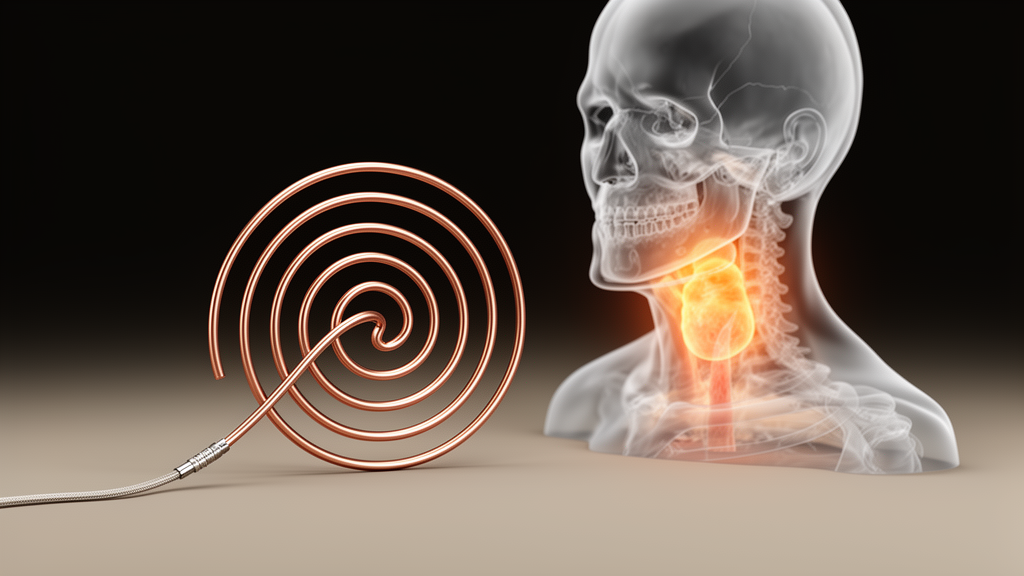
Engineers in India have built a single spiral antenna that can heat tumors at three different depths inside the head and neck simply by switching between three microwave frequencies, according to a study published in Medical & Biological Engineering & Computing. The device, designed and optimized by Nitika Sharma, Rajesh Khanna, and Mayank Kumar Rai at the Thapar Institute of Engineering & Technology in Patiala, measures just 70 by 70 by 1.6 millimeters and is etched on a low-cost FR4 substrate, the same inexpensive fiberglass laminate found in everyday consumer circuit boards. Its compact footprint and tri-band operation could make personalized hyperthermia therapy, in which tumors are warmed to therapeutic temperatures to boost the effectiveness of radiation and chemotherapy, far more practical and affordable for clinics treating head and neck cancers.
Hyperthermia is one of the quieter success stories in modern oncology. When cancerous tissue is raised to temperatures between roughly 41 and 45 degrees Celsius, tumor cells become more sensitive to radiation, oxygen delivery within the tumor improves, and the heat itself can trigger signaling pathways that damage cancer cells while sparing healthy ones. Clinical studies over several decades have shown that adding hyperthermia to chemoradiation can improve outcomes in head and neck cancer, yet the technique has struggled to spread widely, largely because heating equipment has been bulky, difficult to control, and often tuned to a single frequency that suits only a narrow range of tumor locations. The depth of a tumor matters enormously: a superficial lesion on the buccal mucosa requires very different energy delivery than a tumor sitting several centimeters deep in the tongue base or beyond.
The new antenna attacks that limitation directly by operating at three distinct frequency bands: 915 megahertz, 1.8 gigahertz, and 2.45 gigahertz. The physics behind frequency-dependent heating is well established in microwave engineering. Lower-frequency waves penetrate deeper into biological tissue but spread their energy over a larger field, while higher-frequency waves deposit energy more superficially and more intensely. At 2.45 gigahertz, the antenna provides localized heating suited to superficial tumors no deeper than about 3 centimeters. At 1.8 gigahertz, it is effective for intermediate depths between 3 and 3.6 centimeters. At 915 megahertz, it achieves deeper penetration for tumors located beyond 3.6 centimeters. In effect, one applicator replaces three separate devices, and a clinician can select the frequency that matches a patient’s tumor depth rather than the other way around.
The spiral geometry is central to the design. Spiral antennas have long been favored in hyperthermia research because their geometry supports stable resonance and relatively uniform heating patterns, and the Thapar team’s tri-band spiral maintains excellent impedance matching across all three operating frequencies. Impedance matching, expressed through S-parameter analysis, is the measure of how efficiently radio-frequency energy is transferred from the feed line into the antenna and onward into tissue rather than being reflected back toward the generator. Poor matching wastes input power and creates unpredictable heating, so stable tri-band resonance with strong matching ensures that the modest input powers used in the study, between 2.5 and 6 watts, are delivered efficiently into biological tissue.
To evaluate performance, the researchers relied on a hierarchy of computational models. They began with homogeneous and heterogeneous tissue phantoms, simplified models that mimic the dielectric properties of human tissue, and then moved to the Katja voxel model, a detailed anatomical representation of a human head built from medical imaging data, tested both with and without a simulated tumor. Across these models, the team quantified three key metrics. The specific absorption rate, or SAR, describes how much microwave power is absorbed per kilogram of tissue and reveals where heating is concentrated. Penetration depth indicates how far the electromagnetic energy reaches into tissue before its intensity falls off. The effective field size, or EFS, defines the volume of tissue heated to useful levels, which determines whether the entire tumor receives the therapeutic dose.
The thermal simulations delivered the study’s most clinically significant numbers. With input powers between 2.5 and 6 watts, the antenna achieved therapeutic temperatures of 41 to 45 degrees Celsius across all three frequency bands, the range in which hyperthermia sensitizes tumors to concurrent therapy without causing the tissue damage associated with ablative heating. Those power levels are notably low for microwave hyperthermia, which matters for patient comfort and for the safety of surrounding structures in the delicate anatomy of the head and neck, where the spinal cord, salivary glands, and mucosal surfaces sit close to the tumor volume.
Simulation alone is never sufficient for a medical device, so the team validated the antenna experimentally using a liquid that simulates the dielectric properties of human head tissue and ex vivo chicken tissue. The measured heating behavior agreed well with the computational predictions, confirming that the antenna’s real-world performance matches the optimized design. This agreement between simulation and experiment is a critical step for any applicator intended for clinical translation, because it demonstrates that the SAR distributions, penetration depths, and effective field sizes computed in the voxel models are not artifacts of modeling assumptions but reflect genuine, reproducible energy deposition.
The study builds on a growing body of hyperthermia applicator research, much of it from the same group. Earlier work by Sharma and colleagues included a double spiral antenna with an artificial magnetic conductor structure, metamaterial-based compact applicators, a metasurface hyperthermia lens, and an experimental analysis of a metamaterial-integrated applicator published in Scientific Reports. The broader field has produced phased-array systems such as the HYPERcollar applicator used in Dutch clinical studies of deep head and neck hyperthermia, cavity-encapsulated patch antennas for superficial treatment, and transmit-array lens antennas for deep-seated tumors. What distinguishes the new device is the combination of tri-band operation, compact size, and low-cost construction in a single spiral geometry aimed specifically at the depth range encountered in head and neck tumors.
The practical implications are considerable. Head and neck cancers account for a substantial global burden, with risk factors including tobacco and alcohol use, and tumor depth varies widely between patients and even between primary lesions and cervical lymph node metastases in the same patient. An applicator that can be frequency-tuned to a specific tumor depth enables a personalized treatment plan: a clinician could image the tumor, determine its depth, and select 2.45 gigahertz for a shallow lesion, 1.8 gigahertz for an intermediate one, or 915 megahertz for a tumor beyond 3.6 centimeters. Because the antenna is built on FR4, the per-unit cost is low enough to make the technology accessible in low- and middle-income settings, where the prevalence of oral cancer is high and access to advanced heating equipment has historically been limited.
The research, funded by the Ministry of Electronics and Information Technology of the Government of India and carried out at the TIET-VT Center of Excellence in Emerging Materials, offers a versatile and practical solution for frequency-dependent hyperthermia across a wide range of tumor depths. Before such a device reaches routine clinical use, it will need to progress through further validation and eventual clinical trials, and the authors note that the data supporting their findings are available from the corresponding author upon request. But the core achievement stands on its own: a single, palm-sized spiral antenna that turns frequency selection into depth control, bringing personalized microwave hyperthermia for head and neck cancer a decisive step closer to the clinic.
Subject of Research: Design and optimization of a multi-band spiral antenna for frequency-dependent hyperthermia heating in head and neck cancer treatment
Article Title: Design and optimization of a multi-band spiral antenna for frequency-dependent hyperthermia heating in head and neck cancer treatment
Article References: Sharma, N., Khanna, R., & Rai, M. K. (2026). Design and optimization of a multi-band spiral antenna for frequency-dependent hyperthermia heating in head and neck cancer treatment. Medical & Biological Engineering & Computing. https://doi.org/10.1007/s11517-026-03701-1
Image Credits: AI Generated
DOI: 10.1007/s11517-026-03701-1
Keywords: Design, optimization, multi-band, spiral, antenna, frequency-dependent, hyperthermia, heating, head, neck, cancer, treatment
News Source: Nathaniel Bowman. (October 17, 2026). Design and optimization of a multi-band spiral antenna for frequency-dependent hyperthermia heating in head and neck cancer treatment. Scienmag.