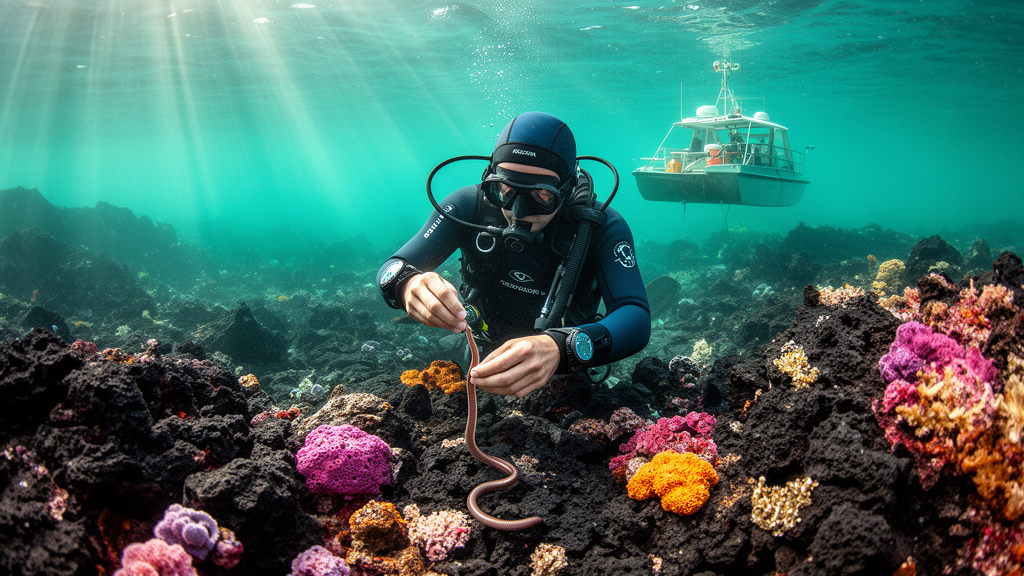
On the island of Maio in Cabo Verde, a snorkeler scooped about 100 milliliters of fine sand from between stones in the sheltered north end of Calheta Bay, at half a meter depth in the lower intertidal. From that modest handful of sediment, extracted with fresh water, two millimeter-scale animals emerged that belong to one of the ocean’s most ancient lineages of predators: the priapulids. The find, published in the journal Evolutionary Systematics, marks the southernmost record of the genus Tubiluchus in the Eastern Atlantic and, perhaps more remarkably, exposes just how much hidden detail separates populations of these tiny wormlike creatures that live only a few hundred kilometers apart.
Priapulids are marine invertebrates named for their suggestive body shape, and they range enormously in size. Some macroscopic species reach up to 40 centimeters, while the meiobenthic members of the group, including all Tubiluchus species, measure only a few millimeters. Microscopic priapulids were discovered surprisingly late, in the 1960s in the Red Sea and then in the Caribbean, where the species Tubiluchus corallicola was described in 1968. Since then, ten species of the genus have been named from locations spanning the Caribbean, the Red Sea, the Philippines, Australia, Vanuatu, Japan, the Mediterranean, the White Sea and the Canary Islands. The new Cabo Verde specimens likely belong to Tubiluchus lemburgi, a species previously known only from the Canary Islands of Tenerife and Lanzarote, which would extend its known range southward across the Eastern Atlantic.
The body plan of Tubiluchus is deceptively simple. The animal consists of a trunk densely covered by small cuticular elevations called tumuli, an eversible introvert armed with sensory structures called scalids, and a posterior tail. Scattered among the tumuli are two kinds of more elaborate structures with assumed sensory or secretory functions: tubuli, which are long tapering tubes, and flosculi, which are flower-shaped organs with petals arranged around a central pore. Both are accompanied by a smaller basal structure called the accessory tubulus. The introvert carries 25 longitudinal rows of scalids, which aid in burrowing and sensing the environment, and at its tip sits a cylindrical mouth cone bearing scalid-like structures known as buccal papillae. The mouth leads into a pharynx equipped with comb-shaped, or pectinate, teeth.
What makes the new study technically significant is the level of fine-structural comparison it achieves. The two Cabo Verde specimens, both females with trunk lengths of 1.4 millimeters and 500 micrometers, were examined with a Keyence digital light microscope and, after dehydration, critical point drying and platinum coating, with a scanning electron microscope. Their transparency allowed observation of the intestinal tract, including the pharynx and the polythyridium, a characteristic priapulid organ. The trunk tumuli carry 10 to 11 radial ridges, the flosculi contain 8 to 10 petals of unequal size, and the tubuli terminate in a hollow apical opening about one micrometer wide that internally contains approximately 20 radial septae extending into thin threads that can entangle into tuft-like structures.
The scalids themselves reveal a striking mathematical order. In a pattern recognized by Adrianov and Malakhov and now confirmed as almost universal among priapulids, the first ring of eight scalids, called primary scalids, defines eight axes on the introvert. The second ring of eight scalids sits between two primary scalids, and subsequent scalids align either with second-ring scalids or flank the lines extending from the primary scalids. A duplication of the ventral scalid in some rings creates rings with nine scalids, and the resulting 25 positions form the 25 longitudinal rows. Because the rings sit extremely close together, exact counting is notoriously difficult, but the researchers used the arrangement relative to the first two rings as a practical landmark, counting 22 rings of scalids in one Cabo Verde specimen.
The fine structure of the scalids changes gradually along the body axis, and it is precisely in these changes that species differ. Primary scalids are the longest, slender and elongate, carrying microsetae along more than half their basal length and ending in two apical tubuli of different shape, one with an open pore and one covered by a flap-like structure. Second-ring scalids are slightly shorter but similarly built. Scalids from rings 3 and 4, probably up to ring 7, have a triangular base covered by microsetae and a slender naked upper part with one tubulus. From at least ring 8 onward, scalids are completely covered by microsetae and gradually change from a broader basal and slender apical part to shorter apical parts that eventually disappear. The cuticle between scalids is structured by a fingerprint-like pattern of fine ridges.
Comparing the Cabo Verde animals with reinvestigated specimens of Tubiluchus lemburgi from the Canary Islands, including the holotype held in Hamburg, shows near-identity with only a few fine differences. In the Canary Island species, both apical tubuli of the primary scalids carry flaps, while in the Cabo Verde specimens only one does. More scalids have a microsetae-covered base and a naked apical part in the Cabo Verde animals, presumably up to ring 7, compared to up to ring 5 in T. lemburgi. And the last observed ring of buccal papillae carries a single apical tubulus in the Cabo Verde specimens but two in T. lemburgi. Despite these tiny discrepancies, the authors hesitate to describe a new species and instead assign the specimens to T. lemburgi as the morphologically and geographically closest species.
The reinvestigation also closed documentation gaps in the founding species of the genus. Tubiluchus corallicola, the Caribbean species, was described in a series of publications, but because it was the first Tubiluchus known, early authors could not know which characters would later prove taxonomically important. The new SEM work documented its male genital region at high magnification for the first time, revealing a trapezoid region set off by a transverse groove, paired narrow urogenital openings, a club-shaped clavula, and perigenital setae whose numbers differ between individuals and even between the left and right sides of a single specimen. The study also clarified the pharyngeal armature, showing that pectinate teeth, each composed of a primary comb of strong spines and a secondary comb of finer bristles, change shape along the pharynx until they become fimbrillae, fringe-like structures of long fine hairs.
Attempts to extract DNA from the tails of the Cabo Verde specimens failed, which the authors regret, because molecular sequence comparisons of the cytochrome oxidase I gene would be highly desirable for closely related species and geographically separated populations. To date, DNA analyses at the population and species level have been performed only for macroscopic priapulids, while Tubiluchus species have been included only in broader phylogenomic studies. The problem is compounded by the fact that museum specimens are few, distributed over several institutions, and partly preserved as SEM preparations or in unknown fixatives. For future collections, the authors recommend routine DNA extraction from part of the tail, with fixation by freezing, ethanol, RNAlater or DESS, followed by barcoding of the COI gene.
The broader lesson of the study is that ten species of Tubiluchus that look nearly identical at first sight differ consistently in fine details, especially in the structure of scalids, buccal papillae and pharyngeal teeth. Three species, T. remanei, T. philippinensis and T. australensis, remain documented in too little detail for fine-structural comparison, and T. vanuatensis is known only from light microscopy. The study also warns that length measurements and maturity assessments in priapulids demand caution, since preservation and preparation cause contraction, and the postlarval development of Tubiluchus is completely unknown. The reinvestigation of the White Sea species T. arcticus suggested that its original description was based on immature specimens. As meiobenthic predators that burrow through marine sands on every continent’s margins, these tiny animals are proving that the frontier of discovery lies not in distant oceans but in the micrometer-scale architecture of their cuticle.
Subject of Research: A new record of the meiobenthic priapulid Tubiluchus from Cabo Verde and a comparison of external characters in adults within the genus
Article Title: A new record of the meiobenthic priapulid Tubiluchus from Cabo Verde and a comparison of external characters in adults within the genus
Article References: Schmidt-Rhaesa, A., Sørensen, M. V., Ott, J., & Raeker, J. (2026). A new record of the meiobenthic priapulid Tubiluchus from Cabo Verde and a comparison of external characters in adults within the genus. Evolutionary Systematics, 10(1), 1-20. https://doi.org/10.3897/evolsyst.10.181089
Image Credits: AI Generated
DOI: 10.3897/evolsyst.10.181089
Keywords: record, meiobenthic, priapulid, Tubiluchus, Cabo, Verde, comparison, external, characters, adults, within, genus
News Source: Violet Maxwell. (October 17, 2026). Tiny Wormlike Predators Reveal Hidden Diversity off Cabo Verde. Scienmag.