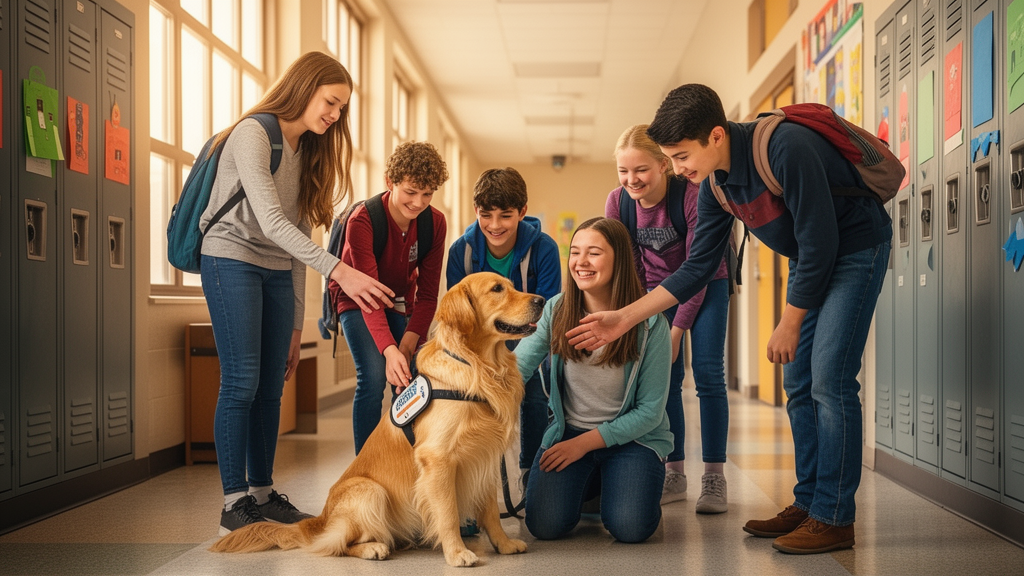
At a special education school in New Jersey, a handful of large-breed therapy dogs have become part of the daily routine, greeting students at arrival and dismissal, joining speech and occupational therapy sessions, and even supporting reading instruction. A new cross-sectional study published in Discover Animals on 17 October 2026 offers one of the most comprehensive assessments yet of how such a long-standing animal-assisted services program is perceived by the people who live with it every day. Psychologists Jean P. Kirnan and Olivia Sampson of The College of New Jersey surveyed 161 members of The Calais School community, a K-12+ institution serving students with multiple disabilities, and found broad endorsement of the dogs’ benefits across six distinct stakeholder groups, with one striking exception: students consistently rated the benefits lower than the adults around them did.
The research arrives against a sobering backdrop. Data from The Stanford Educational Opportunity Project cited in the study indicate that, compared to a decade earlier, 2025 reading and math scores were down 83 percent and 70 percent respectively, a decline the authors describe as a learning recession that predates the COVID-19 pandemic. Chronic absenteeism has nearly doubled relative to pre-pandemic years, with 30 percent of students chronically absent in 2021-22 compared with 16 percent in 2017-18. Meanwhile, roughly 20 percent of children aged 3 to 17 exhibit a mental, emotional, or behavioral health concern, including 11 percent diagnosed with anxiety and 4 percent with depression. Kirnan and Sampson frame animal-assisted services, in which trained and registered dogs and their handlers collaborate with educational professionals, as one innovative response to these converging academic and mental health struggles.
What sets the new study apart is its comparative design. Most prior research on therapy dogs in schools has examined short-term pilot programs and solicited feedback from a single group, typically students, teachers, or parents. The Calais program, by contrast, began in 2013 and has matured well past the novelty phase, with dog and handler teams on campus one to three days a week. The 2023 online survey captured the views of classroom teachers, professional staff such as counselors and therapists, other school staff, dog handlers, parents, and students, making it, to the authors’ knowledge, the first study to assess all six groups within a single school regarding the same program. Each group received its own tailored survey, with items rated on a 4-point Likert scale that was dichotomized to agree or disagree before statistical analysis.
The methodological architecture reflects four benefit themes drawn from the published literature: Well-Being, Academic Engagement, Socio-Emotional Competence, and Climate. All 161 respondents rated nine general statements, including whether the dogs help students feel welcomed, feel less anxious, feel supported, feel motivated to go to school, get along better with other students and with teachers, feel better about themselves, and feel less depressed, plus a ninth item on whether the dogs create a positive environment. A subset of nine task-specific statements, covering persistence after mistakes, preparation, focus, and emotional awareness and control, was rated only by the professional staff and the 30 students who participated in structured sessions led by counselors, speech therapists, occupational therapists, and reading specialists.
The statistical results were emphatic. Fisher’s exact tests revealed significant group differences for seven of the nine general benefit statements, with Cramer’s V identifying medium effect sizes, and the pattern was consistent: students expressed lower agreement than any adult group. The three lowest-rated items among students were getting along with others, getting along with teachers and staff, and being motivated to go to school, all falling below 50 percent agreement. The authors speculate that students may not perceive themselves as having difficulty in these areas and are therefore less likely to credit the dogs with enhancing them. Notably, agreement that the dogs create a positive environment was high across all groups, with no significant differences, suggesting that the climate benefits of a school-wide program are visible to everyone regardless of role.
Perhaps the most practically important finding concerns dosage, the informal concept describing how much exposure to a therapy dog a student receives. The study is the first to directly compare students who worked with the dogs in formal animal-assisted services sessions with those who encountered them only casually in hallways, at arrival and dismissal, or at school events. Contrary to the researchers’ hypothesis, the two groups reported broadly similar benefits. Students in formal sessions rated every benefit higher except one, but only a single difference, feeling welcome, achieved statistical significance, and its effect size was small. Casual participants still strongly endorsed reductions in anxiety and depression and feelings of being supported, reinforcing earlier reports that animal-assisted services ripple outward to non-targeted individuals and the broader school climate.
Within the structured sessions themselves, both professional staff and students strongly endorsed all nine task-specific outcomes, spanning persistence, preparation, longer work duration, harder effort, focus, anticipation of sessions, task performance, and emotional awareness and control. Professional staff rated every outcome higher than students except preparing work ahead of time, an asymmetry the authors attribute to information access: students know their own preparation efforts, while staff would only be aware of them if students shared that information. A chi-square test found only one statistically significant difference, with students rating persistence after mistakes lower than staff, though the phi coefficient revealed a medium effect size, suggesting the difference is noteworthy despite the small samples of 11 professional staff and 6 handlers that constricted statistical power.
The program’s operational details offer a technical template for schools considering similar interventions. The Calais model employs what the authors call the diamond model, in which a handler, an educational professional, a dog, and a student work together, with the professional responsible for the student and the handler responsible for the dog’s participation and welfare. This contrasts with the triangle model, where the educational professional also handles the dog. All dogs weigh between 50 and 70 pounds, range in age from 1 to 8 years, and must pass a recognized therapy dog evaluation and earn Canine Good Citizen certification before completing 6 to 12 months of additional training in The Calais Method. Welfare safeguards are explicit: dogs take a 30-minute break after every hour of work, never work two consecutive days, and have dedicated indoor and outdoor break space. The school is a member of IAHAIO, the International Association of Human-Animal Interaction Organizations.
The authors are candid about limitations. The findings may be specific to one school, one program model, and a student population with distinct needs, and respondents in a long-standing program may have been influenced by favorable school culture. Student perceptions warrant deeper investigation, since developmental differences in self-awareness, comprehension of survey questions, or social desirability may explain why adults consistently rated benefits higher. The authors suggest future studies use faces scales instead of verbal agreement scales, add interviews to verify how children interpret questions, and directly measure outcomes such as school belonging, reading skills, attendance, and task completion rather than relying on perspectives alone. They also call for research on dosage, including session frequency, duration, and dog-to-student ratio.
Nevertheless, the study dispels a persistent concern about therapy dog programs: that their perceived benefits might fade once the novelty of having a dog at school wears off. After more than a decade of operation, stakeholders at The Calais School still strongly endorse benefits spanning well-being, socio-emotional competence, academic engagement, and school climate. The high endorsement of a program spanning upper grades, where published research is thin, adds an important contribution to the literature. For educators searching for innovative supports amid a generation-long academic decline and elevated youth mental health concerns, the message from this real-world assessment is that school-based therapy dogs, implemented carefully across grade levels with rigorous welfare standards, are perceived as beneficial by nearly everyone in the building, students included, even if the students themselves are the most modest about it.
Subject of Research: Stakeholder perceptions of the benefits of school-based therapy dogs in animal-assisted services at a special education school
Article Title: Comparative analysis of multiple stakeholder perspectives on the benefits of school-based therapy dogs at a special education school
Article References: Kirnan, J. P., & Sampson, O. (2026). Comparative analysis of multiple stakeholder perspectives on the benefits of school-based therapy dogs at a special education school. Discover Animals, 3(1), Article 103. https://doi.org/10.1007/s44338-026-00264-1
Image Credits: AI Generated
DOI: 10.1007/s44338-026-00264-1
Keywords: therapy dogs, animal-assisted services, special education, school climate, student well-being, socio-emotional competence, academic engagement, stakeholder perspectives, mental health, The Calais School, human-animal interaction, K-12 education
News Source: Drew Townsend. (October 17, 2026). Therapy Dogs Win Over a Whole School, But Students Rate the Benefits Lower. Scienmag.