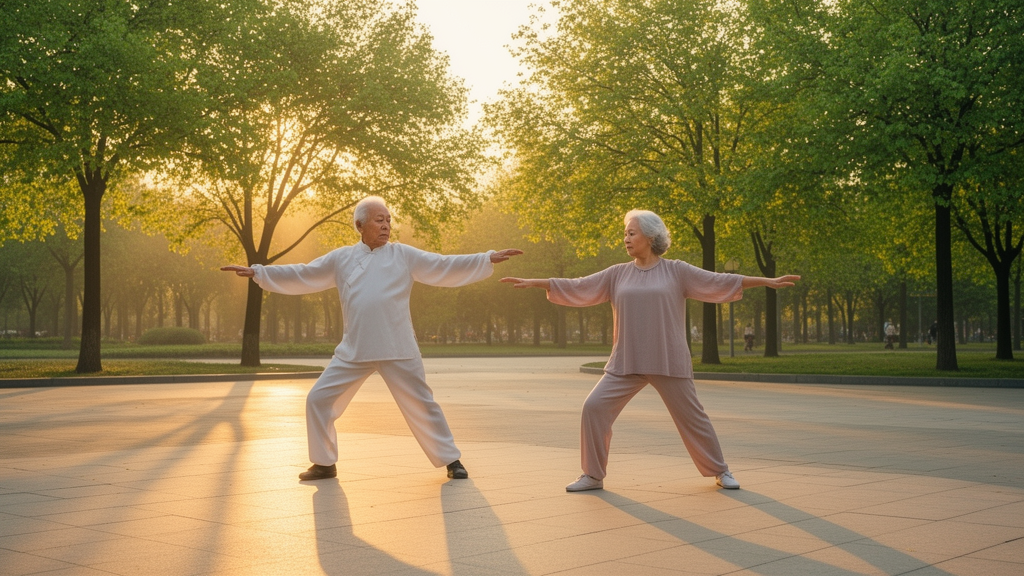
A slow, flowing sequence of movements practiced for centuries in Chinese courtyards and parks has now delivered one of the most intriguing results in modern mind-body medicine. A randomized controlled trial published in BMC Complementary Medicine and Therapies reports that a structured Tai Chi rehabilitation program not only lowered blood pressure in patients with essential hypertension but also shifted the biology of immune aging in ways that conventional exercise did not. The study, led by Jianan Xu and Cuihan Li of Beijing Normal University together with colleagues, followed 105 hypertensive participants for 24 weeks and found that only the Tai Chi group showed a significant rise in SIRT3, a mitochondrial protein increasingly viewed as a gatekeeper of cellular longevity. The finding suggests that the specific quality of a movement practice, not merely the act of exercising, may determine how deeply it reaches into the machinery of aging.
The trial was designed around a deceptively simple question: does Tai Chi, as a rehabilitation program, affect immune senescence, the progressive deterioration of immune function that accompanies aging and chronic disease? Hypertension is far more than a mechanical problem of elevated pressure in blood vessels. It is a chronic cardiovascular disorder involving endocrine-immune dysregulation and oxidative stress, a state in which hormones, immune cells, and reactive oxygen species interact in a feedback loop that accelerates vascular damage. The researchers hypothesized that a movement practice combining balance, controlled breathing, and meditative focus might interrupt this loop, and they chose to measure the interruption directly in the blood.
Participants with essential hypertension were recruited in August 2022 and randomly divided into three groups in a 1:1:1 ratio. One group performed the Tai Chi rehabilitation program, known in the study as TCRP. A second group followed a conventional exercise rehabilitation program, or CERP, representing standard physical activity rehabilitation. A third group served as a blank control, receiving no structured exercise intervention. The experiment lasted 24 weeks, long enough for measurable changes in both cardiovascular and immune parameters to emerge. The primary outcome was blood pressure, while secondary outcomes centered on markers of immune aging, measured through enzyme-linked immunosorbent assay, or ELISA, a laboratory technique that quantifies specific proteins in blood serum by using antibodies that bind to them.
The blood pressure results were clear and, in one sense, reassuring for anyone who exercises. After 24 weeks, both the Tai Chi group and the conventional exercise group showed significant reductions in blood pressure, with statistical significance at p less than 0.01. In other words, for the cardiovascular system, moving the body regularly appears to work, whether the movement is a brisk conventional routine or the slow, weight-shifting forms of Tai Chi. This is consistent with a large body of evidence showing that regular physical activity reduces systolic and diastolic blood pressure through mechanisms involving improved endothelial function, increased nitric oxide availability, and modulation of the renin-angiotensin-aldosterone system, the hormonal cascade that regulates vascular tone and fluid balance.
But the immune aging markers told a more nuanced story. Across all groups, levels of lysozyme, an enzyme that breaks down bacterial cell walls and serves as a marker of innate immune activity, and telomerase, the enzyme that rebuilds the protective caps at the ends of chromosomes, increased significantly at p less than 0.05. At the same time, levels of dehydroepiandrosterone, or DHEA, an adrenal hormone that declines with age and supports immune function, and oestradiol, or E2, decreased significantly at p less than 0.01 in all groups. These parallel shifts suggest that the passage of time and the general effect of participating in a study moved several hormonal and immune markers in the same direction regardless of intervention, a reminder that aging biology is not easily redirected by any single program.
Yet two markers separated the Tai Chi group from the rest. In the TCRP group, SIRT3 was significantly increased and growth hormone was significantly decreased. In the conventional exercise group, there were no significant changes in either GH or SIRT3 levels. In the blank control group, GH and SIRT3 levels were significantly decreased over the 24 weeks. Most strikingly, SIRT3 levels in the Tai Chi group were significantly different from both the conventional exercise group and the blank control group at p less than 0.01. This pattern indicates that something specific about the Tai Chi intervention, rather than exercise in general or the passage of time, drove the change in SIRT3.
SIRT3, or sirtuin 3, is a member of the sirtuin family of proteins, which are NAD-dependent deacetylases that regulate mitochondrial function and cellular stress responses. SIRT3 resides primarily in the mitochondria, the energy-producing organelles inside cells, where it removes acetyl groups from target proteins. One of its best-characterized targets is superoxide dismutase 2, or SOD2, the mitochondrial enzyme that neutralizes reactive oxygen species. When SIRT3 deacetylates SOD2, the enzyme becomes more active, increasing the capacity of the mitochondria to detoxify the free radicals generated during oxidative phosphorylation. The study notes overacetylation of SOD2 as a relevant process, implying that reduced SIRT3 activity leaves SOD2 in an overacetylated, less efficient state, allowing oxidative damage to accumulate. By elevating SIRT3, Tai Chi may have enhanced the antioxidant capacity of immune cells, reducing the oxidative stress that drives both vascular damage and immune senescence.
The connection between SIRT3 and blood pressure is not incidental. Oxidative stress in the vasculature reduces nitric oxide bioavailability, the molecule that relaxes blood vessel walls, and activates nuclear factor kappa-B, or NF-κB, a transcription factor that orchestrates inflammatory responses. Chronic activation of NF-κB in endothelial cells and immune cells promotes the low-grade inflammation characteristic of hypertension and aging. SIRT3, by boosting mitochondrial antioxidant defenses, can interrupt this cascade at its source, reducing the reactive oxygen species that would otherwise trigger NF-κB activation and inflammatory signaling. The researchers suggest that SIRT3 may be a potential mediator of Tai Chi’s anti-hypertensive effect, meaning that the rise in SIRT3 could be part of the causal pathway through which the practice lowers blood pressure, not merely a parallel change.
The study also measured growth hormone, which decreased significantly in the Tai Chi group. This may seem counterintuitive, since growth hormone is often associated with vitality, but elevated GH in adulthood is linked to increased oxidative stress and inflammation, and its decline with age is part of the normal somatopause process. A significant decrease in GH alongside a significant increase in SIRT3 suggests a coordinated hormonal and mitochondrial shift toward a calmer, more antioxidant state. In the blank control group, both GH and SIRT3 decreased significantly, indicating that without intervention, the participants’ biology moved toward greater oxidative burden and reduced mitochondrial protection over the 24 weeks.
The trial was retrospectively registered in the International Traditional Medicine Clinical Trial Registry on December 13, 2024, under registration number ITMCTR2024000813, and was approved by the Ethics Committee of the College of Physical Education and Sport of Beijing Normal University under registration number 2022011H. The study strictly followed the Declaration of Helsinki, and all subjects signed informed consent forms. The work was financially supported by the Beijing Natural Science Foundation under grant number 7244482, awarded to Jianwei Zhang. The authors declare no competing interests. The open access article, published on October 17, 2026, carries the DOI 10.1186/s12906-026-05623-9 and is licensed under a Creative Commons Attribution-NonCommercial-NoDerivatives 4.0 International License. The corresponding authors are Jianwei Zhang and Shaojun Lyu, both of Beijing Normal University.
The implications reach beyond hypertension. Immune senescence, the gradual decline of immune competence with age, underlies increased susceptibility to infection, poor vaccine responses, and chronic inflammatory disease in older adults. A biomarker that responds to a specific, accessible, low-impact movement practice could offer a new tool for tracking immune aging in clinical settings. The researchers propose that SIRT3 could serve as a new biomarker for immune aging, and they support the inclusion of Tai Chi in hypertension management. For the millions of people living with elevated blood pressure, the message is that the slow, deliberate, breath-coordinated forms of Tai Chi may reach deeper into the biology of aging than conventional exercise alone, and that the mitochondrial protein SIRT3 may be the thread connecting an ancient practice to modern vascular medicine.
Subject of Research: Effect of a Tai Chi rehabilitation program on immune senescence in patients with essential hypertension: a randomized controlled trial
Article Title: Effect of a Tai Chi rehabilitation program on immune senescence in patients with essential hypertension: a randomized controlled trial
Article References: Xu, J., Li, C., Huang, Y., Fang, H., Ma, Y., Liu, M., Cui, M., Liu, Z., Liu, N., Meng, Z., Zhang, P., Du, J., Zhang, J., & Lyu, S. (2026). Effect of a Tai Chi rehabilitation program on immune senescence in patients with essential hypertension: a randomized controlled trial. BMC Complementary Medicine and Therapies. https://doi.org/10.1186/s12906-026-05623-9
Image Credits: AI Generated
DOI: 10.1186/s12906-026-05623-9
Keywords: Tai Chi, hypertension, SIRT3, immune senescence, randomized controlled trial, mitochondria, oxidative stress, Beijing Normal University, Effect, rehabilitation, program, immune
News Source: Beatrice Stafford. (October 17, 2026). Tai Chi Slows Immune Aging in Hypertension Patients, Trial Finds. Scienmag.