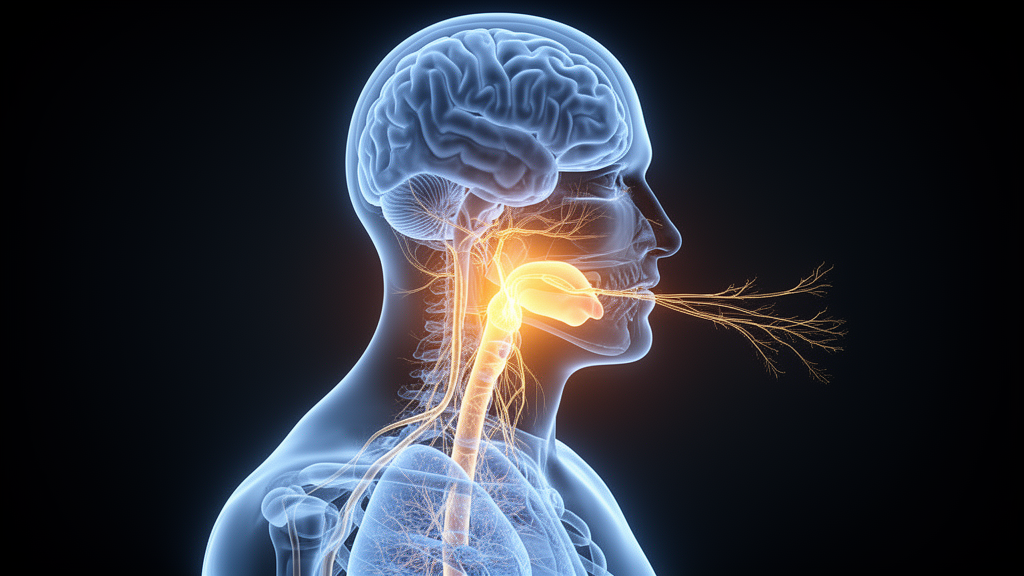
Deep in the brainstem, a slender column of neurons has been quietly running the business of survival for hundreds of millions of years. It monitors blood pressure, coordinates breathing, guards the airway during swallowing, and decides when a cough is needed. Yet the same ancient circuit also underpins one of humanity’s most distinctive abilities: speech. A new review published in Frontiers in Integrative Neuroscience argues that the nucleus tractus solitarius, long treated as a reflex relay for cardiovascular and respiratory housekeeping, is better understood as a conserved sensory platform whose organization has been functionally reweighted across vertebrate evolution—and whose layered control in humans reflects anatomical constraints and ecological demands rather than biological superiority.
The review, authored by researchers synthesizing developmental, comparative, and human neuroimaging evidence, traces the origins of the nucleus tractus solitarius to embryonic structures shared across jawed vertebrates. Its neurons arise from the alar plate of the brainstem, and its sensory inputs come from placode-derived ganglia rather than neural crest, a developmental arrangement that has remained remarkably stable. This stability, the authors contend, explains why the fundamental architecture of the solitary tract system is recognizable in fish, amphibians, reptiles, birds, and mammals alike: a sensory tract converging on a medullary hub that connects peripheral signals with autonomic and behavioral outputs.
What changes across species is not what the nucleus does but how its circuits are emphasized. In fish, the system integrates chemical and mechanical signals from the aquatic environment, with no clear separation between upper and lower airway processing. Amphibians, facing the transition to air breathing, show expanded processing of oropharyngeal and airway signals. Reptiles, with fully established pulmonary respiration, display the neurological differentiation needed to distinguish airway compartments. Birds, equipped with a syrinx rather than a larynx, conserve the topographic organization of visceral inputs while adapting phonation control. Mammals, with their complex pharynx and larynx, exhibit the most elaborate coordination of swallowing, breathing, and vocalization. The review frames these differences as functional reweighting of conserved circuits rather than wholesale reorganization.
This comparative perspective sets the stage for the review’s most provocative claim: that the extensive supranuclear modulation observed in humans is not evidence of an improved brainstem but of layered control that became prominent under human-specific pressures. Speech, the authors argue, imposed extraordinary demands on a system originally designed to coordinate breathing with swallowing. The human larynx, descended relative to that of other primates, and the descended hyoid bone created anatomical conditions in which airway protection, phonation, and respiration had to be managed simultaneously with unprecedented precision. The nucleus tractus solitarius, as the primary convergence site for laryngeal and pharyngeal sensory inputs, became a critical node in this layered architecture.
The review rejects the framing of human supranuclear control as biological superiority, instead describing it as particularly prominent layered control shaped by human-specific constraints. Complex social communication, the authors note, required the brainstem to manage airway defense, respiration, and phonation in contexts far removed from the survival scenarios in which these circuits originally evolved. The result is a system in which ancient reflexive architecture remains intact but operates under extensive contextual modulation from higher brain regions.
Clinically, this perspective reframes several disorders. Dysphagia, the review argues, is not simply a failure of a single reflex arc but a breakdown of the layered coordination in which the nucleus participates. Cough hypersensitivity syndrome, similarly, reflects dysregulation of the inhibitory gating mechanisms that normally filter airway sensory inputs. Taste disturbances and feeding disorders, the authors suggest, involve disruption of the convergent pathways linking the nucleus with limbic and hypothalamic circuits. By treating these conditions as failures of network coordination rather than isolated reflex breakdowns, the review opens new avenues for therapeutic intervention.
The review’s final section addresses neuromodulation therapies, particularly vagus nerve stimulation. Rather than viewing stimulation as a simple activation of a peripheral nerve, the authors propose that it be understood as patterned modulation of the convergent sensory architecture in which the nucleus participates. This reframing, they argue, suggests that stimulation parameters might be optimized to target specific aspects of the layered control system, potentially offering more precise therapeutic outcomes for conditions ranging from epilepsy to depression.
The review’s synthesis carries implications beyond the clinic. By tracing the developmental origins, comparative organization, and human-specific modulation of the nucleus tractus solitarius, it demonstrates how a conserved sensory platform can be functionally reweighted across evolution while maintaining its fundamental architecture. The nucleus, the authors conclude, is not a primitive relay that humans have improved upon but a conserved sensory hub whose layered control reflects the extraordinary demands that speech, social communication, and complex ecological contexts have imposed on an ancient survival circuit.
Part of what makes the nucleus tractus solitarius such a compelling subject for cross-species comparison is that its developmental blueprint can be traced with unusual molecular precision. The sensory neurons that eventually populate the nucleus are specified by transcription factors including Nkx2.2 and Nkx2.9, while the adjacent branchial motor nuclei—structures the nucleus must ultimately cooperate with—depend on a separate genetic program centered on Phox2b. This means that two populations of neurons sitting side by side in the adult medulla actually follow strictly segregated lineages from the earliest stages of hindbrain patterning. The separation is not an accident of anatomy but a consequence of transcriptional regulation, and it provides the developmental substrate on which later functional coupling is built.
Modern mapping techniques have sharpened this picture considerably. Rather than arising from a vague dorsal region of the medulla, the nucleus in humans can be assigned to specific alar plate domains spanning rhombomeres seven through eleven, the caudal segments of the embryonic hindbrain. Gene expression data from human brain atlases suggest that neuronal identity within these segments is pre-patterned by conserved transcription factors, implying that the viscerotopic organization of the nucleus and the assembly of its circuits are genetically programmed rather than emergent byproducts of activity. In parallel, the peripheral inputs that feed the nucleus—the geniculate, petrosal, and nodose ganglia, which carry taste and visceral information—derive from epibranchial placodes rather than from the neural crest. This placodal origin distinguishes the visceral sensory lineage from many other cranial structures and reinforces the theme of developmental independence followed by functional integration.
The classical view of the adult nucleus as a neatly laminated viscerotopic map, with each organ’s afferents occupying a discrete subregion, has also been refined in recent years. Viral tracing studies of vagal afferents indicate that fibers from the gastrointestinal, cardiovascular, and respiratory systems are distributed far more broadly across the nucleus than the traditional textbook layout suggests. Individual neurons frequently receive convergent inputs from multiple organ systems, and the apparent topography reflects gradients of weighting rather than hard-wired compartments. This distributed convergence is precisely what allows the nucleus to act as an integrative node rather than a passive relay, and it helps explain how the same circuitry can support such diverse functions as baroreflex control, swallowing, and the coordination of breathing with vocalization.
The developmental separation of sensory and motor lineages, combined with their eventual functional coupling, offers a useful lens for thinking about complex behaviors. Swallowing, for example, is often described colloquially as a reflex, but it involves the precisely timed recruitment of dozens of muscles across the tongue, pharynx, and larynx, sequenced by central pattern generators that sit downstream of the nucleus. Airway protection during swallowing must be coordinated with respiration on a breath-by-breath basis, and in humans it must additionally be suspended during phonation. The review’s framing suggests that these behaviors are recombinations of neural elements with distinct developmental origins, assembled according to functional demand rather than inherited as monolithic reflex units. This perspective has practical consequences: a lesion that disrupts one component of the network may spare the reflex arc itself while degrading the coordination among components, producing clinical pictures that look like reflex failure but are actually failures of integration.
The network-level view also reframes how clinicians might think about diagnostic assessment and treatment targets. If dysphagia reflects a breakdown of layered coordination rather than a damaged reflex arc, then rehabilitation strategies that train the interaction between respiratory timing, laryngeal closure, and pharyngeal contraction may succeed where approaches targeting a single component do not. Similarly, cough hypersensitivity may respond better to interventions that restore inhibitory gating across the distributed sensory network than to those aimed at suppressing a single reflex pathway. The authors’ treatment of nausea and vomiting as network-level dysregulation points in the same direction, since emesis depends on coordination among visceral afferents, autonomic outputs, and behavioral responses that no single reflex arc could orchestrate alone.
The reframing of vagus nerve stimulation deserves particular attention because it connects evolutionary reasoning to a rapidly growing clinical field. If stimulation is understood as delivering patterned afferent input that shapes network plasticity within the nucleus, rather than as non-specific electrical activation of a peripheral nerve, then the design space for therapy expands considerably. Parameters such as pulse timing, waveform shape, and duty cycle could be tuned to engage specific classes of afferent fibers or to bias the nucleus toward particular integrative states. The evolutionary perspective adds a caution here: because the nucleus is a conserved hub whose components have been functionally reweighted across species, findings from animal models may not translate directly to humans, whose layered supranuclear control alters how afferent signals are interpreted. Therapies designed with this layered architecture in mind, the review suggests, are more likely to achieve the precision that current stimulation approaches have struggled to reach.
Ultimately, the synthesis underscores a broader principle in neuroscience: conservation of structure does not imply uniformity of function. The same developmental program, laid down in the hindbrain of every jawed vertebrate, has been repeatedly redeployed under different ecological and behavioral pressures, producing systems that share their wiring logic but differ profoundly in how that logic is weighted and controlled. The human nucleus tractus solitarius, operating under the demands of speech and complex social interaction, represents one particularly elaborate point on that continuum rather than a departure from it.
Subject of Research: Neuroscience
Article Title: The nucleus tractus solitarii across vertebrates: developmental origins, comparative organization, and supranuclear modulation in humans
Article References: Hong, Y.-S., & Park, Y.-S. (2026). The nucleus tractus solitarii across vertebrates: developmental origins, comparative organization, and supranuclear modulation in humans. Frontiers in Integrative Neuroscience, 20, Article 1768344. https://doi.org/10.3389/fnint.2026.1768344
Image Credits: AI Generated
DOI: 10.3389/fnint.2026.1768344
Keywords: brainstem, nucleus tractus solitarius, comparative neuroanatomy, speech, vagus nerve stimulation, evolution, nucleus, tractus, solitarii, across, vertebrates, developmental
News Source: Gavin Prescott. (October 17, 2026). The Brainstem Hub That Keeps You Alive—and Lets You Speak. Scienmag.