For the roughly one in three heart surgery patients who never show up for cardiac rehabilitation, a new study offers a provocative answer: bring the rehab to them. A single-center observational cohort from the First Hospital of Hebei Medical University in Shijiazhuang, China, followed patients recovering from coronary artery bypass grafting (CABG) and found that those who chose a home-based telerehabilitation program completed more of their prescribed exercise sessions than patients attending supervised center-based programs, while achieving essentially the same gains in peak aerobic capacity at 12 weeks. The findings, published in Frontiers in Cardiovascular Medicine, add real-world weight to the idea that the hospital gym may no longer be the only place where cardiac recovery can happen.
The problem the study tackles is one of the most stubborn in cardiovascular medicine. Cardiac rehabilitation, which combines structured exercise, education, and psychosocial support, carries a Class IA recommendation in international guidelines for patients recovering from bypass surgery, and its benefits are well documented: better exercise capacity, improved cardiac function, and stronger psychological well-being. Yet participation remains dismal. Fewer than half of eligible patients in developed countries attend a program, and in developing nations the figure drops below 10 percent. The barriers are mundane but powerful: distance to the hospital, transportation costs, work schedules, and family obligations. Home-based telerehabilitation, delivered through wearable heart rate monitors, mobile applications, and periodic video or telephone consultations, has been proposed as a way around these obstacles, but rigorous real-world comparisons with careful confounding control have been scarce.
The research team screened the electronic health records of 288 adults aged 30 to 75 who underwent isolated CABG between February 2024 and February 2025, ultimately identifying 195 potentially eligible patients. After excluding 28 whose rehabilitation exposure could not be clearly documented, 167 patients formed the propensity-score estimation cohort: 56 who enrolled in home-based telerehabilitation, 54 in center-based rehabilitation, and 57 who received usual care without any formal program. The primary complete-case analysis then focused on the 105 patients, 35 per group, who completed full 12-week assessments. Because patients were not randomized, the investigators used generalized propensity scores and overlap weighting to adjust for 25 baseline covariates, ranging from age, sex, and body mass index to digital literacy, family support, distance to the rehabilitation center, and baseline fitness measures.
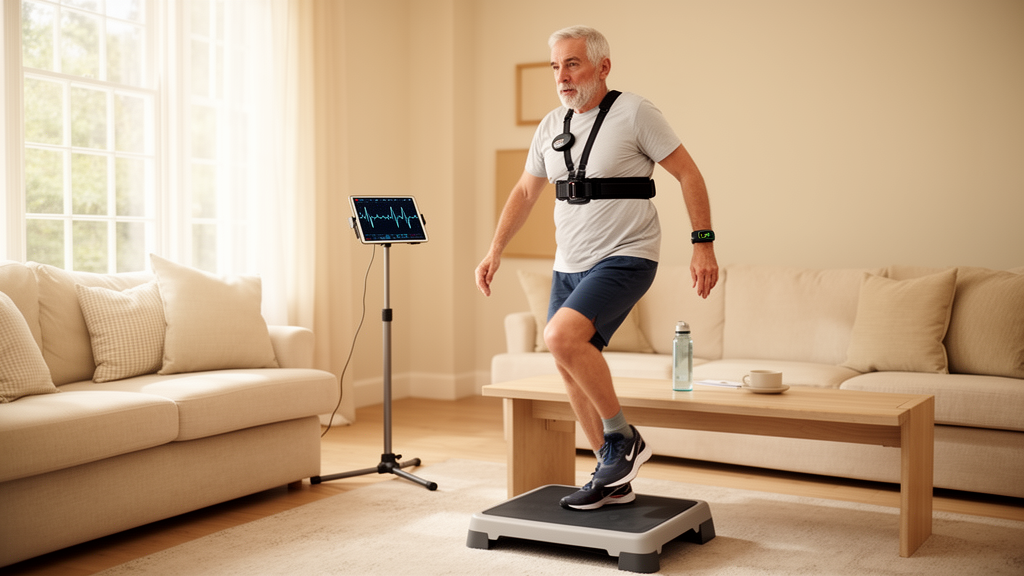
The home program itself was a carefully structured prescription rather than a casual suggestion to stay active. Patients received a wearable Polar H10 heart rate monitor paired with a dedicated mobile application and were asked to complete three aerobic sessions per week for 12 weeks, 36 sessions in total, each targeting 30 to 60 minutes of exercise at 60 to 80 percent of heart rate reserve, plus two weekly resistance training sessions. Intensity was progressed every two weeks based on heart rate response and perceived exertion on the Borg scale. Crucially, the researchers defined a session as completed only when at least 30 minutes of prescribed exercise at target intensity were objectively documented by the wearable device; app entries without valid sensor data did not count. Center-based patients attended the hospital’s outpatient program with the same prescription but under direct supervision with continuous ECG telemetry, and their adherence was verified through physiotherapist-signed attendance records and telemetry logs.
The headline result concerns adherence, the study’s primary implementation outcome. Patients in the home-based arm completed a mean of 87.7 percent of their prescribed sessions, compared with 78.5 percent in the center-based arm, an overlap-weighted difference of 9.1 percentage points with a 95 percent confidence interval of 4.4 to 13.7 and a P value below 0.001. The gap widened at the high end of the distribution: 78.6 percent of home-based patients achieved at least 80 percent completion, versus 44.4 percent of center-based patients, and 46.4 percent of the home group reached 90 percent or more, compared with just 13.0 percent of the center group. Home patients also logged more objectively verified exercise minutes overall, 1,578 versus 1,413, and more minutes at target intensity. Technical failures, such as lost or invalid wearable recordings, affected only 1.7 percent of prescribed home sessions.
On the key clinical outcome, the two delivery models proved remarkably close. Peak oxygen uptake, or VO2peak, measured by symptom-limited cardiopulmonary exercise testing on a cycle ergometer, rose from a baseline of roughly 18.3 to 18.4 mL/kg/min to about 23.1 to 23.6 mL/kg/min at 12 weeks in both rehabilitation groups. The adjusted difference between the home and center arms was a mere 0.17 mL/kg/min, with a confidence interval spanning −0.50 to 0.84 and a P value of 0.616, statistically indistinguishable from zero. Both active groups, however, dramatically outperformed usual care, which saw VO2peak inch up from 18.5 to 19.1 mL/kg/min; the adjusted advantages over control exceeded 4.0 mL/kg/min for both rehabilitation modalities. Given that lower VO2peak is strongly associated with increased mortality in cardiac populations, gains of that magnitude are clinically noteworthy.
Secondary outcomes told a consistent story. Six-minute walk distance improved by roughly 75 meters in both rehabilitation groups compared with control, with no meaningful difference between them. Left ventricular ejection fraction, measured by blinded readers using the biplane Simpson method, rose by about 4 to 5 percentage points in both active arms. Psychological measures moved in parallel: scores on the Hamilton Anxiety and Depression scales fell by 6 to 8 points in both rehabilitation groups while barely changing in usual care, and quality-of-life scores on the SF-36 physical and mental component summaries climbed by 16 to 22 points. Safety findings were reassuring in absolute terms: no major adverse cardiovascular events occurred in either rehabilitation group during the 12-week window, while two occurred among usual-care patients, though the small event counts precluded formal comparative safety inference. Exercise-related adverse events were uncommon and similar in character across both programs, including occasional chest pain, arrhythmia, and musculoskeletal complaints.
The investigators were careful about what their design can and cannot show. Because patients self-selected into each modality, unmeasured differences in motivation and preference may persist despite the extensive covariate adjustment, and the study was not powered or designed to formally test equivalence or non-inferiority between the two delivery models. Selection is a real concern: of the 195 potentially eligible patients, 46.2 percent were excluded from the complete-case analysis, and those excluded patients had fewer years of education, more frailty, lower employment rates, and markedly lower family support scores. The authors also note that the two delivery models differed not only in setting but in supervision intensity, with home patients exercising independently and receiving roughly 12 scheduled tele-consultations, so residual differences in how adherence was ascertained, device verification at home versus direct observation in center, cannot be fully excluded. Sensitivity analyses, including unweighted models, multiple imputation, restriction to a strict 11-to-13-week assessment window, and exclusion of crossovers, all produced directionally consistent estimates for the VO2peak comparison.
An exploratory analysis probing whether higher adherence drove better functional outcomes found a positive but non-significant association: each 10-percentage-point increase in adherence was associated with roughly 0.62 mL/kg/min greater VO2peak gain, with a confidence interval that just crossed zero. The authors explicitly caution against a causal reading, since healthier, more motivated, or faster-recovering patients may both complete more sessions and improve more, a classic healthy-adherer effect that observational data cannot untangle. The adherence-by-modality interaction was also non-significant, suggesting the adherence-outcome relationship did not differ meaningfully between the home and center programs.
What the study does establish is feasibility in routine practice. Among post-CABG patients who chose between the two options in a real clinical setting, home-based telerehabilitation delivered objectively verified adherence that exceeded center-based care and functional recovery that looked essentially identical at 12 weeks. For patients juggling work, travel, or caregiving obligations, the findings support offering a monitored home program as a legitimate alternative rather than a second-best compromise. The authors call for future work on clinical meaningfulness and cost-effectiveness, and longer follow-up will be needed to see whether early fitness gains translate into durable outcomes. But the message for the millions of bypass patients each year who cannot reach a hospital gym is clear: with a chest strap, a smartphone, and a structured prescription, the road to recovery may run straight through their living room.
Subject of Research: Home-based versus center-based cardiac rehabilitation adherence and functional outcomes after coronary artery bypass grafting
Article Title: Home-based telerehabilitation after CABG: higher objectively verified adherence and 12-week functional outcomes in a single-center observational cohort
Article References: Liu, Y., Wang, X., Wang, C., Zhang, M., Kong, M., Wang, M., Ma, J., & Liu, H. (2026). Home-based telerehabilitation after CABG: higher objectively verified adherence and 12-week functional outcomes in a single-center observational cohort. Frontiers in Cardiovascular Medicine, 13, Article 1947232. https://doi.org/10.3389/fcvm.2026.1947232
Image Credits: AI Generated
DOI: 10.3389/fcvm.2026.1947232
Keywords: cardiac rehabilitation, coronary artery bypass grafting, telerehabilitation, wearable sensors, adherence, VO2peak, observational cohort, cardiovascular medicine, propensity score analysis, exercise capacity, digital health, patient recovery
News Source: Ophelia Keating. (October 17, 2026). Rehab From the Living Room: Wearable-Verified Home Cardiac Rehab Matches Hospital Programs After Bypass Surgery. Scienmag.