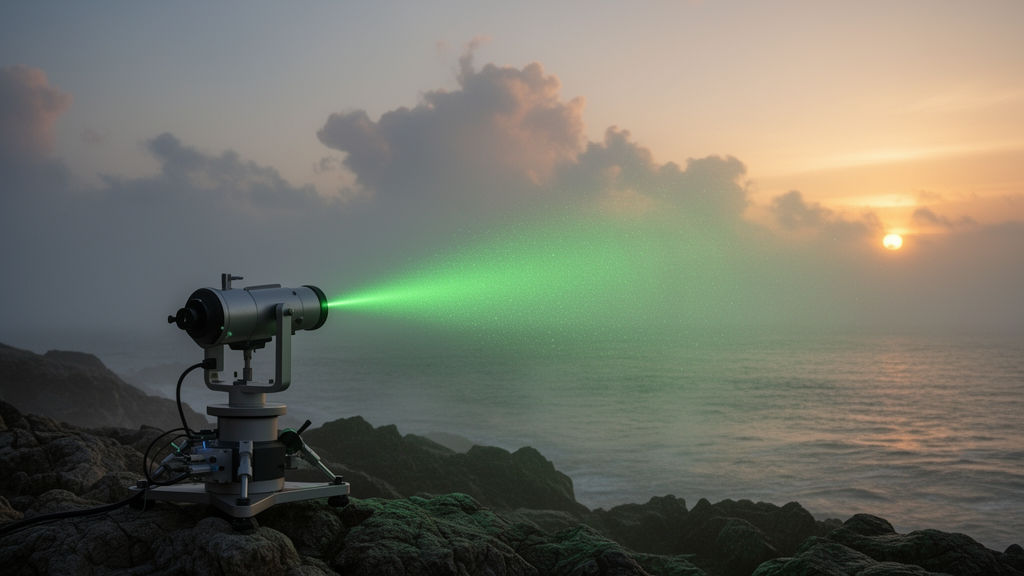
Light does not simply pass through the air above the ocean. It collides with salt crystals, spray droplets and other marine aerosols, and every collision scatters a fraction of the beam in new directions while subtly reshaping its polarisation. For engineers trying to push free-space optical signals across humid coastal atmospheres, and for climate scientists trying to read the composition of the marine boundary layer from afar, those scattering events are both an obstacle and a source of information. A new theoretical study published in Scientific Reports now shows that a novel family of diffraction-free light beams, known as Tricomi beams, could give researchers an unusually precise dial for controlling exactly how light scatters from these airborne particles.
Tricomi beams belong to the broader class of non-diffracting beams, light fields that resist the natural tendency to spread as they propagate. Ordinary laser beams broaden and lose intensity over distance, but non-diffracting beams maintain their transverse structure over extended ranges and possess a remarkable self-healing property: if the beam encounters an obstruction, its profile reconstructs itself downstream. These qualities have already made beams such as Bessel beams attractive for free-space optical communication, atmospheric optics and remote sensing. Tricomi beams, however, are a newer addition to this family, and their behaviour when illuminating realistic aerosol particles in humid maritime environments had remained largely unexplored until this work.
The research team, led by Muhammad Arfan with colleagues including Igor Meglinski of Aston University’s Aston Institute of Photonic Technologies, carried out a comprehensive numerical investigation of how Tricomi beams scatter from spherical marine aerosol particles. Their approach rests on the generalized Lorenz-Mie theory, the standard mathematical framework for describing how an arbitrarily shaped light beam interacts with a spherical particle. The central computational challenge lies in determining the beam shape coefficients, the set of numbers that encode how the specific structure of the illuminating beam couples into the various scattering modes of the sphere. The team calculated these coefficients for Tricomi beams and then traced the resulting far-field scattering intensity and polarisation response.
What makes the study technically significant is the degree of control it reveals. The scattering pattern produced when a Tricomi beam strikes an aerosol particle can be meticulously tuned by adjusting the beam’s configuration parameters: the topological charge, which quantifies the orbital angular momentum carried by the beam’s helical phase structure; the asymmetry parameters, which describe how the beam’s intensity profile deviates from perfect symmetry; and the half-cone angle, which sets the geometry of the beam’s conical wavefront. Each of these knobs reshapes the interference pattern of light scattered into the far field, offering a level of command over the scattering amplitude and polarisation that conventional Gaussian beams cannot easily match.
The particle side of the problem matters just as much as the beam side. Marine aerosols are not static objects; their size and refractive index respond directly to the relative humidity of the surrounding air. As humidity rises, hygroscopic sea-salt particles absorb water vapour and swell, changing both their radius and their optical properties. The numerical results show that these humidity-driven variations induce significant changes in the scattering amplitude and in the relative polarisation response of the illuminated particles. In other words, the optical fingerprint of a marine aerosol population carries an embedded record of the moisture conditions in which it formed and evolved.
Among the specific findings, the scattered intensity grows as the aerosol radius increases, a result consistent with the general expectation that larger particles present more scattering cross-section to the incident field. The intensity is also enhanced by increasing the topological charge of the Tricomi beam, demonstrating that the beam’s internal angular momentum structure directly amplifies the scattering signal. This coupling between beam parameters and particle size suggests practical strategies: an operator who needs a stronger return signal from a distant aerosol-laden channel could raise the topological charge rather than simply increasing the transmitted power, potentially improving the signal-to-noise ratio of an optical link without additional energy cost.
The polarisation results carry particular weight for environmental monitoring. Polarisation-based sensing techniques distinguish between particles and atmospheric conditions by measuring how the polarisation state of scattered light deviates from that of the incident beam. Because the study shows that the polarisation response can be deliberately shaped through the beam’s asymmetry parameters and half-cone angle while remaining sensitive to the particle’s humidity-dependent refractive index, Tricomi beams could serve as versatile probes whose interrogation geometry is matched to the specific measurement task. A monitoring system could, in principle, select beam parameters that maximise sensitivity to a particular aerosol property, then read the humidity-driven polarisation shifts as a diagnostic signal.
The implications for free-space optical communication over the ocean are equally compelling. Optical links that carry data through the atmosphere must survive scattering from aerosols, fog and precipitation, which deplete the signal and corrupt its polarisation. The self-healing and diffraction-free propagation of Tricomi beams makes them natural candidates for maintaining beam integrity across such channels, and the new scattering analysis clarifies precisely how these beams interact with the aerosol particles they will inevitably encounter. The authors highlight the potential of their findings for robust optical communication over aerosol-laden channels, where the beam’s tunable scattering behaviour could be exploited to preserve signal quality in maritime conditions that would cripple conventional beams.
It is worth emphasising that this is a theoretical study. The team solved the scattering problem numerically rather than experimentally, using the generalized Lorenz-Mie theory as the computational engine. The results therefore establish the fundamental scattering response of Tricomi beams in humid maritime surroundings and map out the parameter space that future laboratory and field experiments should explore. Translating the numerical predictions into working communication links or deployed monitoring instruments will require experimental validation, but the theoretical framework now exists to guide that translation with specific, quantified expectations about how beam and particle parameters combine to shape the scattered field.
The work, funded by Taif University’s Research Center of Basic Sciences, Engineering and High Altitude, with partial support from the Russian Science Foundation and the Horizon Europe EIC Pathfinder Open programme, opens a new chapter in the optics of structured light. As non-diffracting beams continue to migrate from mathematical curiosity to practical photonic tool, the demonstration that Tricomi beams offer simultaneous command over scattering intensity and polarisation in realistic marine aerosol environments positions them as a promising technology for the next generation of atmospheric sensing and free-space optical networks. The air above the sea has always scattered light; now researchers have a beam designed to control exactly how.
Subject of Research: Optics and photonics
Article Title: Numerical study of scattering and polarisation characteristics of marine spherical aerosol particles illuminated by non-diffracting Tricomi beams
Article References: Arfan, M., Althobaiti, A., Althobaiti, S., & Meglinski, I. (2026). Numerical study of scattering and polarisation characteristics of marine spherical aerosol particles illuminated by non-diffracting Tricomi beams. Scientific Reports. https://doi.org/10.1038/s41598-026-63538-4
Image Credits: AI Generated
DOI: 10.1038/s41598-026-63538-4
Keywords: Tricomi beams, non-diffracting beams, marine aerosols, light scattering, polarisation, generalized Lorenz-Mie theory, free-space optical communication, atmospheric optics, remote sensing, Numerical, scattering, characteristics
News Source: Denise Maddox. (October 17, 2026). Tricomi beams reveal how humidity reshapes light scattering over the sea. Scienmag.