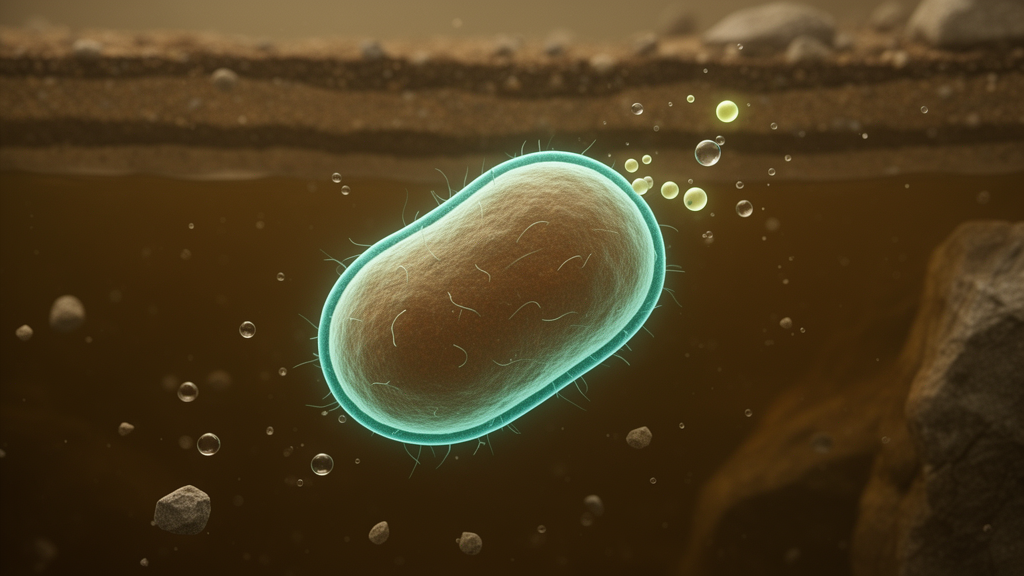
Deep beneath the frozen plains of Western Siberia, in water so hot it steams at the wellhead, scientists have captured and named a new species of methane-producing archaea that appears to run one of the planet’s most inaccessible ecosystems. The microorganism, formally described as Methanothermobacter tomskensis sp. nov., was isolated from borehole 3P, a nearly 2.7-kilometer-deep well near the small town of Parabel in the Tomsk Region of Russia. The discovery, published in Frontiers in Microbiology, is remarkable not just because the archaeon is new to science, but because it turns out to be the single most abundant member of the entire microbial community in this deep thermal aquifer, accounting for 25.54 percent of all 16S rRNA gene sequences recovered from the water.
The well itself has become something of a legend among subsurface microbiologists. Drilled through Quaternary, Paleogene, Cretaceous and Jurassic sedimentary layers down to the Paleozoic basement, borehole 3P taps an artesian aquifer in the West Siberian Basin, the world’s largest sedimentary basin. Because the water flows out under its own pressure, the risk of contamination by surface microorganisms is minimized, making the well a natural window into the deep biosphere. Over the past decade, researchers have pulled a parade of novel bacteria from this water, including polysaccharide-degrading Mobilitalea sibirica, cellulolytic Melioribacter roseus, and the filamentous Ornatilinea apprima. But all of those organisms were chemoorganoheterotrophs, living off decomposing organic matter. The question of what actually produces organic matter at this depth remained open.
To answer it, the team led by Vladimir Trubitsyn and Viktoria Shcherbakova of the Russian Academy of Sciences turned to a radioactive tracer technique that few deep-subsurface studies have attempted. Water collected directly at the wellhead in February 2020 was sealed without headspace into sterile vials and injected with 14C-labeled sodium bicarbonate. After 24 hours of incubation at the in situ temperature of 55 to 57 degrees Celsius, the researchers measured how much of the radioactive label had been converted into methane. The result was striking: a potential hydrogenotrophic methanogenesis rate of 5.45 ± 0.528 nanomoles of methane per cubic decimeter per day. That figure is compatible with rates known from anaerobic sediments of surface water bodies, such as marine basins of the Barents and White Seas, where rates ranged from 3 to 40 nanomoles per cubic decimeter per day, and methane seeps of the Laptev Sea shelf, where rates spanned 0.4 to 5.0 nanomoles per cubic decimeter per day.
The physicochemical context makes the measurement even more compelling. The wellhead temperature of 57 degrees Celsius was the highest ever recorded at the site, the water was strongly reducing with an Eh of −270 millivolts, and the pH was circum-neutral at 7.42. Methane dominated the gas phase at nearly 70 percent, reaching a concentration of 678 micromoles per liter, while molecular hydrogen was present at only a negligible 0.0046 percent. The carbon isotopic composition of the methane, δ13C of −54.9 per mil, falls within the range characteristic of a mixture of thermogenic and biogenic methane, suggesting that geological methane and microbially produced methane are blending in this aquifer. The team also measured a sulfate reduction rate of 2.61 nanomoles per cubic decimeter per day using 35S-labeled sulfate, indicating that hydrogenotrophic methanogens may be outcompeting sulfate reducers for the scarce hydrogen, and that sulfate turnover in the water must be rapid given its low concentration.
Genomic analysis of the water metagenome revealed who was doing the work. Sequencing with both Illumina and Oxford Nanopore technologies generated roughly 24 gigabases of data, from which the team assembled nine metagenome-assembled genomes with more than 90 percent completeness and less than 5 percent contamination. One of these, designated MAG 3P-20-001, consisted of a single circular contig of 1,745,437 base pairs and was estimated to be 99.78 percent complete with only 0.02 percent possible contamination. Taxonomic assignment using the Genome Taxonomy Database placed it in the genus Methanothermobacter as a novel species. Its closest validly described relative was Methanothermobacter marburgensis, with an average nucleotide identity of just 92.66 percent, well below the 95 percent threshold used to delimit prokaryotic species.
Obtaining that genome was only the beginning. The researchers then spent twelve months coaxing the dominant methanogen into pure culture, a feat of patience in a biotope where microbial cell counts were astonishingly low, at roughly 856 cells per milliliter. Enrichments were set up with well water added to anaerobic mineral medium, incubated at both 37 and 55 degrees Celsius with a hydrogen and carbon dioxide gas mixture as the sole substrate. Methane appeared only in the flask held at 55 degrees, and only after a full year. Serial tenfold dilutions with sequential additions of antibiotics, including vancomycin, methicillin, and erythromycin, eventually yielded a pure rod-shaped archaeon designated strain K4T.
The new isolate is a strict specialist. Cells are non-motile, long, thin rods measuring 2.0 to 5.4 by 0.25 to 0.40 micrometers, staining Gram-positive and confirmed by transmission electron microscopy to possess a Gram-positive-type cell wall. Strain K4T grows only on a gas mixture of hydrogen and carbon dioxide and refuses every other substrate tested, including formate, methanol, acetate, methylamine, ethanol plus carbon dioxide, isobutanol plus carbon dioxide, and isopropanol plus carbon dioxide. Its optimum temperature is 60 degrees Celsius, with no growth below 45 or above 70 degrees, its optimum pH is 7.5, and its optimal sodium chloride concentration is 17 millimolar. The minimum doubling time under optimal conditions is 6.5 hours. Comparison of the strain’s genome with MAG 3P-20-001 showed they were nearly identical, with an average nucleotide identity of 99.96 percent, confirming that the cultivated archaeon is indeed the dominant methanogenic lineage revealed by metagenomics.
The genome itself, 1,744,648 base pairs assembled into 12 scaffolds, harbors all the core genes encoding the methanogenesis pathway, along with the complete carbon monoxide dehydrogenase and acetyl-CoA synthase complex, suggesting the strain may also be capable of carboxydotrophic growth like its relative M. marburgensis. Notably absent are genes encoding the molybdenum-containing isoform of formylmethanofuran dehydrogenase found in M. marburgensis, and no homologs of the fdhBAC cassette that enables formate utilization were detected, consistent with the strain’s inability to grow on formate. Instead, the genome contains a distinct formate dehydrogenase variant, designated FdhFD, which appears more prevalent among Methanothermobacter species than the classical FdhAB and likely exchanges electrons directly with the respiratory chain. The genome also carries genes for pyruvate-formate lyase, absent from the other Methanothermobacter genomes examined, and the hydrogen-dependent methylenetetrahydromethanopterin dehydrogenase, an alternative enzyme present in some hydrogenotrophic methanogens.
Based on morphological, physiological, genotypic, and phylogenetic data, the team proposes the name Methanothermobacter tomskensis, honoring the Tomsk Region where the type strain was isolated. The type strain has been deposited as VKM B-3410T and JCM 39440T, and its DNA guanine-plus-cytosine content is 48.67 mole percent. To the best of the authors’ knowledge, M. tomskensis is the first thermophilic methanogen isolated from a terrestrial subsurface aquifer at a depth exceeding 500 meters. Few methanogens from the deep subsurface have been described in such detail; previous isolates include Methanobacterium subterraneum from granitic groundwater at the Äspö Hard Rock Laboratory at less than 420 meters below sea level, Methanosarcina hadiensis from the Boom Clay formation in Belgium at 161 to 263 meters, and Methanoculleus horonobensis from a Japanese exploratory borehole at roughly 362 to 386 meters.
The broader significance lies in what the discovery says about life on Earth. Since Thomas Gold first hypothesized the existence of a deep, hot biosphere, methanogenic archaea have been considered key players in producing methane and biomass in the subsurface, fueled by hydrogen and carbon dioxide emanating from geological processes. The acronym SLiME, for Subsurface Lithoautotrophic Microbial Ecosystems, was coined to describe such geosphere-fueled communities. The West Siberian Basin, with its vast petroleum reserves and buried organic matter, adds a sedimentary twist to this classical picture, yet the dominance of a hydrogenotrophic methanogen in borehole 3P water suggests that chemosynthesis based on molecular hydrogen remains the foundation of the ecosystem. With the water flowing at an estimated 0.2 to 0.3 liters per second, the team calculates that hydrogenotrophic methanogenesis alone could yield roughly 2.26 milliliters of methane per day from the well. Given its obligately hydrogenotrophic metabolism and its measured activity, M. tomskensis K4T may well represent the main producer of organic matter in the deep horizons of this thermal aquifer, a single species quietly anchoring an entire ecosystem nearly three kilometers below the Siberian tundra.
Subject of Research: Microbiology
Article Title: Archaeal methanogenesis in a deep terrestrial aquifer driven by Methanothermobacter tomskensis sp. nov.
Article References: Trubitsyn, V. E., Rusanov, I. I., Rechkina, V. I., Kadnikov, V. V., Zasko, D. N., Beletsky, A. V., Pimenov, N. V., Ravin, N. V., Shcherbakova, V. A., & Karnachuk, O. V. (2026). Archaeal methanogenesis in a deep terrestrial aquifer driven by Methanothermobacter tomskensis sp. nov.. Frontiers in Microbiology, 17, Article 1973590. https://doi.org/10.3389/fmicb.2026.1973590
Image Credits: AI Generated
DOI: 10.3389/fmicb.2026.1973590
Keywords: archaea, deep subsurface, methanogenesis, Methanothermobacter, thermophiles, extreme microbiology, Archaeal, deep, terrestrial, aquifer, driven, tomskensis
News Source: Morgan Morrow. (October 17, 2026). New Methanogen Species Found Thriving 2.7 Kilometers Deep in Siberian Aquifer. Scienmag.