Learning a new language is hard enough, but for adults with developmental language disorder (DLD), even the basic building blocks of speech can pose a persistent challenge. Now, new research suggests that the brain activity that unfolds during sleep may play a subtle but meaningful role in how speech sounds are consolidated into memory, and that this role differs depending on a person’s language ability. The findings, published in Frontiers in Behavioral Neuroscience, offer a rare window into the electrophysiological events that accompany offline improvements in speech perception, and raise the possibility that sleep-related brain rhythms could serve a protective function in people with language difficulties.
Sleep has long been recognized as a critical partner in memory consolidation, the dynamic process through which newly acquired information is progressively stabilized and reorganized. During non-rapid eye movement (NREM) sleep, two hallmark brain events dominate the landscape: slow oscillations (SOs), large, slow waves that sweep across the cortex roughly once per second, and sleep spindles, brief bursts of rhythmic brain activity that last about one to three seconds. Prior work has consistently linked memory performance to the power and density of these events, and more specifically to the precise timing with which spindles nest within the SO cycle. Fast spindles, those in the 12 to 15 Hz range, tend to couple with the up-state of the SO, while slow spindles, in the 9 to 12 Hz range, tend to align with the down-state. This cross-frequency coupling is increasingly viewed as the mechanistically specific marker of sleep-dependent consolidation, more informative than the density of either event alone.
Yet the extent to which these neural markers relate to changes in speech-perceptual learning over time has remained under-explored. Speech-perceptual learning is thought to engage both declarative and procedural memory systems, leaving open questions about how sleep contributes to changes in speech perception. Some studies show that talker-specific perceptual learning remains stable over 24 hours, while others report improvements following daytime rest independent of sleep. In synthetic speech learning paradigms, sleep has been shown to restore performance declines observed during wake and protect newly learned mappings from forgetting. For nonnative speech contrasts such as the Hindi dental-retroflex distinction, overnight sleep, but not equivalent wake intervals, has been associated with stabilization against interference and improved identification of novel talkers. Notably, improvements in identification do not always correspond to gains in discrimination, because identification requires a listener to assign a single token to a learned category, whereas discrimination requires only a same-different judgement between two tokens and can in principle be performed on acoustic detail alone. These tasks index qualitatively different perceptual skills and may point to distinct effects of sleep on task performance.
To probe these questions, a team of researchers from the University of Delaware, Georgetown University, and Florida Atlantic University recruited 29 monolingual English-speaking adults aged 18 to 35, spanning a broad range of language ability from those with typical language histories to those with a history of DLD. DLD is a neurodevelopmental disorder that affects language acquisition in approximately 7 percent of children in the United States, and beyond language learning difficulties, individuals with DLD also experience deficits in speech perception that can further impact communication. Participants were classified as having DLD if they reported a history of receiving services and obtained scores that resulted in a positive index for DLD under methods devised by Fidler and colleagues, which utilize raw scores of a 15-word spelling and modified token tests. Participants were assigned to the typically developed group if they indicated no history of speech, language, or reading remediation and obtained a negative index. The researchers excluded individuals with current ADHD, since ADHD medication can alter sleep, and screened for dyslexia to ensure that performance on the DLD classification tasks could not be attributed to a disorder of reading.
The experimental task centered on a notoriously difficult nonnative contrast: the Hindi dental-retroflex distinction, contrasting the retroflex /ɖ/ and dental /d̪/ consonants in the context of minimally pairing words. Participants first completed a baseline discrimination task in which they heard two speech tokens and indicated whether the word onsets belonged to the same or different speech sound category. They were then exposed to a familiarization sequence pairing the auditory tokens with novel visual objects, followed by 200 trials of two-item forced-choice identification training with written feedback after each response. Perceptual ability was measured immediately after training, and again after a delay that included a polysomnography-monitored nap. To take advantage of the natural circadian rhythms of sleep propensity that peak in the early afternoon for this age group, all participants were scheduled from noon to 5 p.m. for a single session, and the laboratory was dimly lit with low-frequency red light to promote sleepiness.
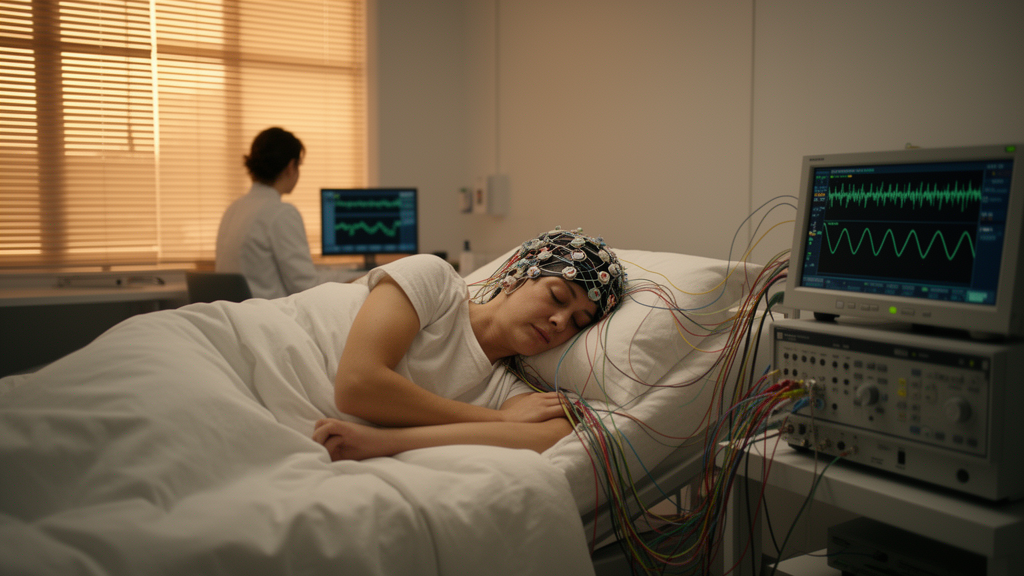
During the nap, participants underwent a lights-out period of 2.5 hours while EEG, EOG, and EMG were recorded continuously at 500 Hz using a 32-channel electrode cap. The researchers used automated sleep scoring software to classify sleep into stage 1, stage 2, slow-wave sleep, and REM. They then identified slow oscillations by low-pass filtering the EEG signal at 3.5 Hz and detecting negative-to-positive zero-crossings within an interval of 0.8 to 2 seconds, requiring the negative peak amplitude to exceed 1.25 times the averaged negative peak. Spindles were detected by band-pass filtering the signal between 9 and 12 Hz for slow spindles and 13 to 16 Hz for fast spindles, computing the root mean square of the filtered signals, and flagging events where the RMS signal remained above 1.5 times the standard deviation for 0.5 to 3 seconds. Slow spindles were quantified over frontal channels F3 and F4, reflecting their predominantly anterior distribution, while fast spindles were quantified over central channels C3 and C4. SO-spindle coupling was estimated using the continuous synchronization index described by Ladenbauer and colleagues, with coupling estimates restricted to stage 2 within NREM sleep because not all participants entered slow-wave sleep during their rest period.
The behavioral results revealed a nuanced picture. Discrimination performance improved significantly from baseline to pre-nap, confirming that the training itself was effective, but there was no significant change in discrimination across the nap interval. In contrast, identification performance improved significantly across the nap interval, with a main effect of Time that was statistically significant. The magnitude of offline changes to perceptual behavior was not modulated by language status, which differs from a previous account that reported a significant difference between TD and DLD adults in perceptual performance following overnight sleep. One possibility is that a nap is too short a duration of sleep for such group-level observations to emerge. Another may be that the study was underpowered in its DLD sample to detect a significant interaction. Indeed, an exploratory paired t-test conducted on identification scores by group suggests that whereas the TD participants improved, the DLD participants did not.
The sleep physiology results were equally revealing. After controlling for baseline and pre-nap discrimination performance, greater slow spindle density significantly predicted better post-nap discrimination performance, whereas greater SO density significantly predicted poorer post-nap performance. Fast spindle density was not significantly associated with post-nap discrimination performance. Neither the association with slow spindle density nor the association with SO density were moderated by language status. The negative correlation between SO density and changes in perceptual discrimination performance is particularly intriguing. NREM sleep characterized by a high density of SOs is thought to support systems-level reorganization, abstraction, and integration. For speech categories, that process may preserve category-level information while reducing access to token-specific acoustic detail. Higher SO density could therefore accompany stronger abstraction but poorer performance on a task requiring fine-grained acoustic comparison. This is consistent with recent observations that slow-wave sleep promotes the preservation of category-level representations at the expense of item-level information.
Perhaps the most striking finding emerged from the coupling analyses. For slow spindles, the coupling strength of SO-slow spindle coupling was negatively associated with language difficulties in those with DLD, meaning that those with stronger SO-spindle coupling had better language skills within the DLD sample. This correlation, with a Spearman rank-order coefficient of -0.71 and a p-value of 0.047, raises the intriguing possibility that SO-spindle coupling may serve a compensatory or protective role in the context of language disorder. However, given the small number of participants with DLD, this finding should be interpreted cautiously. The researchers also observed a numerically lower slow spindle density in adults with DLD relative to TD, with a p-value of 0.067, and exploratory analyses suggested a potential difference in the scalp topography of fast spindle activity between the two groups. Interestingly, prior reports of spindle activity in populations with learning disabilities have suggested that children with dyslexia have higher sleep spindle density relative to TD children, though these earlier studies did not examine spindle topography.
The study has several important limitations that the authors acknowledge. The DLD group was substantially smaller than the TD group, limiting the ability to conduct meaningful between-group comparisons. Nap sleep may not provide sufficient time for a complete sleep cycle, including deeper stages of NREM sleep such as slow-wave sleep, and because approximately half of the participants did not reach this stage, the effects observed here may not fully reflect those associated with longer sleep periods. The study also did not include a wake control group, nor did it include baseline polysomnographic measures of sleep, meaning that although the post-nap improvements observed are consistent with sleep-dependent consolidation, the researchers cannot rule out the possibility that comparable gains would have occurred in the absence of sleep. Future studies should recruit larger and more balanced samples, examine the effects of a full night of sleep, incorporate measures of generalization alongside assessments of trained-item perception, and include a wake control group to allow for a more definitive assessment of the specific contributions of sleep to memory consolidation. Nevertheless, these findings point to a potential relationship between sleep physiology and perceptual-linguistic representation, and suggest that the timing of sleep spindles relative to slow oscillations may be a promising target for understanding individual differences in language ability.
Subject of Research: Sleep-dependent consolidation of speech-sound memory in adults with and without developmental language disorder
Article Title: Speech-sound memory consolidation over a daytime nap in adults with and without developmental language disorder
Article References: Solbi, A., Thimmugari, R. G., van Zelst, A. L., & Earle, F. S. (2026). Speech-sound memory consolidation over a daytime nap in adults with and without developmental language disorder. Frontiers in Behavioral Neuroscience, 20, Article 1903903. https://doi.org/10.3389/fnbeh.2026.1903903
Image Credits: AI Generated
DOI: 10.3389/fnbeh.2026.1903903
Keywords: developmental language disorder, sleep spindles, slow oscillations, memory consolidation, speech perception, NREM sleep, polysomnography, Hindi dental-retroflex contrast, SO-spindle coupling, perceptual learning, neurodevelopmental disorders, daytime nap
News Source: Cassandra Pierce. (October 17, 2026). A Daytime Nap Reveals How Sleep Brain Waves Shape Speech-Sound Memory in Adults With and Without Language Disorder. Scienmag.