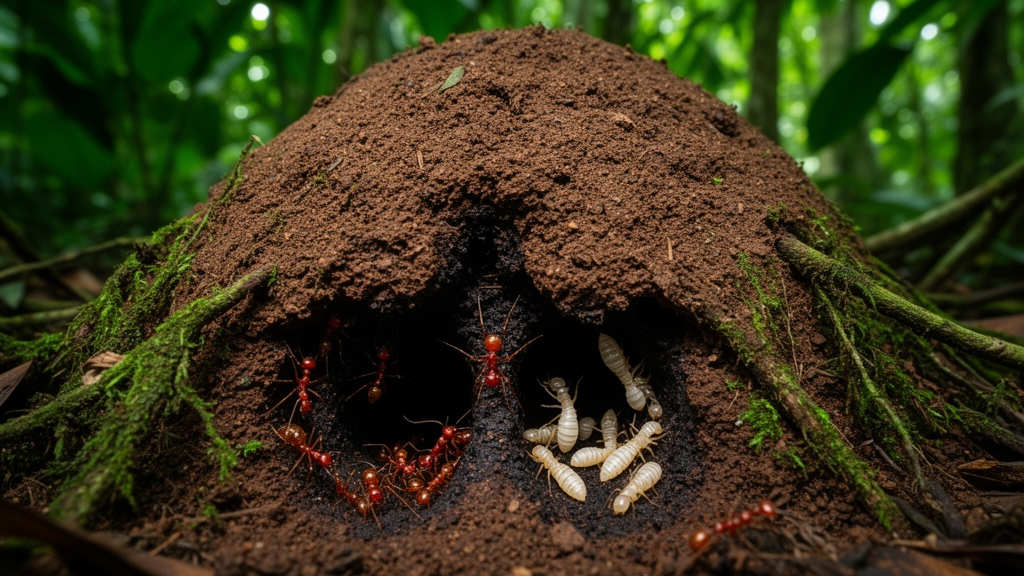
Deep in the forests of the Colombian Amazon, some of the most consequential roommates in the animal kingdom are sharing walls without ever signing a lease. Termites build the nests; ants move in. A new study, published in Neotropical Biology and Conservation, has mapped this hidden cohabitation on an unprecedented scale, constructing interaction networks from 283 shared nests across 30 sampling sites and revealing a world of cryptic partnerships that most ecological surveys never detect. The findings show that these nest-sharing arrangements are far from random, and that the complexity of the networks depends heavily on the kind of forest in which they occur.
The research team, working across the departments of Amazonas, Vaupés, Guainía, and Guaviare, sampled termites and ants between 2002 and 2004 using a modified transect protocol adapted for termite diversity research. At each site, collectors searched eight plots along a 250-meter transect, spending 25 minutes per plot actively excavating nests and probing feeding galleries. The cohabitation criterion was deliberately strict: ants were only recorded as cohabitants when they were observed inside galleries, chambers, or tunnels actively occupied by termites, not merely loitering on the surface. In total, 413 specimens were collected, representing 197 interacting species—110 ant species across 36 genera and 10 subfamilies, and 87 termite species across 50 genera, four families, and seven subfamilies.
When the researchers assembled these encounters into a bipartite network, with termite species on one side and ant species on the other, a distinctive architecture emerged. The network showed moderate connectance (C = 0.279), meaning only a fraction of the possible pairwise interactions actually occurred, and this value did not differ significantly from what a random null model would predict. But modularity—the degree to which species cluster into distinct subgroups that interact more among themselves than with outsiders—was significantly higher than expected by chance (Q = 0.602, p < 0.001). In other words, while any given ant-termit pairing was rare, the ones that did occur were organized into meaningful clusters rather than scattered randomly across the network.
Nestedness, by contrast, was low (NODF = 4.91) and statistically indistinguishable from random expectations, suggesting that the network lacks the hierarchical structure seen in many other mutualistic systems. At the species level, the picture was even more striking: 88.7 percent of the 283 recorded interactions occurred exclusively between a single ant species and a single termite species, with only 11.3 percent repeated more than once. This predominance of unique, species-specific encounters suggests that cohabitation in Amazonian forests is not a generalized free-for-all but a collection of highly particular associations, each shaped by the nesting habits, abundance, and behavioral ecology of the partners involved.
Certain species emerged as structural linchpins. Among ants, the predatory species Pseudoponera stigma stood out dramatically, cohabiting with 21 different termite species and acting as the network’s only hub—a role that combines high within-module connectivity (z = 2.76) with high among-module connectivity (c = 0.815). Other important ants included Pheidole cf. longiscapa, Pheidole biconstricta, Mayaponera arhuaca, and Camponotus cf. orthocephalus, along with Acropyga tricuspis and Ectatomma tuberculatum. On the termite side, Heterotermes tenuis and Nasutitermes ephratae each hosted 11 ant species, while Termes fatalis hosted 10. Termite genera such as Nasutitermes, Heterotermes, and Araujotermes emerged as key nodes, likely because their nesting habits—large aerial nests for Nasutitermes, abundant wood-dwelling chambers for Heterotermes—create stable refuges that ants can exploit.
The researchers also classified species by their topological roles using the framework of Olesen and colleagues, distinguishing peripherals, connectors, module hubs, and network hubs based on within-module degree (z) and among-module connectivity (c). Among termites, 10 species acted as connectors, including Neocapritermes braziliensis, Termes fatalis, Heterotermes tenuis, and Araujotermes parvellus, which bridged otherwise compartmentalized interaction groups. Among ants, Mayaponera arhuaca and Camponotus cf. orthocephalus served as module hubs, while Pseudoponera stigma was the sole network hub. Notably, 31 termite species and 54 ant species were recorded interacting with only a single partner, underscoring how much of the network consists of peripheral, one-off associations rather than broad, generalized relationships.
When the networks were stratified by forest type and conservation status, clear differences appeared. Primary forests—those never subjected to anthropogenic disturbance—supported more complex networks with a greater number of connector species. In primary forest networks, Pseudoponera stigma acted as a connector and Acropyga tricuspis as a network hub, while eight ant species showed high cross-module connectivity. In secondary forests, by contrast, no species functioned as a network hub, all termite species were peripheral, and only two ant species—Pseudoponera stigma and Hypoponera sp. 3—acted as connectors. Modularity was significantly higher than expected in both primary (Q = 0.66, p < 0.001) and secondary forests (Q = 0.79, p < 0.001), but the structural richness differed markedly, with primary forests hosting more intricate cohabitation arrangements.
The comparison between terra-firme and seasonally flooded forests revealed another layer of complexity. Terra-firme forests showed significantly higher modularity than expected (Q = 0.667, p < 0.001), while seasonally flooded forests showed a slightly elevated but statistically non-significant modularity (Q = 0.729, p = 0.10). Interestingly, despite the fact that periodic flooding restricts termite nest establishment in lowland várzea forests, seasonally flooded primary forests exhibited the highest median number of cohabitation events per site. The researchers suggest this paradox may reflect the dynamics described by Pringle and colleagues: while flooding reduces ground-level ant diversity, arboreal ants such as Azteca, Crematogaster, Camponotus, and Pseudomyrmex thrive above the waterline and increasingly exploit available termite nests as refuges when ground-level nesting is limited.
Substrate type also shaped the cohabitation landscape. Wood-based nests—dry, minimally decomposed pieces—supported the highest diversity of cohabiting ant genera, accounting for 47 percent of associations, surpassing the more conspicuous epigeal and arboreal mounds that have traditionally dominated cohabitation studies. Ant genera such as Pheidole, Crematogaster, Camponotus, and Pseudoponera were associated with multiple substrate types, suggesting generalist nesting behavior, while soil-associated genera like Octostruma, Acanthostichus, and Pachycondyla showed more specialized preferences. The hyperdiverse genus Pheidole was recorded across all substrate types, demonstrating the broadest ecological amplitude. A PERMANOVA confirmed that ant assemblages differed significantly across nesting substrates (F = 6.869, R² = 0.47, p = 0.001), with aerial and epigeal substrates supporting more distinct associations than soil or wood.
Trophic guild composition added yet another dimension. Out of 50 termite genera, 60 percent were primarily associated with omnivorous ants, 34 percent with predatory ants, and only 6 percent with herbivorous ants. A PERMANOVA confirmed that termite genera differed significantly in their interaction profiles across dominant ant guilds (F = 12.776, R² = 0.35, p < 0.001), with the first two principal components explaining 91.8 percent of the variation. Genera such as Acorhinotermes, Nasutitermes, Aparatermes, and Neocapritermes showed broad interaction profiles across guilds, while most others displayed more specific affinities. These patterns suggest that the trophic identity of ants plays a structuring role in cohabitation networks beyond termite taxonomy alone, hinting at ecological mechanisms—predation pressure, nutrient exchange, or defensive mutualism—that may underlie these associations.
The study’s authors frame their work as addressing what ecologists call the Eltonian shortfall: the persistent lack of information on species interactions and their functional roles within ecosystems. While taxonomic and distributional gaps have historically dominated biodiversity research, understanding biotic interactions remains a critical and often neglected frontier, particularly in hyperdiverse regions like the Neotropics. By documenting termite-ant cohabitation across multiple forest coverages and nesting substrates, this study provides a rare quantitative window into a cryptic ecological system that has been largely overlooked, revealing that even the most inconspicuous nest-sharing arrangements carry measurable structural signatures.
The implications for conservation are direct. Primary forests, with their greater structural complexity and diversity of nesting substrates, consistently supported more intricate cohabitation networks than secondary forests undergoing succession after logging, agricultural expansion, or cattle ranching. As deforestation pressures intensify across the Amazon frontier, the loss of structurally complex habitats may erode not only species diversity but also the interaction networks that bind communities together. The researchers acknowledge that standardized sampling protocols, constrained by excavation depth and search time, may underestimate the full frequency of rare or transient cohabitation events, and that the high proportion of one-to-one interactions may have inflated modularity estimates in sparse networks. Even so, the consistent patterns across forest types, substrates, and trophic guilds point to a system shaped by real ecological processes rather than mere spatial coincidence—processes that depend on preserving the structural richness of primary forests if these hidden partnerships are to persist.
Subject of Research: Termite-ant cohabitation networks in Amazonian forests
Article Title: Cohabitation networks: exploring how termites and ants share nests in Amazonian forests
Article References: Castro, D., & Fernández, F. (2025). Cohabitation networks: exploring how termites and ants share nests in Amazonian forests. Neotropical Biology and Conservation, 20(3), 221-246. https://doi.org/10.3897/neotropical.20.e154485
Image Credits: AI Generated
DOI: 10.3897/neotropical.20.e154485
Keywords: termites, ants, cohabitation networks, Colombian Amazon, forest conservation, ecological interactions, Cohabitation, networks, exploring, share, nests, Amazonian
News Source: Gavin Prescott. (October 17, 2026). Hidden roommates: how ants and termites share nests across the Colombian Amazon. Scienmag.