Every eight to ten minutes, a new name is added to the United States organ transplant waiting list, which now holds more than 100,000 patients. Yet between 15 and 20 of them die every day while they wait. The numbers are just as stark worldwide: the World Health Organization estimates that only about 10 percent of the global need for organ transplantation is currently being met, even though more than 150,000 transplants are performed each year. Chronic kidney disease alone affects roughly 10 percent of the world’s population, and many of those patients progress to end-stage renal disease that demands dialysis or a new organ. A new review published in Frontiers in Transplantation argues that the crisis is not only about donor scarcity but about how badly the systems that manage donated organs actually work.
The review, authored by Rachana Yogesh Patil of Pimpri Chinchwad College of Engineering and Yogesh H. Patil of D. Y. Patil College of Engineering in Pune, India, takes a deliberately broad view. Rather than examining artificial intelligence, blockchain, organ preservation or digital health in isolation, as most previous reviews have done, it synthesizes these emerging technologies with global transplantation trends, donor utilization patterns and implementation barriers within a single framework. The authors conducted a structured literature search across five electronic databases, screening 512 records down to 69 studies for qualitative synthesis, with a focus on publications from 2020 to 2026. Their conclusion is blunt: transplantation systems remain disjointed, and the missing integration of infrastructure, policy and technology is now as much of a problem as the shortage of donors itself.
The data the authors compiled reveal how uneven the global picture really is. According to the Global Observatory on Donation and Transplantation, 173,727 solid organ transplants were reported across 92 countries in 2024. Kidney transplants dominated with 110,467 procedures, roughly 64 percent of the total, followed by liver transplants at 42,497, or about 24 percent. Heart transplants accounted for 10,287 cases and lung transplants for 8,236, while pancreas transplants numbered just 2,066 and small bowel transplants a mere 174. When the authors normalized these figures per million population, the regional disparities became dramatic. The Americas led with 69.96 transplants per million people and Europe followed at 63.28, but South-East Asia managed only 12.09 and the Eastern Mediterranean 11.51. Africa recorded just 1.35 transplants per million people, a figure the review describes as a serious concern for access, infrastructure and resources.
Donor utilization efficiency, the capacity to convert identified donors into successfully transplanted organs, emerged as one of the most telling performance indicators in the analysis. Between 2014 and 2024, overall deceased donor utilization rates climbed steadily from 89.77 percent to 94.20 percent. Donation after brain death proved the most efficient donor type, rising from 88.74 percent to 96.76 percent, a trend the authors attribute to well-developed clinical guidelines, improved organ viability and streamlined decision-making. Donation after circulatory death told a very different story. Utilization rates fluctuated sharply, dropping to 45.23 percent in 2018 before recovering and stabilizing at around 87.88 percent in recent years. The review notes that the reasons for the 2018 decline cannot be determined from aggregated data and may reflect changes in reporting practices, donor selection criteria or allocation policies, but the persistent gap between brain-death and circulatory-death donors points to structural inefficiencies, including warm ischemia that degrades organ quality after circulatory arrest.
The imbalance extends to the donor sources themselves. Kidney transplantation drew on both pools in 2024, with 69,472 organs from deceased donors and 40,995 from living donors, while liver transplants combined 32,618 deceased-donor and 9,865 living-donor cases. Thoracic organs, by contrast, rely almost entirely on deceased donors, since hearts and lungs cannot be partially donated and tolerate only very short preservation windows. Living donors provide roughly 37 percent of kidney and 23 percent of liver transplants globally, which the review frames as both a strength and a warning sign. Healthy people undergo major surgery with no direct medical benefit, exposing them to surgical risks, long-term health effects and psychological pressure. The authors argue that heavy reliance on living donation also signals that deceased donor programs are under-optimized, and that differences in the availability of willing donors can create inequities in transplant access tied to social, family and economic backgrounds.
Logistics and preservation constraints compound these problems. Organ transplantation is a race against cold ischemia time, the period during which an organ is deprived of blood flow at low temperature before graft failure risk climbs. Hearts and lungs must be transplanted within a few hours, while kidneys have a longer shelf life, placing enormous pressure on coordination among donor hospitals, procurement organizations, transport systems and transplant centers. Any communication failure can lead to organ discard, especially in geographically dispersed systems. Donation after circulatory death is particularly vulnerable because organs are exposed to ischemic damage before retrieval. Static cold storage remains the cheapest and most widely used preservation method, but its shortcomings are increasingly apparent for marginal organs, and machine perfusion technologies, though clinically proven, are not yet universal because of cost and infrastructure requirements.
Against this backdrop, the review examines the technologies that could transform the field. Artificial intelligence applications fall into four domains: donor-recipient matching, organ offer and discard prediction, post-transplant outcome prediction, and allocation policy simulation. The evidence is nuanced. Externally validated models such as the D-TOP kidney transplant outcome prediction tool have outperformed traditional indices, and deep learning approaches have achieved roughly 98 percent matching accuracy in kidney matching prototypes and about 10 percent improvement in kidney discard prediction. Yet other studies found machine learning performed only similarly to regression-based methods, and most research remains retrospective, registry-based or single-center, lacking the prospective external validation needed to establish generalizability. The authors conclude that AI should be viewed as a decision-support technology that augments, rather than replaces, clinician judgment, with challenges including algorithmic bias, data drift and interpretability.
Blockchain, meanwhile, is positioned as coordinating infrastructure rather than a standalone solution. Decentralized, tamper-resistant ledgers combining smart contracts, decentralized registries and permissioned access control could secure donor registration, waiting list integrity, consent traceability, organ custody tracking and audit logging. Sensitive clinical data would be stored off-chain, with the blockchain holding hashes and transaction histories to preserve privacy. Blockchain paired with Internet of Medical Things sensors could monitor organ transport conditions and custody chains in real time, increasing accountability and reducing mishandling risks. But most blockchain applications remain at the prototype or pilot stage, built on platforms such as Ethereum and Hyperledger Fabric, and the review stresses that blockchain does not address organ shortage, allocation fairness or clinical decision complexity, which depend on policy and institutional practice. IoMT itself faces barriers of data security, device reliability, network dependency and integration with hospital information systems.
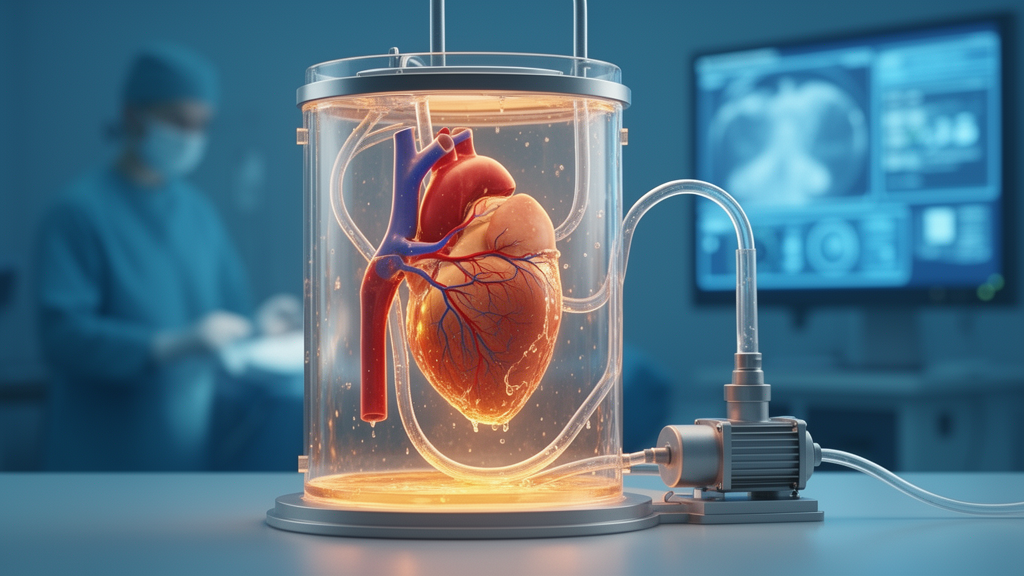
Organ preservation is where the review finds the greatest clinical maturity. Hypothermic machine perfusion reduces metabolic demand while maintaining cellular integrity, proving especially useful for high-risk kidney and liver grafts, while normothermic machine perfusion restores near-physiological conditions and allows real-time functional assessment and even repair of organs before transplantation. Emerging sequential perfusion combines the protection of hypothermia with the evaluation capabilities of normothermia. More experimental approaches push the frontier further: supercooling preserves livers at subzero temperatures without ice formation, partial freezing has enabled ten-day storage of rat livers in preclinical work, and vitrification with nanowarming offers ice-free cryogenic preservation with rapid, uniform rewarming that could eventually enable true long-term organ banking, though cryoprotectant toxicity and scalability remain obstacles. Big data analytics and clinical decision support systems round out the ecosystem, combining electronic health records, donor registries and real-time monitoring data to forecast organ supply and demand and support evidence-based allocation, though data heterogeneity, quality and privacy issues persist.
The review’s future directions converge on integration rather than invention. The authors call for interoperable data ecosystems with standardized data models and secure cross-institutional sharing protocols, explainable and equitable AI frameworks, scalable and cost-effective preservation technologies, and translational research in tissue engineering and bioartificial organs that could reduce dependence on donor organs. Equally important, they argue, is tackling the infrastructure gap between high-income and low- and middle-income regions through capacity building, international cooperation and affordable solutions for resource-poor settings. The vision is a data-driven, patient-centered transplantation system in which intelligent forecasting, secure data exchange and real-time monitoring work together. Success, the authors conclude, will depend not on any single technology but on matching digital innovation with clinical workflows, policy support, ethical governance and sustained international collaboration to make transplantation efficient, transparent and accessible on a global scale.
Subject of Research: Emerging technologies and systemic challenges in organ donation and transplantation systems
Article Title: Transforming organ donation and transplantation: challenges, innovations, and future directions
Article References: Patil, R. Y., & Patil, Y. H. (2026). Transforming organ donation and transplantation: challenges, innovations, and future directions. Frontiers in Transplantation, 5, Article 1855853. https://doi.org/10.3389/frtra.2026.1855853
Image Credits: AI Generated
DOI: 10.3389/frtra.2026.1855853
Keywords: organ transplantation, organ donation, artificial intelligence, blockchain, Internet of Medical Things, machine perfusion, organ preservation, big data analytics, donor shortage, health equity, allocation policy, transplant logistics
News Source: Drew Townsend. (October 17, 2026). AI, blockchain and machine perfusion aim to fix the global organ shortage. Scienmag.