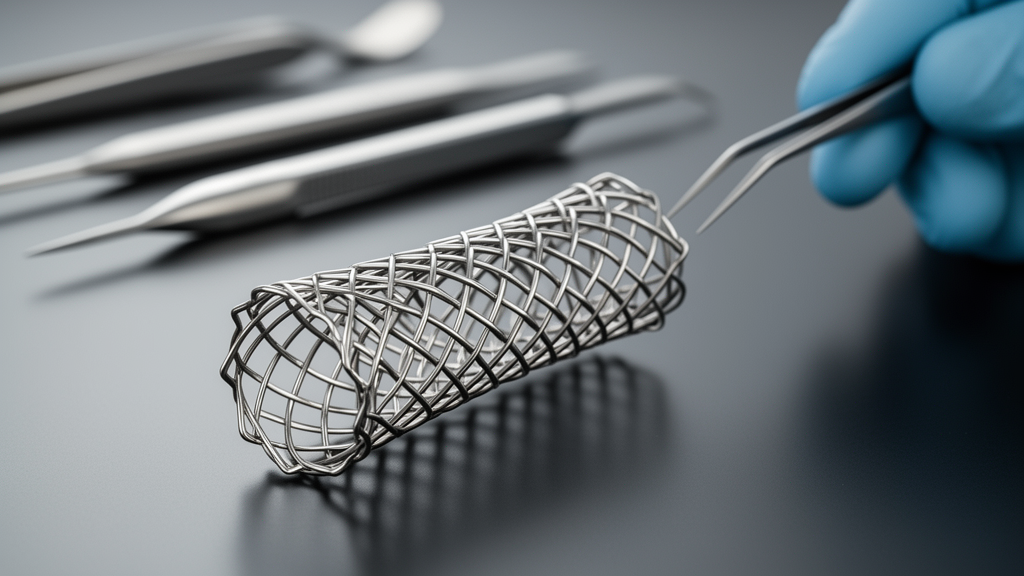
Every year, millions of patients receive metallic stent frames engineered to prop open arteries, seal off aneurysms, or hold replacement heart valves in place. Behind each of these devices sits a quiet computational workhorse: finite element analysis, or FEA, the simulation technique that predicts how a stent frame will deform, strain, and stress under the punishing loads of the human body. But a simulation is only as trustworthy as the geometric mesh underlying it, and a team of medical device engineers has now published a rigorous methodology for choosing that mesh wisely. Their work, appearing in Frontiers in Medical Engineering, tackles a deceptively simple question with enormous patient-safety implications: how fine must a stent simulation’s mesh be before its predictions can be believed?
The challenge stems from the fundamental architecture of FEA. Traditional solvers require the stent’s geometry to be subdivided into elements, closed one-, two-, or three-dimensional shapes composed of nodes connected by lines or curves. Each element contains one or more integration points where strain and stress are actually calculated. When a stent frame bends or twists, the peak strains and stresses occur at the structure’s surface, yet the integration points of three-dimensional elements sit inside the element volume, away from that surface. Refining the mesh, meaning a uniform reduction in element size, pushes those integration points closer to the surface and generally improves accuracy. The catch is that finer meshes demand dramatically more computational resources, and engineers must justify every hour of simulation time against the marginal gains in numerical precision.
The industry’s traditional answer has been a mesh refinement study reporting the fractional change in a quantity of interest, typically peak strain, between successive refinements. A common acceptance criterion for medical device simulations is a fractional change of 5.0 percent or less between peak strain predictions. But the authors argue this threshold is arbitrary and disconnected from the real stakes. As they point out, the 5.0 percent criterion bears no relation to the patient or business risk associated with making a decision based on the simulation results, nor to the computational cost of the simulations. Worse, the fractional change calculation provides no insight into the actual error and uncertainty in the prediction due to the mesh’s discretization, leaving analysts without the evidence needed to defend their model choices before regulators or internal review boards.
To close this gap, the team, drawing on engineers from Gore Medical, Medtronic, Ansys, Becton Dickinson, and Nuno Rebelo Associates, built a methodology anchored in three pillars: discretization error, computational cost, and model risk. The approach begins by estimating the exact solution of the numerical model, the value the simulation would converge to if the mesh could be refined indefinitely. They employed Richardson extrapolation, which estimates the converged value from a sequence of systematically refined meshes, and compared two ways of quantifying uncertainty. The first is the Grid Convergence Index, or GCI, a well-established technique that calculates numerical uncertainty with a safety factor, typically 1.25 or 3.0 depending on how closely the observed order of accuracy matches the theoretical value. The second is a newer method proposed by P. Krysl in 2022, which requires four systematically refined meshes rather than three but dispenses with the variable safety factor entirely.
The Krysl method proved the authors’ preference. It works by calculating the convergence rate for all four possible combinations of three meshes drawn from the four refinement levels, extrapolating a solution for each combination, and taking the median of those extrapolated values. The estimated exact solution is then a weighted combination, in a 2:1 ratio, of the extrapolation from the three finest meshes and the median of all four. Uncertainty is quantified using the median absolute deviation, scaled by a constant of 1.4826 under the assumption of a normal distribution. In the team’s three-point bend benchmark, the GCI method using the three finest meshes estimated an exact solution of 0.008006 with a 95 percent confidence interval spanning 0.000616, while Krysl’s method, using all four meshes, estimated 0.008000 with a far narrower interval of just 0.000080. Both methods placed the confidence band around the estimated exact solution itself, but Krysl’s tighter range gave analysts greater credibility per unit of computational effort.
To demonstrate real-world applicability, the team applied the methodology to a laser-cut nitinol stent frame, the superelastic nickel-titanium alloy that dominates modern stent design. The test article was a strut section cut from a nitinol tube with a 1.2 millimeter outer diameter and 0.1 millimeter thickness. Using symmetry, the model was reduced to a single strut, which was then simulated through a complete lifecycle: expanded to a 4 millimeter outer diameter from its as-cut geometry, annealed to mimic the shape-setting step in manufacturing, radially compressed to 1.5 millimeters to simulate catheter loading, and finally released to 3.2 millimeters to represent deployment into an artery 20 percent smaller than the stent’s nominal size. Submodeling of the region of interest kept the mesh refinement study affordable, with meshes containing 4, 8, 16, and 32 elements across the strut width systematically refined by a factor of two at each level.
Crucially, the team ran the entire exercise across four different finite element solvers, anonymized as solvers A through D, spanning products from Dassault Systèmes and Ansys. The converged solutions differed between solvers, an expected outcome given variations in physics, constitutive equations, element formulations, and boundary constraint methods, but the methodology itself proved agnostic to solver type and developer. For each solver, Krysl’s method produced an estimated exact solution with uncertainty, such as 0.010333 plus or minus 0.000136 for solver A. The team also tested whether expensive quadratic elements were necessary, running a three-point bend benchmark with four hexahedral element types. All four converged toward a peak maximum principal strain of approximately 0.008, showing that a linear element with a single integration point can be as accurate as a quadratic element with over 20 integration points, though the linear reduced-integration element required roughly four times as many elements through the beam thickness to match the quadratic element’s prediction.
With the exact solution estimated, discretization error and computational cost could be calculated for candidate meshes. The team evaluated meshes with 6 and 8 elements across the strut width at a 1.0 aspect ratio, and 8 and 10 elements at a 1.25 aspect ratio, where the element lengths in non-critical directions were set 25 percent greater than in the critical width direction to trim element counts without sacrificing density where the strain gradient is highest. The results revealed genuine trade-offs. The six-element mesh carried discretization errors between 4.2 and 9.8 percent across solvers but ran at 0.4 to 0.8 times the computational cost of the reference eight-element mesh. The ten-element, 1.25 aspect ratio mesh reduced error for three of four solvers, down to as little as 0.3 percent, but at a cost of 1.0 to 1.3 times the reference. No single mesh emerged as universally correct.
That subjectivity is precisely the point, and the authors grounded it in the ASME V&V 40 standard, which assesses model credibility by considering the influence of simulation results on a decision and the ramifications of an incorrect one. They presented three realistic contexts of use spanning a continuum of model risk. In the low-risk scenario, screening 50 stent designs across three boundary condition sets with no patient risk, the team selected the computationally efficient eight-element, 1.25 aspect ratio mesh with a 5.0 percent discretization error, prioritizing cost across roughly 150 simulations. In the medium-risk scenario, certifying fatigue requirements for a stent family where the simulation informs subsequent in vitro testing, they chose the ten-element mesh with 4.1 percent error, accepting a 1.3 times cost because the model’s output guides physical testing. In the high-risk scenario, where the computational model is the sole means of assessing durability with no in vitro fatigue testing planned, the same ten-element mesh was selected despite each of twelve simulations expected to exceed 40 hours, because the elevated stakes demanded the lowest achievable discretization error.
The authors deliberately declined to set a universal discretization error acceptance threshold, reasoning that the contribution of numerical uncertainty to a model’s overall accuracy cannot be determined during the mesh refinement study alone, since total uncertainty also includes input uncertainty and model form error. Instead, they recommend selecting the mesh based on the calculated discretization error, the computational cost, and knowledge of the risk associated with using the model to inform the decision, with a poor match against validation data signaling the need for further refinement. For an industry in which FEA evidence shapes regulatory submissions and patient outcomes alike, the methodology offers something the old 5 percent rule never could: a defensible, transparent, and risk-aware rationale for every mesh choice, one that two analysts can debate openly rather than guess at silently.
Subject of Research: Mesh discretization selection methodology for finite element analysis of cardiovascular stent frames
Article Title: Finite element analysis of cardiovascular stent frames: identifying appropriate mesh discretization
Article References: Lurie, B. A., Kari, S., Horner, M., Basciano, C. A., Kumar Murugadass, S., & Rebelo, N. (2025). Finite element analysis of cardiovascular stent frames: identifying appropriate mesh discretization. Frontiers in Medical Engineering, 3, Article 1606951. https://doi.org/10.3389/fmede.2025.1606951
Image Credits: AI Generated
DOI: 10.3389/fmede.2025.1606951
Keywords: finite element analysis, cardiovascular stent, mesh discretization, discretization error, model risk, nitinol, Richardson extrapolation, Grid Convergence Index, Krysl method, ASME V&V 40, submodeling, medical device simulation
News Source: Denise Maddox. (October 17, 2026). How Fine Mesh Choices Shape the Safety Evidence for Cardiovascular Stents. Scienmag.