The Moorish gecko, Tarentola mauritanica, is one of the most successful human-following reptiles of the Mediterranean Basin, and it has quietly established itself in the heart of Santiago, Chile. First detected in the city in 2005, the gecko now reaches its densest Chilean population in the San Miguel district, where it lives alongside native Liolaemus lizards and a suite of exotic carnivores. Yet until now, almost nothing was known about what this alien reptile actually eats in Chile, whether it threatens native lizards, or which animals might be keeping its numbers in check. A new study published in the journal Herpetozoa provides the first detailed look at the diet and predator relationships of this introduced population, combining stomach flushing, arthropod trapping, field surveys, camera traps, citizen science, and faecal analysis into a single integrative investigation.
The research team captured 31 geckos in spring (October 2023) and 32 in summer (February 2024) at Ciudad del Niño, an abandoned former orphanage of roughly 12.5 hectares in San Miguel. Stomach contents were collected using a modified gastric suctioning protocol, in which a 0.5 mm caliber tube was inserted into the animal’s mouth until it reached the stomach and a small amount of saline solution was used to draw out the contents, which were then fixed in 70% ethanol for identification under stereoscopic magnification. Prey items were classified into operational taxonomic units, counted, and measured to estimate their volume using a modified spheroid equation, allowing the researchers to calculate the Index of Relative Importance for each prey category.
The results reveal a strongly insectivorous diet dominated by ten insect categories, supplemented by other invertebrates, shed gecko skin, and occasional plant remnants. In spring, the diet was overwhelmingly dominated by Lepidoptera, which accounted for 88% of prey volume and 75.8% of the Index of Relative Importance. By summer, the picture had flipped: Coleoptera became the dominant prey, contributing 44.5% of volume and 68.6% of relative importance, while Lepidoptera nearly vanished from the diet. Several categories appeared exclusively in one season, including Blattodea and Diptera in spring and Chelicerata, Neuroptera, and Hymenoptera in summer, indicating that prey availability and foraging behavior shift markedly across the year.
Statistical analysis confirmed that diet composition differed significantly between seasons (pseudo-F = 3.36, R² = 0.11, p = 0.002) but not between sexes. A similarity percentage analysis showed that Coleoptera alone accounted for 21.8% of the overall between-season dissimilarity, with additional contributions from Lepidoptera, Embioptera, Isopoda, and Hemiptera, which together explained roughly 60% of the observed differences. The dietary niche breadth, measured using the inverse of Simpson’s diversity index, was wider in summer (B = 6.41) than in spring (B = 4.59), consistent with an expansion of available prey as arthropod communities respond to seasonal warming and drought.
To understand whether the gecko simply eats whatever is most abundant, the researchers deployed 100 sticky traps on walls and 100 pitfall traps on the ground across ten study points, running for two consecutive weeks in each season. The trap data showed that the most abundant environmental groups were not necessarily the most consumed. In spring, Chelicerata dominated wall habitats and Diptera dominated the ground, yet neither was a preferred prey. In summer, Hymenoptera was the most prevalent group on walls and Isopoda the most common on the ground, but both were actively avoided according to the selectivity index. Meanwhile, Embioptera and Dermaptera were selected even when scarce, suggesting that the gecko’s foraging decisions are shaped by energy reward, detectability, and prey defenses rather than by raw abundance alone.
Notably, no remains of native lizards were found in any of the 63 stomach content samples, a finding that alleviates immediate conservation concerns for the sympatric Liolaemus lizards. However, the researchers urge caution. In its native Mediterranean range, T. mauritanica is documented to occasionally consume juvenile lizards of several Podarcis species and even adult individuals, and DNA metabarcoding studies have shown that it can consume a native lizard, Teira dugesii, in large quantities on island environments. The authors recommend ongoing monitoring of the gecko’s saurophagous behavior, as it may vary with population density or shifts in food availability.
The predator component of the study took an integrative weight-of-evidence approach, combining literature records, citizen-science observations, 300 hours of nocturnal field prospection, camera-trap records, and faecal analysis. A global literature review identified 24 predator species worldwide, including 12 birds, six reptiles, four mammals, and two arthropods, with most records originating from the gecko’s native range in Southwest Europe and North Africa. At the study site, 29 animal species were identified in sympatry with the gecko, of which 13 were considered potential predators, primarily diurnal birds such as the austral thrush, chimango caracara, and long-tailed meadowlark, along with false black widow spiders and the native thin tree iguana.
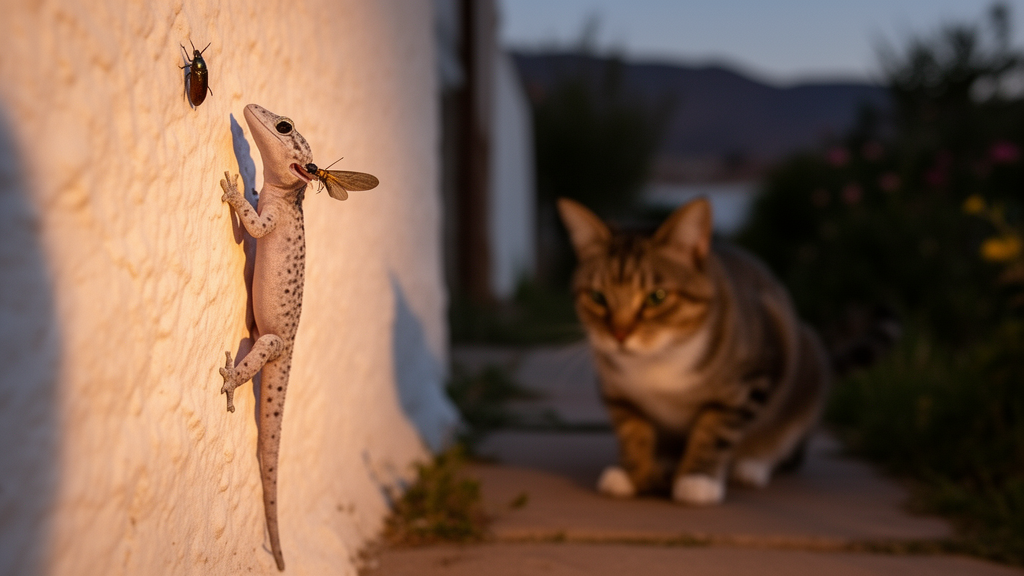
Citizen science yielded 33 responses, of which five people reported observing predation events on the gecko, primarily by cats, with single cases attributed to the austral thrush, chimango caracara, American barn owl, and domestic dog. Field prospection and camera traps recorded no direct predation events, but indirect evidence of predatory attacks was found: a juvenile gecko carcass with its head, tail, and one forelimb torn off, and an adult with abdominal lacerations exposing its entrails. Camera traps documented cats, dogs, and austral thrushes in areas where geckos gather. Faecal samples from carnivorous mammals contained no reptile remains, only unidentified mammal hairs.
When all evidence sources were scored cumulatively, only the domestic cat emerged as a probable predator, supported by two independent lines of evidence: the literature record from Santiago and the five citizen-science attack reports. Cats are solitary, opportunistic, and highly efficient predators whose mainly nocturnal habits overlap with those of the gecko, increasing the likelihood of encounters. The amputated remains and skin injuries found during fieldwork are consistent with cat handling behavior, as cats break vertebrae and tear prey skin, and the incomplete consumption of the carcasses aligns with their predatory play behavior. However, the authors acknowledge that the highly localised scope and exploratory nature of the predator component warrants further evaluation before firm conclusions can be drawn about the intensity of this interaction.
From a trophic perspective, the study positions T. mauritanica as an insectivorous mesopredator that exploits abundant arthropod groups and adjusts to intra-annual changes, potentially contributing to the decline of urban invertebrate populations whose diversity is already reduced. The gecko’s diet includes both native taxa, such as the beetle Monocrepidius cf. chilensis, and introduced species, including the order Embioptera and the earwigs Forficula dentata and Euborellia annulipes, confirming new introductions to Santiago. The researchers also hypothesise that the gecko may indirectly impact native sympatric lizards such as Liolaemus tenuis through competition for shared arthropod resources, as the two species share temporal and spatial niches. In urban Santiago, where lizard diversity and abundance are declining, the introduction of a mesopredator like this gecko could intensify competition for prey. At the same time, if cats are indeed preying on the gecko, the alien reptile could serve as a trophic subsidy that supports this exotic predator in urban areas, adding another layer to the complex community dynamics of biological invasions. Future studies should assess the intensity of dietary competition between the gecko and native lizards, and evaluate how trophic interactions between cats and the gecko unfold within a community-based approach in urban environments.
Subject of Research: Diet and predator interactions of the introduced Moorish gecko Tarentola mauritanica in central Chile
Article Title: Diet and trophic interactions in an introduced population of the Moorish gecko, Tarentola mauritanica (Linnaeus, 1758), of central Chile
Article References: Reyes-Olivares, C., Salinas, B., Valdivia-Villagra, J., Chávez-Jofré, L., Alarcón-Toledo, F., Miquio-Portell, T., Olate-Ávila, R., & Botto-Mahan, C. (2026). Diet and trophic interactions in an introduced population of the Moorish gecko, Tarentola mauritanica (Linnaeus, 1758), of central Chile. Herpetozoa, 39, 109-125. https://doi.org/10.3897/herpetozoa.39.e183674
Image Credits: AI Generated
DOI: 10.3897/herpetozoa.39.e183674
Keywords: Moorish gecko, Tarentola mauritanica, invasive species, Chile, diet analysis, trophic interactions, predation, domestic cats, urban ecology, herpetology, seasonal foraging, trophic subsidy
News Source: Drew Townsend. (October 17, 2026). Invasive Moorish gecko in Chile eats moths and beetles while cats stalk it as a probable predator. Scienmag.