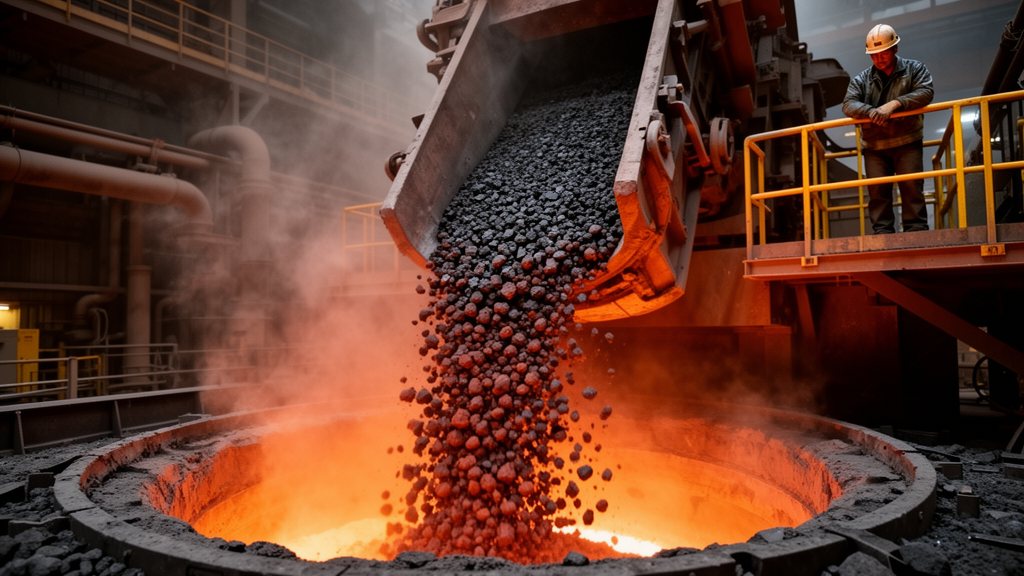
Deep inside a blast furnace, a quiet chemical tug-of-war decides how much carbon the steel industry pumps into the atmosphere. Iron ore sinter must be stripped of its oxygen by carbon monoxide, and every molecule of CO that gets consumed in that process is gone unless something regenerates it. A new study published in Results in Engineering by Xin Jiang and colleagues at Northeastern University in China now shows that the size of the small coke particles mixed into the burden—the so-called nut coke—plays a decisive role in how efficiently that regeneration happens, with particles of just 5 to 10 millimeters delivering the strongest boost to sinter reduction.
The stakes could hardly be higher. China’s total carbon dioxide emissions have surpassed 20 billion tons, roughly 30.65 percent of the global total, and the steel industry alone accounts for about 15 percent of the country’s emissions. Within ironmaking, blast furnaces are responsible for around 70 percent of the sector’s CO2 output. Coke is indispensable in these furnaces because it serves simultaneously as reducing agent, heat source, carburizing agent, and structural support for the burden column, but producing it releases CO2, CO, SO2, and nitrogen oxides along the way. Finding ways to stretch every kilogram of metallurgical coke has therefore become a central goal of low-carbon ironmaking research.
Nut coke is the fraction of screened coke smaller than 25 millimeters that has traditionally been burned as simple fuel rather than charged into the furnace. In every other respect it is virtually identical to the larger metallurgical coke, which is why steelmakers in China, the United States, France, and Japan already consume it at rates of 20 to 50 kilograms per ton of hot metal. Earlier plant trials by Murao and colleagues showed that controlled distribution of small coke during burden charging increased the blast furnace permeability index by about 5 percent while improving gas utilization by roughly 0.4 percent, and operating data analyzed by Logachov’s team indicated that nut coke consumption could be raised to 40 kilograms per ton of hot metal without hurting furnace productivity, with one kilogram of coke briquettes replacing approximately 0.67 kilograms of conventional coke.
What previous laboratory work had largely overlooked, however, was the effect of nut coke particle size itself. Most co-reduction studies employed nut coke of 10 to 12.5 millimeters, leaving the size question unexamined. Jiang’s team set out to close that gap by testing three size fractions—5 to 10 millimeters, 10 to 15 millimeters, and 15 to 20 millimeters—mixed with sinter of 10 to 12.5 millimeters at addition ratios of 0, 2, 4, 6, and 8 percent. The sinter, supplied by a commercial steel company, contained 59.28 percent total iron and 11.17 percent FeO, with hematite as its primary mineral phase, while the nut coke carried 87.07 percent fixed carbon, a coke reactivity index of 23.4, and a coke strength after reaction of 71.32.
The isothermal reduction experiments were conducted at 900, 950, and 1000 degrees Celsius under a gas atmosphere of 70 percent nitrogen and 30 percent CO, with the reducing gas switched on after a protective nitrogen hold and the sample mass tracked continuously by a balance system. The results were unambiguous: the reduction index of the sinter climbed steadily as the nut coke addition ratio rose from 0 to 8 percent, and it fell as the particle size increased. At 900 degrees Celsius, sinter alone reached a reduction index of 80.41 percent, but with 8 percent of 5 to 10 millimeter nut coke the index rose to 85.55 percent. The same 8 percent addition of 10 to 15 millimeter and 15 to 20 millimeter nut coke yielded only 83.95 percent and 82.57 percent, respectively. The pattern held at 950 and 1000 degrees Celsius, where the finest fraction pushed the reduction index to 88.52 and 90.56 percent, confirming that the optimum condition in this system is 8 percent nut coke of 5 to 10 millimeters.
The mechanism behind these numbers is a two-part story of chemistry and physics. Chemically, CO strips oxygen from hematite in a stepwise cascade—Fe2O3 first becomes Fe3O4, then FeO, and finally metallic Fe—generating CO2 in the process. Nut coke counteracts the resulting loss of reducing potential through the Boudouard reaction, in which solid carbon reacts with CO2 to regenerate CO, sustaining the atmosphere needed to keep the iron oxides shrinking. Physically, sinter particles tend to adhere and agglomerate at elevated temperatures, choking the burden bed and creating stagnant zones where the reducing gas never reaches the ore. The mixed nut coke alleviates this agglomeration, improves bed permeability, and ensures more complete contact between gas and sinter. Intriguingly, the study suggests that larger nut coke improves permeability so well that the reducing gases flow through faster, shortening their residence time and actually limiting reduction—which may explain why coarser fractions underperform the finest ones.
To probe the kinetics, the researchers applied the classical unreacted core model to their thermogravimetric data, testing whether the reaction was limited by interfacial chemistry, by gas diffusion through the solid product layer, or by a mixture of both. External diffusion was ruled out because the gas velocity of 0.26 meters per second far exceeds the critical velocity of 0.05 meters per second for diffusion-controlled reactions. The interfacial chemical reaction model produced excellent linear fits, with coefficients of determination above 0.95, while the diffusion and mixed-control models performed poorly—demonstrating that the rate-limiting step is the chemical reaction at the oxide interface itself. The fitted rate constants also showed that sinter mixed with 5 to 10 millimeter nut coke reacted fastest, consistent with the reduction index measurements.
From the Arrhenius relationship between the rate constants and temperature, the team calculated apparent activation energies of 10.81, 10.48, and 10.89 kilojoules per mole for the three nut coke fractions at 8 percent addition, compared with 12.39 kilojoules per mole for sinter alone. These values are strikingly low next to previous reports: Jin and colleagues found 28.88 kilojoules per mole for sinter-coke systems, Mousa’s team reported 24 to 40 kilojoules per mole, and Bao’s work on iron carbon agglomerates reached 72.58 to 97.41 kilojoules per mole. The authors attribute the low values to the sinter’s superior reducibility, the narrow 900 to 1000 degree Celsius window used for the Arrhenius fit, and the extra CO regenerated by the Boudouard reaction, while noting that activation energy is strongly influenced by ore type, particle size, gangue composition, reducing atmosphere, and raw material properties.
Microstructural analysis backed up the macroscopic picture. X-ray diffraction of the reduced products showed Fe, FeO, and SiO2 as the dominant phases, while scanning electron microscopy with energy-dispersive spectroscopy revealed FeO progressively transforming into Fe, with iron phases crystallizing and growing into a dense network structure that coarsened as the temperature rose from 900 to 1000 degrees Celsius. The SEM images also confirmed the ranking of the mixtures, with the 5 to 10 millimeter fraction showing the most advanced reduction at every temperature.
For an industry under pressure to decarbonize, the message is practical and precise: when charging nut coke mixed with sinter, favor the smaller end of the size spectrum and push the addition ratio toward 8 percent. Doing so promotes efficient utilization of a coke fraction that would otherwise be wasted as fuel, partially replaces premium metallurgical coke, lowers ironmaking costs, and trims the carbon footprint of the most emissions-intensive step in steel production. As hydrogen metallurgy advances and blast furnaces evolve, understanding these coupled reduction behaviors at the particle scale will be essential groundwork for the furnaces of a low-carbon future.
Subject of Research: Isothermal reduction behavior and kinetics of sinter mixed with nut coke of varying particle sizes and addition amounts
Article Title: Reduction behaviors between sinter and nut coke with varying particle sizes and addition amounts
Article References: Jiang, X., Fan, K., Jiang, Y., He, L., Ai, M., Zheng, H., & Shen, F. (2026). Reduction behaviors between sinter and nut coke with varying particle sizes and addition amounts. Results in Engineering, 32, Article 113546. https://doi.org/10.1016/j.rineng.2026.113546
Image Credits: AI Generated
DOI: 10.1016/j.rineng.2026.113546
Keywords: blast furnace, nut coke, sinter, ironmaking, reduction kinetics, Boudouard reaction, carbon emissions, activation energy, XRD, SEM-EDS, Reduction, behaviors
News Source: Denise Maddox. (October 17, 2026). Smaller nut coke particles boost sinter reduction in blast furnace study. Scienmag.