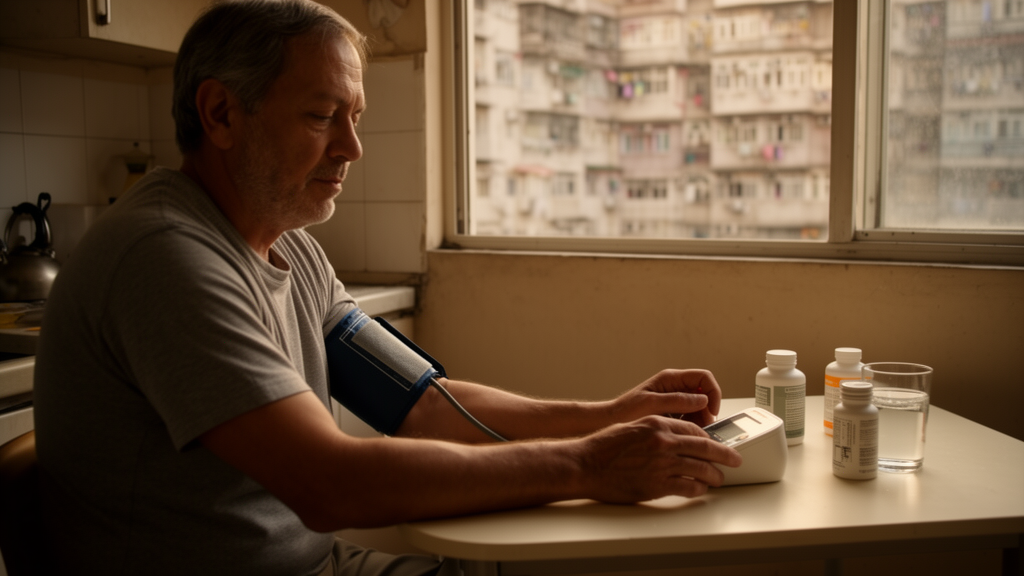
When public health campaigns tell people to eat better, exercise more, and manage stress, they usually assume that motivation is the missing ingredient. A new qualitative study from Karolinska Institutet, published in BMC Public Health, challenges that assumption at its core. Researchers interviewed eighteen adults living in low socioeconomic urban neighbourhoods in Stockholm who had been identified as being at high risk of stroke, and what they found was not a population lacking knowledge or willpower. Instead, they found people whose daily lives were so crowded with competing demands that health-promoting activities became yet another burden rather than a source of relief.
The study used semi-structured interviews and analysed the data through reflexive thematic analysis, following the approach developed by Braun and Clarke. This method allows researchers to capture experiences at multiple levels, from intimate family dynamics to the structural conditions of the neighbourhood itself. From the transcripts, three themes emerged: caring for others becoming a barrier to one’s own health, economic conditions hindering engagement in health-promoting behaviours, and health-promoting spaces turning out to be stressful and unsafe. Together, these themes describe a landscape in which the intention to stay healthy is constantly overruled by circumstances beyond individual control.
The first theme reveals a relational trap that is familiar to millions of informal caregivers worldwide. Participants described how caregiving responsibilities, whether for children, ageing parents, or other relatives, consumed the time, energy, and mental space they would have needed for their own health. In the arithmetic of everyday life, an hour of exercise or a carefully prepared meal loses out to an hour of care that cannot be postponed. The researchers note that participants often knew exactly what healthy behaviours looked like and expressed genuine motivation to pursue them, but their efforts were disrupted by these competing demands. Knowledge, in other words, was never the bottleneck.
The second theme exposes the financial machinery behind what health professionals often treat as free choices. Economic constraints shaped what participants could afford to eat, whether they could pay for a gym membership, and how much discretionary energy remained after covering basic needs. When a household budget is stretched thin, the modifiable risk factors for stroke, such as physical inactivity, poor diet, and chronic stress, are not so much modifiable as structurally imposed. The study’s technical contribution here is to show how these constraints operate at the level of lived experience, converting abstract socioeconomic gradients in stroke risk into concrete, daily negotiations.
Perhaps the most striking finding concerns the spaces that urban planners and health promoters typically frame as supportive of health. Gyms, which appear in official discourse as accessible venues for physical activity, were not always experienced that way by the participants. Instead, they could evoke discomfort, stress, or a sense of insecurity. This finding carries real technical weight for the field of health promotion, because it demonstrates that accessibility is not a property of a facility alone but of the encounter between a person’s circumstances and that facility’s social atmosphere. A neighbourhood gym that feels intimidating to a resident already carrying the stress of financial precarity does not function as a health resource, no matter what its equipment catalogue promises.
Social support, often celebrated in public health literature as a protective factor, was present in the participants’ lives but frequently proved insufficient to overcome the cumulative weight of these challenges. This nuance matters. It suggests that the popular strategy of encouraging peer networks and community bonds, while valuable, cannot substitute for addressing the underlying structural conditions. Support from family or friends may help someone attend a health programme once, but it cannot change the caregiving schedule, the household income, or the feeling of unsafety in a public space.
The researchers conclude that engagement in health-promoting activities among people in low socioeconomic urban contexts is shaped by the intersection of relational, structural, and contextual factors, rather than by individual motivation alone. This framing moves the scientific conversation beyond the individual behaviour change model that has dominated stroke prevention for decades. Stroke is one of the leading causes of death and disability globally, and its modifiable risk factors, including hypertension, physical inactivity, unhealthy diet, and stress, cluster disproportionately in disadvantaged neighbourhoods. The Karolinska study provides a lived-experience perspective on why that clustering persists even in a wealthy welfare state like Sweden.
That last point deserves emphasis. Sweden offers universal healthcare, subsidized medications, and extensive public health infrastructure, yet residents of low socioeconomic urban neighbourhoods still experience elevated exposure to stroke risk factors. The study, which was funded by the Kamprad Family Foundation and Karolinska Institutet grants and recruited with support from the City of Stockholm, shows that the barriers are not primarily within the healthcare system. They lie in the texture of everyday life, in the hours consumed by unpaid care, in the arithmetic of a constrained budget, and in the emotional experience of spaces that are supposed to promote health but instead generate stress.
The authors argue that health promotion may be experienced as an additional burden within already constrained lives, a conclusion that should unsettle anyone designing prevention programmes. If a health initiative asks a financially strained, caregiving, stressed resident to add meal planning, exercise sessions, and stress management to their week, it risks deepening the very sense of overload it aims to relieve. The researchers therefore call for context-sensitive, multi-level approaches that are integrated into everyday life and that foster meaningful and varied forms of engagement. In practical terms, this could mean embedding health-promoting activities into caregiving routines, designing public spaces that feel genuinely safe, and aligning prevention with the economic realities of the households it serves.
For the broader field of health equity, the study offers a methodological lesson as well as a substantive one. By listening to how people at high risk of stroke actually experience their neighbourhoods, the researchers surfaced barriers that no questionnaire on motivation or knowledge would have detected. The finding that gyms can be experienced as stressful and unsafe, that caregiving can crowd out self-care, and that social support has limits, only becomes visible through qualitative inquiry. As cities worldwide grapple with widening health inequalities, the Stockholm evidence makes a compelling case: effective stroke prevention in disadvantaged urban areas must stop treating residents as individuals who need persuading, and start treating their constrained everyday lives as the primary design constraint for every health-promoting initiative.
Subject of Research: Health Inequalities
Article Title: Everyday struggles to stay healthy: experiences of people at high risk of stroke residing in low socioeconomic urban neighbourhoods in Stockholm
Article References: Farias, L., Holmlund, L., Hawajri, O., Guidetti, S., & Patomella, A.-H. (2026). Everyday struggles to stay healthy: experiences of people at high risk of stroke residing in low socioeconomic urban neighbourhoods in Stockholm. BMC Public Health. https://doi.org/10.1186/s12889-026-29974-7
Image Credits: AI Generated
DOI: 10.1186/s12889-026-29974-7
Keywords: Everyday, struggles, stay, healthy, experiences, people, high, risk, stroke, residing, socioeconomic, urban
News Source: Cassandra Pierce. (October 17, 2026). Why Motivation Alone Cannot Protect People at High Risk of Stroke in Poor Urban Neighbourhoods. Scienmag.