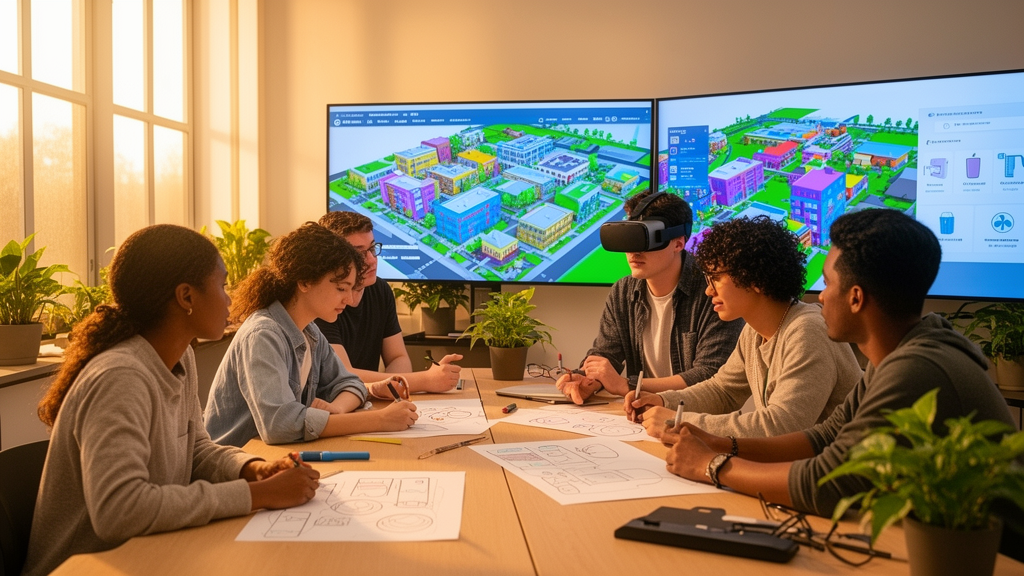
For two decades, gamification in higher education has largely meant instructor-controlled systems: points for completing tasks, badges for reaching milestones, leaderboards for spurring competition. A new wave of research argues that this model has hit its ceiling. The most promising direction now emerging is not another gamified app but something far more ambitious: persistent, student-built digital worlds that grow, evolve, and are evaluated as living educational ecosystems.
The research, published in Frontiers in Education by Andrii Bulgrov and colleagues, traces how educational gamification has moved beyond isolated applications toward immersive, collaborative environments. In these spaces, students do not merely consume content; they construct virtual objects, organize shared digital territories, and shape the very structure of their learning experience. The shift reflects broader changes in digital pedagogy associated with learner agency, participatory learning, and collaborative educational design.
At the heart of the argument is a distinction between two kinds of motivation. Traditional gamification relies on external rewards, which research shows can fade quickly. Immersive student-generated environments, by contrast, may foster intrinsic motivation through autonomy, experimentation, and social interaction. When learners influence the structure of their own learning experience, the researchers argue, motivation becomes more sustainable, particularly in blended higher education where students move between physical classrooms and digital spaces.
To move from concept to practice, the team developed a framework for evaluating expandable digital learning ecosystems. The framework combines technological affordances with pedagogical alignment, assessing usability, scalability, and the capacity of environments to grow without losing educational coherence. It was applied to two contrasting case studies: a structured immersive learning environment and an open, continuously evolving virtual campus.
The first case study involved a gamified three-dimensional environment for teaching computer architecture. Originally described in earlier empirical work, the environment allowed students to manipulate interactive models of computer components within a structured instructional framework. Previous research by the same team reported that students using the three-dimensional gamified version achieved higher assessment scores than those using two-dimensional alternatives, suggesting that spatial interaction with digital objects can support deeper learning of abstract technical material.
The second case study was an open virtual campus built in a sandbox game platform. Students designed buildings, educational locations, and thematic activity zones, while instructors coordinated activities and guided development. One documented educational use was a quest combining exploration tasks, hidden-object challenges, and multiplayer competitions organized within the virtual campus, connecting institutional events with learning objectives through collaborative gameplay.
Expert evaluation of both environments revealed complementary strengths. The structured environment scored higher on usability and instructional alignment, making it well suited for courses requiring clear guidance and assessment. The open virtual campus scored higher on scalability and learner agency, supporting long-term evolution and community building. The researchers argue that the two models are not competitors but complementary approaches that institutions can combine depending on context.
The implications extend beyond individual courses. If digital learning environments are treated as living ecosystems rather than static tools, universities may need to rethink how they design, maintain, and evaluate educational technology. The researchers suggest that institutions should invest in environments that grow with their communities, support participatory design, and maintain pedagogical coherence as they evolve.
Challenges remain, however. The researchers caution that student-built environments require ongoing moderation, clear learning objectives, and institutional support to avoid losing educational focus. Questions about assessment, accessibility, and long-term maintenance also need to be addressed before such ecosystems can become mainstream in higher education.
Nevertheless, the direction is clear. As digital learning moves from gamified apps to living worlds, the role of students is shifting from consumers of educational technology to builders of educational ecosystems. The researchers argue that this shift may represent one of the most significant changes in higher education pedagogy in the digital era, with implications for how universities design, deliver, and evaluate learning in the years ahead.
The three-component architecture proposed in the study reflects a deliberate attempt to formalize what has often remained an informal process. The Transformation Model describes how individual learner-generated artifacts—models, scenes, quests, and interactive objects—can be converted into reusable educational fragments rather than remaining tied to a single course or project. The Algorithmic Extension Layer addresses the structural side of this process, defining how new contributions can be integrated into an existing environment without fragmenting it. The Expert-Supported Quality Assurance Layer then introduces human judgment into the pipeline, with educators assessing whether student-built content meets the pedagogical standards required for institutional adoption.
This layered design responds to a problem that has limited earlier participatory approaches: student contributions frequently remain isolated demonstrations of skill rather than components of a durable educational infrastructure. By specifying how fragments are integrated and reused, the framework treats student work as cumulative. A virtual laboratory built by one cohort can become the starting point for the next, and a thematic zone created for one course can be adapted for another discipline. This cumulative logic is what distinguishes an ecosystem from a collection of separate applications.
The two case studies illustrate the framework at different points on a spectrum of openness. The structured ecosystem, built around a three-dimensional simulation environment, demonstrates how tightly scaffolded immersive learning can still support expansion: the environment provides clear instructional boundaries while allowing students to extend content within them. The Minecraft-based virtual campus represents the opposite pole, where world-building itself is the primary educational activity and the environment grows organically through collaborative design. The very high overall expert ratings for both cases suggest that neither approach inherently sacrifices quality, but the criterion-level differences indicate that the choice between them should follow pedagogical intent rather than technological fashion.
The complementary pattern in the expert assessments carries practical weight for institutional decision-making. Structured environments appear better suited to contexts where learning outcomes must be measured precisely and instructional alignment is paramount, such as technical courses with defined competencies. Open collaborative environments appear better suited to developing agency, community, and long-term engagement, which are harder to capture in conventional assessments but central to persistence in blended programs. An institution adopting ecosystem-oriented design could therefore deploy both models in parallel, using structured environments where curricular constraints dominate and open worlds where community-building and exploratory learning are priorities.
The study also situates itself within a documented shift in gamification research. Systematic reviews in the field have noted that scholarship remains heavily weighted toward discrete affordances—points, badges, challenges, leaderboards—and toward measurable outcomes, while social, immersive, and participation-oriented dimensions receive comparatively little attention. By centering the framework on learner-generated environments and their long-term evolution, the authors address a gap that reviews have repeatedly identified: the role of students not merely as participants in gamified activities but as contributors to the development and maintenance of the educational infrastructure itself.
The emphasis on intrinsic motivation aligns with a broader theoretical current in educational psychology. Self-determination perspectives hold that autonomy, competence, and relatedness sustain engagement more reliably than external incentives, and immersive sandbox environments are well positioned to support all three. Autonomy arises when learners decide what to build and how; competence develops through mastering creation tools and seeing contributions integrated; relatedness emerges through collaborative world-building and shared institutional spaces. The framework’s quality assurance layer, notably, does not treat this motivational dimension as separate from quality but as part of what experts evaluate when judging readiness for institutional integration.
Several questions remain open for future research. The framework was illustrated through two cases at a single stage of maturity, and longitudinal evidence will be needed to confirm that ecosystems built this way sustain engagement and pedagogical coherence over multiple academic cycles. The scalability of the expert assessment process is another open issue: human evaluation of every student contribution may be feasible for a single course but becomes demanding as ecosystems grow across programs and institutions. Questions of accessibility, equitable participation, and the training instructors need to curate student-generated content also remain on the research agenda.
Even with these caveats, the study’s central contribution is conceptual clarity. It names and structures a transition that many institutions are experiencing informally: from purchasing or licensing finished educational applications toward cultivating environments that their own communities continuously shape. If that transition continues, the durable measure of educational technology may shift from the sophistication of an individual tool to the vitality of the ecosystem surrounding it—and students, in that model, are not the audience but the primary builders.
Subject of Research: Education Technology
Article Title: Designing expandable digital learning ecosystems through student-generated immersive learning environments
Article References: Bulgakova, O., Zosimov, V., & Kudriavtsev, A. (2026). Designing expandable digital learning ecosystems through student-generated immersive learning environments. Frontiers in Computer Science, 8, Article 1937475. https://doi.org/10.3389/fcomp.2026.1937475
Image Credits: AI Generated
DOI: 10.3389/fcomp.2026.1937475
Keywords: gamification, higher education, virtual worlds, immersive learning, educational ecosystems, student agency, Designing, expandable, digital, learning, ecosystems, student-generated
News Source: Courtney Benton. (October 17, 2026). From Gamified Apps to Living Worlds: How Student-Built Digital Spaces Are Rewriting Higher Education. Scienmag.