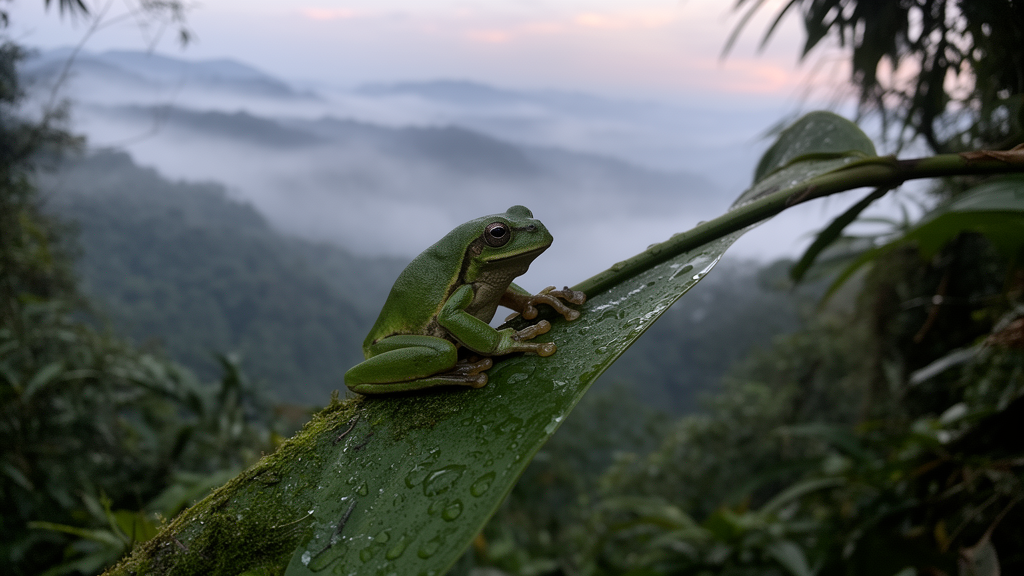
Deep in the montane forests of Damingshan National Nature Reserve in central Guangxi, China, a small tree frog has been quietly calling out a secret: it is not the species scientists thought it was. A team of Chinese researchers has now formally described the animal as a new species, Gracixalus damingshanensis, in the journal Zoosystematics and Evolution, adding a fresh branch to one of Asia’s most taxonomically tangled groups of shrub frogs.
The discovery began during fieldwork in the reserve, when researchers collected seven tree frogs that superficially resembled Gracixalus jinxiuensis, a species long assumed to range widely across southern China and northern Vietnam. That assumption, however, has been crumbling. Recent studies have already shown that some populations previously labeled as G. jinxiuensis are actually distinct species, and the new work suggests the name has been masking a whole complex of lookalike frogs across the region.
To untangle the mystery, the team combined three independent lines of evidence: DNA sequences, detailed body measurements, and the frogs’ advertisement calls. Genetic analysis of the mitochondrial 16S rRNA gene, based on an alignment of 1,447 base pairs, placed the Damingshan frogs in a strongly supported monophyletic clade, sister to the group containing G. jinxiuensis and G. huaping. Uncorrected genetic distances between the new species and its closest relatives ranged from roughly 1.9 to 4.6 percent, a level of divergence consistent with separate species in this genus.
Two complementary species-delimitation methods, Bayesian Poisson Tree Processes and the automated partitioning tool ASAP, both flagged the Damingshan population as a distinct evolutionary lineage. In the ASAP analysis, the genus split into 28 putative species, with the Damingshan frogs standing apart from every other sampled population. Convergent results from independent algorithms strengthen the case that the differences are real rather than artifacts of a single analytical approach.
The frogs’ bodies tell a similar story. Males measure 27.3 to 32.3 millimeters in snout-vent length and females 32.4 to 40.1 millimeters, making them noticeably larger than several congeners. They bear rough dorsal skin with scattered tubercles, grayish undersides flecked with light brown, fingers without webbing, white tubercles lining the jaw margins and limbs, and a golden-brown iris. Crucially, they lack vomerine teeth, have a tibiotarsal articulation that reaches only the middle of the eye, and show heels that do not meet when the thighs are held at right angles to the body, a combination that separates them from all known relatives.
Statistical analysis sharpened these distinctions further. A one-way analysis of variance found significant differences between the new species and its closest relatives in head length, internarial distance, forearm and hand length, upper eyelid width, and snout length. A principal component analysis of thirteen size-adjusted traits separated the Damingshan frogs cleanly from G. jinxiuensis and G. huaping along the first two axes, which together explained nearly 89 percent of the total morphometric variance. Head width dominated the first component, while internarial distance drove the second.
Perhaps the most striking evidence comes from sound. The researchers recorded seventy-one advertisement calls from three males at an ambient temperature of about 15 degrees Celsius and found a call structure unlike that of any close relative. Each call contained between two and five notes, with an average of 2.9, and lasted between 0.34 and 0.72 seconds depending on note number. Dominant frequencies ranged from 2.53 to 2.91 kilohertz, and spectrograms revealed up to three harmonics. By contrast, calls of G. huaping contain a single note, while those of G. jinxiuensis and G. liusanjieae typically contain two, and none of those species shows the multi-harmonic structure seen in the new species.
Because advertisement calls in frogs are often species-specific and play a central role in reproductive isolation, this acoustic fingerprint provides independent confirmation that the Damingshan frogs are reproductively cut off from their nearest neighbors. In a genus where external morphology can be deceptively convergent, a distinctive mating song is exactly the kind of evidence that helps draw firm species boundaries.
The species is so far known only from evergreen and bamboo forests above 900 meters elevation within Damingshan National Nature Reserve, in Wuming District near Nanning. Intriguingly, all seven specimens were collected from artificial refugia, specifically discarded plastic bottles that researchers had deployed to monitor tree frogs. Gelatinous egg masses were observed inside these bottles in March, and males were heard calling at night, offering a rare glimpse of the species’ breeding behavior. The frogs occur sympatrically with Gracixalus gracilipes, and the endangered salamander-like frog Theloderma rhododiscus was found sharing the same refugia.
The discovery brings the number of Gracixalus species recognized in Guangxi to seven and underscores how much cryptic diversity may still be hiding in China’s subtropical mountains. Four of those species, including the new Damingshan tree frog, are known only from their type localities, and records of G. jinxiuensis from two other Guangxi counties remain unresolved. As integrative taxonomy, combining genetics, morphology, and bioacoustics, becomes standard practice, researchers expect more such hidden species to surface, each one a reminder that even well-studied landscapes can still harbor animals science has never named.
Subject of Research: Description of a new tree frog species, Gracixalus damingshanensis, from Guangxi, China
Article Title: A new species of Gracixalus ( Anura , Rhacophoridae ) from Damingshan National Nature Reserve, Guangxi, China
Article References: Chen, W.-C., & Li, P. (2026). A new species of Gracixalus (Anura, Rhacophoridae) from Damingshan National Nature Reserve, Guangxi, China. Zoosystematics and Evolution, 102(4), 989-1003. https://doi.org/10.3897/zse.102.186426
Image Credits: AI Generated
Keywords: Gracixalus, new species, tree frogs, Guangxi, China, taxonomy, herpetology, bioacoustics, phylogenetics, species delimitation, Damingshan, amphibians
News Source: Margaret Porter. (October 17, 2026). Hidden tree frog species uncovered in China’s Damingshan mountains. Scienmag.