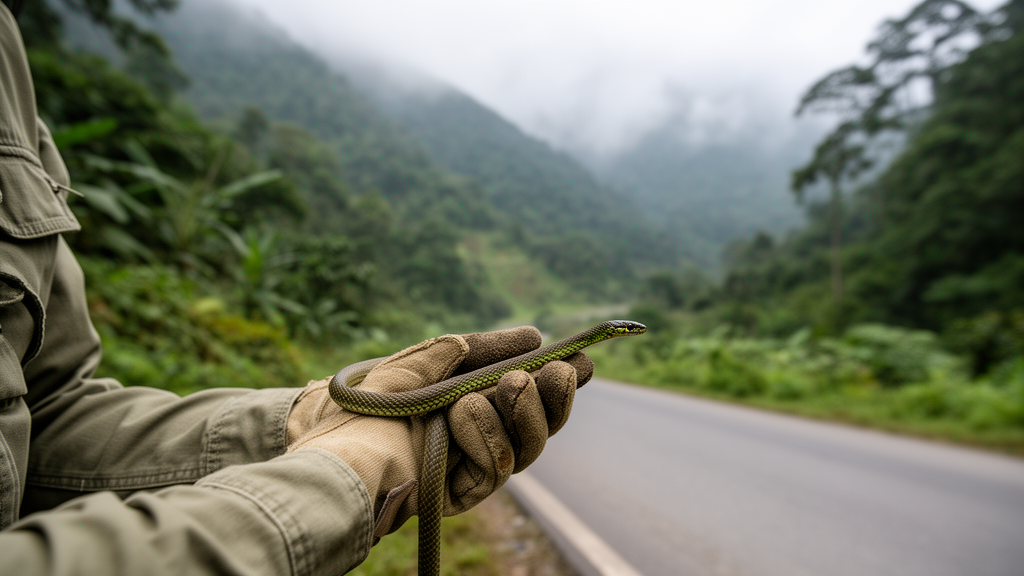
Deep in the evergreen broad-leaved forests of Wenshan Prefecture in southeastern Yunnan Province, China, local villagers stumbled upon a small, freshly dead snake lying on a road in early May 2025. No visible injuries marked its body, and it had not begun to decompose, suggesting it had died only hours before. What seemed like an unremarkable roadkill find would soon become the newest addition to a genus of snakes that scientists have largely overlooked for nearly a century. After detailed morphological comparisons and genetic sequencing, researchers have now formally described the specimen as a new species: Plagiopholis yangi, a semi-fossorial, non-venomous snake that raises the number of valid species in its genus to eight.
The discovery, published in the journal Evolutionary Systematics, is significant not only because it adds a new branch to the snake family tree but also because it highlights how much biodiversity remains hidden in the mountainous borderlands between China and Vietnam. The holotype, an adult male catalogued as KIZ2025059, was collected on 6 May 2025 in Xiajinchang Township, Malipo County, at an elevation of 1,450 meters. It is now preserved in approximately 75% ethanol at the Kunming Natural History Museum of Zoology, part of the Kunming Institute of Zoology at the Chinese Academy of Sciences.
Plagiopholis is a genus of small snakes that live largely underground or beneath leaf litter, a lifestyle that makes them notoriously difficult to find. Species in the group are widely distributed across southern China and northern Southeast Asia, yet many are known only from their original type specimens. For decades, the genus received little scientific attention, but a wave of recent discoveries has begun to reshape our understanding of its diversity. The new species adds to that momentum, and its description is based on a single specimen, a common pattern for this elusive group.
Morphologically, Plagiopholis yangi stands out through a unique combination of scale characteristics. It has one loreal scale on each side of the head, six supralabials, and a 2+2 arrangement of temporal scales. Its anterior dorsal scales are smooth while the posterior ones are feebly keeled, a feature that separates it from most of its congeners, whose dorsal scales are entirely smooth. It possesses 116 ventral scales and 32 subcaudal scales, some of which are paired and some unpaired, an unusual pattern within the genus. Perhaps most striking is the coloration: a large black inverted V-shaped blotch on the nape, a yellowish brown dorsum with irregular black stripes, and a yellowish white ventral surface dotted with many small dark spots.
To confirm that the specimen was truly new, the research team extracted total genomic DNA from liver tissue and amplified a fragment of the mitochondrial cytochrome b gene, a standard marker for species-level phylogenetics in reptiles. They compared the new sequence against those of all six known species of Plagiopholis, using the bamboo snake Pseudoxenodon bambusicola as an outgroup. Bayesian inference and maximum likelihood analyses both placed the new specimen in a distinct lineage, sister to a clade containing P. pluvialis, P. acuta, and P. styani, with strong statistical support from the Bayesian analysis.
The genetic distances were equally compelling. Uncorrected pairwise distances between the new species and its congeners ranged from 8.6% against P. styani to 16.6% against P. nuchalis, based on the cytochrome b gene. These are substantial divergences for closely related snake species and firmly support the recognition of the Wenshan specimen as a separate evolutionary lineage. The new sequence has been deposited in GenBank, allowing other researchers to verify and build upon the finding.
The species is named in honor of the late Professor Datong Yang, a renowned Chinese herpetological taxonomist whose work helped lay the foundations for modern snake systematics in China. The authors suggest Yang’s Mountain Snake as the common English name. The choice reflects a broader trend in taxonomy, where new species increasingly carry names that commemorate the scientists who shaped the field, connecting present-day discoveries to generations of earlier scholarship.
Geographically, Plagiopholis yangi is currently known only from Malipo County in Wenshan Prefecture, but the researchers speculate it may also occur in nearby Ha Giang Province in northern Vietnam, given the proximity of the type locality to the border. The area where the specimen was found supports evergreen broad-leaved forests alongside farmlands, and other snakes recorded from the same region include Achalinus zugorum, Lycodon flavozonatus, Ovophis makazayazaya, Ptyas major, and the green pit viper Trimeresurus stejnegeri. This assemblage hints at a rich, still incompletely documented herpetofauna in the Wenshan borderlands.
The discovery also carries implications for the taxonomy of the genus more broadly. The authors note that two names currently treated as synonyms of P. blakewayi, namely Plagiopholis unipostocularis and Oligodon kunmingensis, may in fact represent valid species in their own right. If future research confirms this, the true diversity of Plagiopholis could be even higher than the current count of eight species suggests. The conservative morphology of the group has historically led to serious underestimation of its species richness, and recent years have seen several new species described as researchers finally begin to look more closely.
Because Plagiopholis snakes are cryptic and rarely encountered, many species in the genus have been described from single specimens, and the new species follows that pattern. The authors acknowledge that a single individual is a slender basis for a species description, but they argue that the distinctive morphological characteristics and the significant genetic divergence from all known congeners are sufficient to confirm the specimen’s status as a new species. They call for strengthened field surveys in the region to clarify the distribution range and population status of Yang’s Mountain Snake, a task made more urgent by the possibility that this newly recognized lineage may be restricted to a small area straddling the China-Vietnam border.
Subject of Research: Taxonomy and phylogenetics of a new snake species from Yunnan, China
Article Title: A new species of Plagiopholis Boulenger, 1893 ( Serpentes , Pseudoxenodontinae ) from southeastern Yunnan, China
Article References: Liu, S., Hou, M., & Rao, D. (2026). A new species of Plagiopholis Boulenger, 1893 (Serpentes, Pseudoxenodontinae) from southeastern Yunnan, China. Evolutionary Systematics, 10(1), 85-92. https://doi.org/10.3897/evolsyst.10.188735
Image Credits: AI Generated
DOI: 10.3897/evolsyst.10.188735
Keywords: herpetology, new species, Yunnan, China, snake taxonomy, Plagiopholis, biodiversity, Evolutionary Systematics, species, Boulenger, Serpentes, Pseudoxenodontinae
News Source: Gavin Prescott. (October 17, 2026). New snake species unveiled from Yunnan road find. Scienmag.