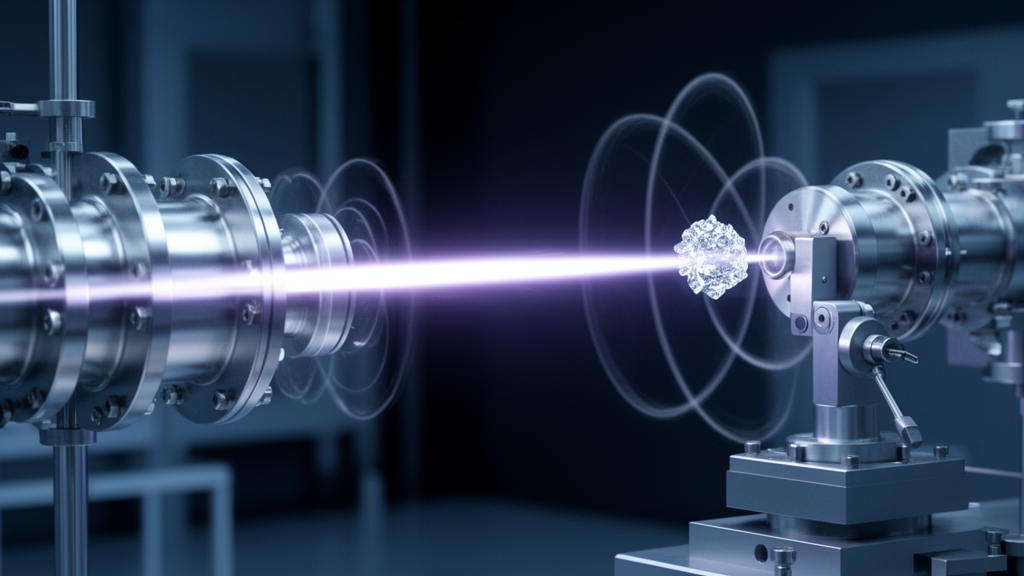
Scientists working at the European XFEL, the world’s most powerful X-ray free-electron laser facility, have generated hard X-ray flashes that are both astonishingly brief and more intense than any attosecond pulse of this kind produced before. The pulses lasted an estimated 300 attoseconds, where one attosecond is a billionth of a billionth of a second, and they were concentrated onto a spot so small that the team describes it as roughly 100,000 times smaller than the cross-section of a typical human hair. The achievement, reported in the journal Optica, sets what the researchers call a world record in both intensity and fluence for a hard-X-ray attosecond pulse, and it opens a path toward watching, and perhaps one day steering, the frantic dance of electrons inside atoms and molecules.
The distinction between the two records matters for understanding why the result is significant. Fluence measures how much energy the light delivers to a given area, while intensity also takes into account how quickly that energy arrives. A pulse can carry a modest amount of energy and still reach enormous intensity if it is compressed into an extremely short duration and an extremely small focus. The European XFEL team achieved both compression and focusing simultaneously, packing their X-ray light into a pulse lasting only a few hundred attoseconds and then squeezing that pulse down to a focal spot measuring just 180 by 330 nanometres. A nanometre is a billionth of a metre, so the illuminated area is comparable in scale to individual features of nanoscale matter.
Hard X-rays are the short-wavelength end of the X-ray spectrum, and their short wavelength is precisely what makes them valuable for resolving atomic-scale structure. Combining hard X-rays with attosecond durations is a long-sought goal because electrons rearrange themselves on attosecond timescales. When a molecule absorbs light, when a chemical bond breaks, or when radiation damages living tissue, the earliest events are shifts in the positions and energies of electrons. Capturing those shifts requires a probe that is faster than the motion itself. Until recently, ultrashort pulses at such high photon energies were either too weak to drive measurable responses in a sample or too long to resolve the fastest electronic dynamics.
The experiment was carried out in April 2026 at the MID instrument of the European XFEL, and the pulses were generated in the facility’s undulator, a device in which a cloud of relativistic electrons wiggles through a magnetic field with alternating polarity, emitting sharp bursts of X-rays in the process. Generating powerful attosecond pulses, however, is only half of the challenge. As DESY scientist Jiawei Yan, one of the corresponding authors of the study, explained, a few years ago the team demonstrated terawatt-scale hard X-ray attosecond pulses at the European XFEL, but what really matters for experiments is what can be delivered to the sample. With this advance, he noted, attosecond X-rays can now be used to explore highly nonlinear interactions between X-rays and matter.
The crucial step from a powerful pulse to a usable experimental tool was taken with an optical system known as an advanced Kirkpatrick–Baez, or AKB, mirror arrangement, which was brought to the facility from Japan. A Kirkpatrick–Baez system uses two extremely precise mirrors arranged in sequence: one mirror focuses the beam vertically and the other focuses it horizontally. Each X-ray flash in the experiment reflected four times in total before converging into the tiny focal spot. Reflective optics are essential at hard X-ray wavelengths because conventional lenses cannot efficiently focus such radiation; grazing-incidence mirrors coated with multilayer structures are among the few practical ways to bring hard X-rays to a diffraction-limited focus.
Verifying that the pulses truly reached a peak intensity of more than 10^20 watts per square centimetre required an independent measurement, and the team found an elegant one in the physics of copper. When the intense X-rays struck a copper foil, they stripped electrons from deep inner shells of the copper atoms, leaving behind vacancies, or holes, in the electronic structure. As outer electrons fell in to fill these holes, the atoms emitted characteristic X-ray light. At ordinary intensities this fluorescence radiates in all directions. But at very high intensities, the emitted light can stimulate other already-excited copper atoms to emit additional X-ray photons in exactly the same direction, amplifying the signal in a process known as amplified spontaneous emission, or ASE.
Anders Madsen, group leader at the MID instrument where the study was conducted, described the transition as almost magical to watch. Normal fluorescence goes in all directions regardless of the direction of the incoming beam, he observed, but when the ASE threshold is crossed, the light cone begins to condense into the forward direction. The researchers saw exactly this behaviour: the amplified signal initially rose rapidly as the pulse energy increased and then levelled off, or saturated, at higher energies. Such saturation is expected only at extremely high X-ray intensities, and its appearance provided an independent confirmation of the intensity the team had estimated from the pulse energy, pulse duration and focal-spot size.
The significance of crossing this threshold extends beyond setting a number. Amplified spontaneous emission is a hallmark of nonlinear X-ray matter interaction, meaning the response of the sample is no longer simply proportional to the light that hits it. Nonlinear X-ray physics has been notoriously difficult to reach because it demands photon densities far beyond what most sources can deliver. With peak intensities above 10^20 watts per square centimetre concentrated into attosecond bursts, experimenters can begin to probe regimes in which multiple X-ray photons interact with a single atom within a single pulse, a regime relevant to fundamental questions about how radiation deposits energy in matter and how inner-shell processes unfold in real time.
The longer-term ambition is to move from observing electrons to controlling them. Because attosecond hard X-rays can deposit energy into specific inner-shell levels of specific elements before the atom has time to rearrange, they could in principle be used to trigger and guide electronic motion during chemical reactions. The European XFEL team notes that the method could enable detailed studies of how electrons behave in atoms and molecules and, in the long term, could even allow researchers to control electrons as reactions proceed. Such element-specific, time-resolved control would complement the capabilities of optical attosecond lasers, which operate at much longer wavelengths and interact primarily with outer, valence electrons.
To make these capabilities available to the wider user community, European XFEL expects delivery of its own AKB mirror system in early 2027. The new system is funded through a collaboration with the University of Hamburg and with support from the Federal Ministry of Research, Technology and Space. Once installed and commissioned on the MID instrument, it is intended to give researchers from around the world access to X-ray flashes that are both short and intense enough to capture information about electrons before the X-rays cause substantial changes in the sample, resolving a long-standing tension in ultrafast X-ray science: the same light that reveals the sample can also destroy it. By shortening the pulse and sharpening the focus, the technique aims to record the electronic state of matter in the window between illumination and damage, turning the world’s brightest X-ray source into a camera fast enough to freeze the motion of the electrons themselves.
Subject of Research: Generation of record-intensity attosecond hard X-ray pulses at the European XFEL for studying electron dynamics
Article Title: World-record intensity in attosecond hard-X-ray pulses could unlock closer study of electrons in atoms and molecules
Article References: World-record intensity in attosecond hard-X-ray pulses could unlock closer study of electrons in atoms and molecules. Original publication (Bibliographic details unavailable.)
Image Credits: AI Generated
DOI: Not provided
Keywords: European XFEL, attosecond pulses, hard X-rays, X-ray free-electron laser, amplified spontaneous emission, Kirkpatrick–Baez optics, electron dynamics, nonlinear X-ray interactions, fluence, peak intensity, Optica, ultrafast science
News Source: Bethany Barker. (October 17, 2026). Record-Breaking Attosecond Hard X-Ray Flashes Bring Electron Motion Into Focus. Scienmag.