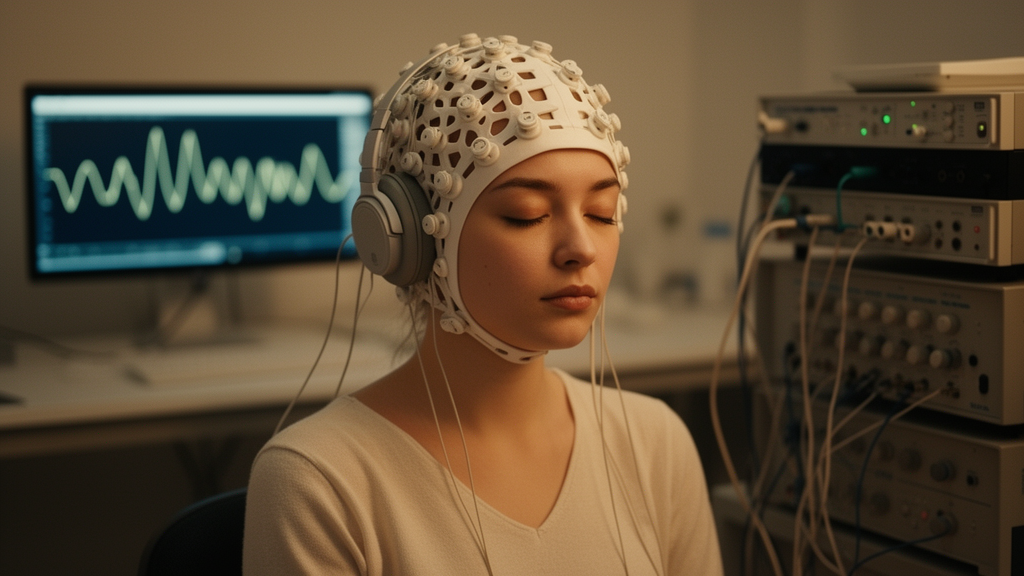
When a favorite song plays, the brain does something remarkably personal. The same is true, it turns out, when a young woman hears the rhythmic recitation of Quranic verses known as murottal. A new exploratory study published in Frontiers in Behavioral Neuroscience has paired first-person accounts of listening with quantitative electroencephalography, or qEEG, to map how the brain’s alpha oscillations shift during these two deeply familiar auditory experiences. The results, drawn from just four healthy 19-year-old women, are preliminary by design, but they offer a vivid glimpse into how subjective feelings of relaxation, imagery, and concentration leave measurable fingerprints on the electrical activity of the cortex.
The research team, based at the Faculty of Medicine of Muhammadiyah University of Surakarta in Indonesia, set out to address a gap that has long frustrated researchers at the intersection of neuroscience and phenomenology. Music listening and Quranic murottal listening share the same sensory gateway—hearing—and both are associated with beneficial health outcomes in the literature. Yet murottal listening carries an additional dimension tied to spiritual belief, while music listening does not necessarily do so. What has been missing, the authors argue, is a way to examine the conscious, first-person texture of these experiences side by side with objective neurophysiological measurements. Their case series attempts exactly that, treating each participant’s verbal report as primary data alongside the spectral power readouts from the EEG.
The technical core of the study rests on a well-established principle of electroencephalography. Neurons in the cortex generate rhythmic electrical activity that can be recorded non-invasively from the scalp, and these rhythms are conventionally sorted into frequency bands: delta below 4 hertz, theta from 4 to 7 hertz, alpha from 8 to 12 hertz in this study’s definition, beta from 16 to 31 hertz, and gamma above 31 hertz. Quantitative EEG applies spectral power analysis across these bands as an indicator of regional cortical engagement during specific cognitive tasks, with temporal resolution on the millisecond scale. Distinct mental states carry characteristic signatures; stress and anxiety, for instance, are frequently accompanied by elevated beta-band activity, with a dominance of high beta waves above 20 hertz.
To quantify change during listening, the researchers used a measure called relative alpha event-related desynchronization and synchronization, abbreviated ERD/ERS. When alpha power drops below a resting baseline, the brain is said to be desynchronized, a pattern often associated with active cortical processing. When alpha power rises above baseline, the brain is synchronized, a pattern classically linked to idling, relaxation, or internally directed states. The formula is straightforward: the mean alpha power during a three-minute listening block is compared with the mean alpha power during the immediately preceding two-minute eyes-closed baseline, and the difference is expressed as a percentage of the baseline value. The authors are careful to distinguish this block-averaged relative power change from the classical event-related potential, which refers to time-locked, phase-aligned voltage deflections occurring within milliseconds of a discrete repeated stimulus. The two concepts are related but not interchangeable, and conflating them, the researchers note, is a common error in the broader literature.
The experimental protocol was deliberately simple. Each participant sat in a quiet room under natural morning daylight, without artificial lighting. She opened and closed her eyes for two minutes each, with the initial eyes-closed epoch serving as the pre-stimulus baseline. Then came three minutes of listening to a favorite song of her own choosing. After a five-minute silent washout, a second two-minute eyes-closed baseline was recorded, followed by three minutes of listening to Quranic murottal. All four participants heard the same recitation, Surat Al-Alaq, performed by reciter Muzammil Hasbullah at a tempo of roughly 95 to 100 beats per minute. The order was fixed and identical for everyone: favorite song first, murottal second. This was not randomized or counterbalanced, a methodological limitation the authors acknowledge openly, because it means order effects, fatigue, and habituation cannot be fully separated from stimulus-specific effects.
The EEG hardware and analysis pipeline were conventional but carefully documented. Recordings were made with a clinical EEG device using 20 silver-silver chloride electrodes arranged according to the international 10-20 system, referenced to the ipsilateral ear, with impedance kept below 5 kilo-ohms. Filter settings ran from 0.53 to 35 hertz with a notch filter engaged, sensitivity was set at 7 microvolts per millimeter, and the recording speed was 30 millimeters per second. Quantitative spectral power analysis using fast Fourier transform and the generation of topographic maps were performed with software from the same manufacturer. Artifact-free epochs were selected by visual inspection, with alpha activity defined as 8 to 12 hertz and averaged per electrode. Heart rate was collected concurrently, derived from a 10-second sampling window multiplied by six to yield beats per minute.
The individual results are striking in their variety. Participant 1, listening to Shania Twain’s “You’re Still the One,” reported feeling relaxed and carried away by the pleasant musical atmosphere, almost falling asleep. Her heart rate dropped from roughly 115 beats per minute at baseline to about 95 during the song, and her alpha topography showed a predominant right-lateralized synchronization across auricular, temporal, and frontal regions, peaking at electrode C4 with a 39.9 percent increase. During murottal, she described feeling calm and comfortable, though she noted she was unconsciously memorizing the passage and recalling the location of verses on the Quranic page, a habit from her routine recitation practice. Her murottal topography showed right-lateralized synchronization in temporal and frontal regions alongside widespread frontal desynchronization, with heart rate again declining relative to baseline.
Participant 2 presented a contrasting picture. Listening to “Bad” by Wave to Earth, she spontaneously followed the lyrics and recalled fond memories, and her EEG showed a strong frontal desynchronization at electrode F4 with a 51.7 percent decrease, without the right-hemispheric lateralization seen in the first participant. During murottal, she described the recitation as heart-warming and reported feeling as though her body were floating. Her alpha response was dramatically left-lateralized, with synchronization peaking at C3 with a 129.5 percent increase, alongside parietal and auricular increases. Her heart rate remained steady at 60 beats per minute throughout. Participant 3, listening to One Direction’s “Live While We’re Young,” reported vivid visual imagery of a beach gathering with friends, and her EEG showed strong occipital synchronization at O2 with a 38.8 percent increase, co-occurring with widespread frontotemporal and parietal desynchronization. During murottal, she reported goosebumps and imagined the Arabic script of the verses, and her occipital synchronization rose even higher, reaching 52.8 percent at O1.
Participant 4’s recordings illustrate why the authors urge caution. Listening to “About You” by The 1975, she imagined scenes of train stations and departures, and her EEG showed a marked right-lateralized occipital synchronization at O2 with a 148.6 percent increase, alongside temporoparietal and auricular increases. But during murottal, she explicitly reported feeling tense because the reciter was unfamiliar to her and the experimental setting was new. Her murottal recording produced the largest synchronization values in the entire series, peaking at O2 with a 579.7 percent increase, a diffuse and disproportionate rise across nearly every electrode. The authors interpret this extreme pattern as reflecting effortful compensatory concentration and possible muscle-tension artifact rather than a stimulus-specific neural response to the recitation itself. Her heart rate rose slightly from 60 to 66 beats per minute, directionally consistent with her self-reported tension.
Across the four cases, the authors identify recurring descriptive patterns: auricular and temporal alpha increases plausibly related to adapting to the laboratory setting, prefrontal increases plausibly related to effortful attention toward the stimulus, occipital increases plausibly related to visual imagery, and middle-temporal-to-central increases co-occurring with subjective calmness. These are within-subject, pattern-level co-occurrences rather than statistically validated associations, given the sample size of four and the absence of inferential testing. The authors also note that heart rate values for the first participant were originally recorded at physiologically implausible levels and were later corrected through careful visual counting of QRS complexes on the raw electrocardiogram trace, yielding values in the 95 to 120 beats per minute range that remain modestly elevated, possibly reflecting genuine situational anxiety. Artifact handling relied on visual inspection rather than automated pipelines such as independent component analysis, which the authors flag as a specific direction for improvement. Taken together with a 2025 systematic review of 22 EEG studies reporting consistent associations between Quran listening and increased alpha and theta power linked to meditative states, these findings support alpha ERD/ERS as a plausible, if still preliminary, neurophysiological correlate of relaxation and internally generated imagery. The authors are clear that larger, statistically powered, counterbalanced studies are needed before any causal or generalizable claims can be established, but the individualized topographies they document suggest that the conscious experience of listening, whether to a beloved pop song or to sacred recitation, is as neurophysiologically unique as the person having it.
Subject of Research: Quantitative EEG correlates of subjective experience during music and Quranic murottal listening in young adult women
Article Title: Subjective experience of listening to favorite songs and Murottal Al-Qur’an in young adult women: a quantitative EEG case series
Article References: Khairunnisa, K., & Romadhon, Y. A. (2026). Subjective experience of listening to favorite songs and Murottal Al-Qur’an in young adult women: a quantitative EEG case series. Frontiers in Behavioral Neuroscience, 20, Article 1903142. https://doi.org/10.3389/fnbeh.2026.1903142
Image Credits: AI Generated
DOI: 10.3389/fnbeh.2026.1903142
Keywords: quantitative EEG, alpha rhythm, event-related desynchronization, music listening, Quranic murottal, case series, relaxation, visual imagery, heart rate, young adult women, Frontiers in Behavioral Neuroscience, phenomenology
News Source: Cassandra Pierce. (October 17, 2026). How the Brain’s Alpha Waves Diverge When Young Women Hear Favorite Songs Versus Quranic Recitation. Scienmag.