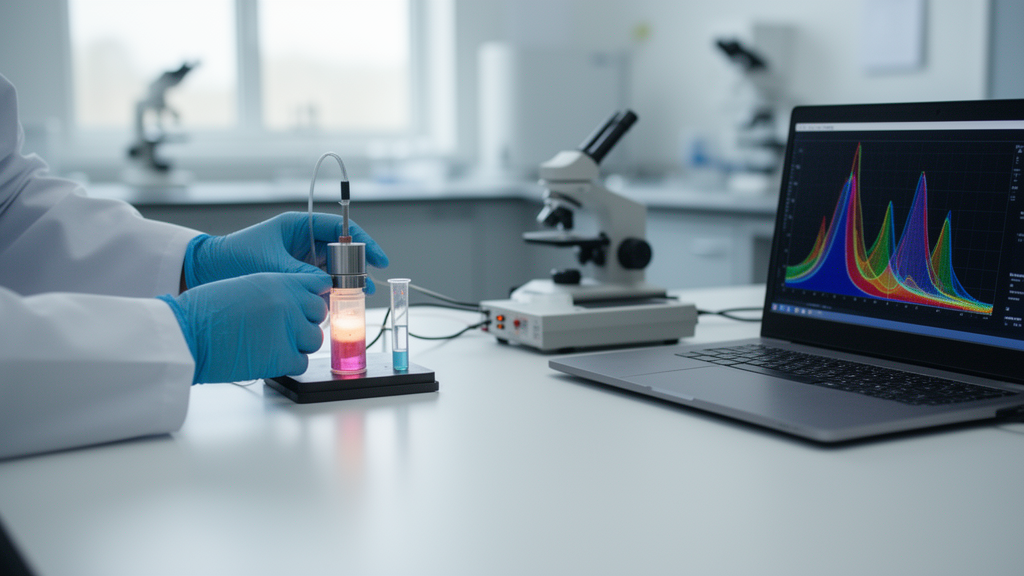
Electrochemistry has a data problem that most people outside the field rarely see. When researchers record Raman, surface-enhanced Raman scattering, absorption, or fluorescence spectra while sweeping the potential of an electrode, the interesting quantity is never a single spectrum. It is the evolution of a spectral band as the applied voltage changes. The same holds for rotating ring-disk electrode voltammetry, where disk and ring currents must be followed across a whole set of rotation rates. Judging these experiments requires representations such as waterfalls, heatmaps, three-dimensional surfaces, and Levich plots that display both dimensions together, yet the tools available to produce them have long forced scientists into a frustrating choice between closed vendor software and code-heavy libraries.
That gap is now being addressed by SpectroElectroChem Suite, an integrated open-source graphical application described in the journal SoftwareX by Achim Habekost. The software, currently at version 5.5.2 and distributed under the MIT license, is built in Python and organised around the native data structures of spectro-electrochemical and RRDE experiments. It reads plain CSV files exported from any spectrometer or potentiostat, so proprietary formats stop being a barrier, and it makes established analysis methods usable without a single line of programming.
The motivation behind the suite reflects two practical obstacles that stand between raw instrument exports and interpretable results. The first is pre-processing. Broad fluorescence and scattering backgrounds can completely mask weak Raman bands, so baseline correction, smoothing, and robust peak detection must be performed before any interpretation, and the chosen parameters must be recorded for reproducibility. The second is quantitative RRDE evaluation, which involves a chain of linked calculations including collection efficiency, apparent electron number, peroxide yield, and mass-transport and kinetic analysis. Done manually in spreadsheets, these calculations are slow, error-prone, and poorly documented.
Existing tools each solve only part of the problem. Powerful open-source Python libraries such as pybaselines for baseline estimation, SciPy for filtering and peak finding, and RamanSPy for scriptable Raman pipelines are aimed squarely at users who write code, and none of them treat the electrochemical dimension as a native axis. Instrument-vendor software, by contrast, is tied to specific hardware and closed formats, is rarely inspectable, and typically treats the electrochemical dimension as an afterthought. The result is that experimental electrochemists, students, and technical staff are left with manual spreadsheet work that is slow and hard to verify.
SpectroElectroChem Suite is a modular desktop application whose central launcher opens four independent modules: Raman Spectrum Analysis, Raman/SERS Voltammogram, Absorpto-/Fluorovoltammogram, and RRDE Analysis. All modules share common input conventions and export routines. The numerical core relies on the scientific Python ecosystem, with NumPy and pandas for data handling, SciPy for Savitzky-Golay filtering and peak processing, pybaselines for baseline estimation, Matplotlib for static figures, Plotly for interactive HTML graphics, and OpenPyXL for Excel export. The graphical interfaces are built with PySide6 and Tkinter, and the suite is distributed both as a self-contained Windows executable requiring no separate Python installation and as a Python source distribution.
Two design principles run through every module. First, every processing stage can be inspected and exported simultaneously, including the raw, smoothed, and baseline-corrected values, the calculated baselines, and a metadata sheet recording the source file, the selected ranges, and all parameters. Second, any visualisation choice that alters the displayed magnitudes, such as percentile clipping, log1p scaling, or waterfall offsets, is recorded in the output so it can be reported explicitly rather than remaining hidden inside a figure. The three spectroscopic modules provide baseline correction using polynomial and penalised methods, Savitzky-Golay and moving-average smoothing, automatic peak detection with position, intensity, and full width at half maximum, tolerance-based identification against reference lists, and linked interactive three-dimensional surface, heatmap, contour, and rotatable waterfall views with numerical export.
The RRDE module goes further, offering a full quantitative analysis of rotating ring-disk experiments. After automatic import, which identifies the corresponding rotation speeds without manual column assignment, it provides ring-background correction options ranging from none to point-by-point subtraction of a nitrogen-atmosphere measurement, along with a user-defined or manufacturer-specified collection efficiency. For the oxygen reduction reaction, the software converts the cathodic disk current to its absolute value and enters the background-corrected ring current as an absolute value, a convention that prevents cancellation of current signs that can depend on potentiostat wiring and export conventions. It then calculates the apparent electron number and the peroxide yield, issuing a warning if the electron number falls outside the range of two to four or if the peroxide yield falls outside zero to one hundred percent. The module also calculates the reversible equilibrium potential from the selected reaction, pH, and temperature, and converts between reference-electrode scales so potentials can be expressed as overpotentials.
The numerical implementation covers the classical pillars of hydrodynamic electrochemistry. For Levich analysis, disk currents are linearly interpolated at user-selected potentials, the rotation rate is converted from revolutions per minute to angular velocity, and an unweighted least-squares regression of the limiting current against the square root of angular velocity yields the slope, intercept, and coefficient of determination. In a dedicated mode, the user supplies the electron number and the diffusion coefficient is calculated from the slope, or the diffusion coefficient is supplied and the electron number is calculated. The Koutecky-Levich relation regresses the reciprocal of the current magnitude against the inverse square root of angular velocity, with the intercept equal to the reciprocal of the kinetic current, requiring at least three rotation rates. Tafel analysis requires the user to select the linear kinetic interval manually in an interactive window, since the physically meaningful region depends on the reaction, and the software reports the slope in millivolts per decade, the intercept, the coefficient of determination, and the exchange current density obtained by extrapolation to zero overpotential. When mass-transport correction is enabled, the limiting current is estimated as the median current within a manually selected plateau range, with plateau scatter and drift reported as quality indicators. A Butler-Volmer estimate of the standard heterogeneous rate constant is available only for a well-defined one-step redox couple and is deliberately disabled for the oxygen reduction, oxygen evolution, hydrogen evolution, and hydrogen oxidation reactions, where unique oxidised and reduced bulk concentrations cannot be assigned.
The validation is notable for its transparency. The RRDE results were recalculated from the exported numerical data using separate linear regressions and the published equations, with a dataset comprising five rotation rates from 500 to 2,500 revolutions per minute, a collection efficiency of 0.25, a disk area of 0.196 square centimetres, a concentration of 1.2 times ten to the minus three moles per litre, and a kinematic viscosity of 0.010 square centimetres per second. Every independently recalculated quantity agreed with the software output within numerical precision. The peroxide yield of 25.9 percent and the electron number of 3.48 at a specific potential and rotation rate, the Levich slope and its coefficient of determination of 0.988, the diffusion coefficient of 9.20 times ten to the minus seven square centimetres per second, the Koutecky-Levich slope and its coefficient of determination of 0.978, the kinetic current of 1.02 times ten to the minus four amperes, the mean Tafel slope of 84.7 millivolts per decade, and the mean exchange current density of 1.46 times ten to the minus eleven amperes per square centimetre all matched exactly. In an illustrative alkaline oxygen reduction experiment on a platinum disk with a glassy carbon ring in oxygen-saturated 0.1 molar potassium hydroxide, the Levich regression at one selected potential gave a coefficient of determination of 0.9883 and the Koutecky-Levich regression at another gave 0.9778, with no out-of-range electron numbers or peroxide yields occurring within the evaluation range.
The impact of the suite lies less in a new algorithm than in an integrated, reproducible, GUI-based workflow spanning both spectroscopic and hydrodynamic electrochemistry. Because raw and processed values are preserved alongside the software version, its archived digital object identifier, and all parameters, any figure can be traced back to its underlying data, and an independent user can regenerate the same output using the archived CSV files and recorded parameters. The software was developed for and is used in university spectro-electrochemistry experiments, where transparent, verifiable processing steps have direct educational value by enabling students to see the effect of each pre-processing and evaluation choice. Development is public on GitHub with issue tracking, and each release is permanently archived on Zenodo under a citable identifier, supporting reuse and extension. The modular structure isolates the four workflows behind shared input and output code, allowing additional baseline models, further spectroscopic modalities, or batch processing to be added without disturbing existing modules, and future development will expand the automated test suite and continuous integration coverage.
Subject of Research: SpectroElectroChem Suite open-source software for spectro-electrochemical and RRDE data analysis
Article Title: SpectroElectroChem Suite: An integrated open-source graphical application for reproducible spectro-electrochemical and rotating ring–disk electrode data analysis
Article References: Habekost, A. (2026). SpectroElectroChem Suite: An integrated open-source graphical application for reproducible spectro-electrochemical and rotating ring–disk electrode data analysis. SoftwareX, 36, Article 103124. https://doi.org/10.1016/j.softx.2026.103124
Image Credits: AI Generated
DOI: 10.1016/j.softx.2026.103124
Keywords: SpectroElectroChem Suite, spectro-electrochemistry, RRDE, oxygen reduction reaction, open-source software, reproducibility, SpectroElectroChem, Suite, integrated, open-source, graphical, application
News Source: Denise Maddox. (October 17, 2026). New Open-Source Suite Brings Reproducible Spectro-Electrochemical Analysis to Every Lab Bench. Scienmag.