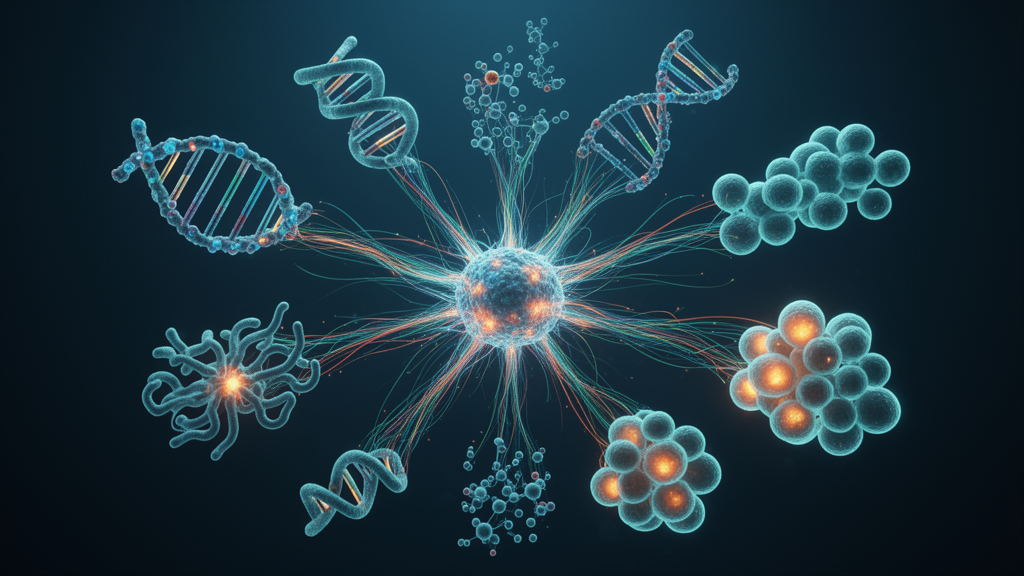
Scientists have unveiled a new machine-learning framework that dramatically improves prediction from integrated microbiome and metabolomics data, extending a powerful technique called supervised contrastive learning to the continuous responses that dominate biological research. The framework, described in the journal Frontiers in Microbiomes, tackles a stubborn limitation of existing artificial intelligence approaches in the life sciences: most were designed for categorical tasks, such as classifying images or assigning disease labels, yet the questions biologists most want answered—how old is this person, how much weight did this mouse gain, what is the concentration of this metabolite—are continuous in nature.
The new method, called MB-SupConCon, was developed by a team led by researchers at the University of Texas Southwestern Medical Center and collaborators at several other institutions. It builds on the success of supervised contrastive learning, a technique that has transformed fields from computer vision to natural language processing by teaching models to pull similar examples together and push dissimilar ones apart in a learned representation space. But the standard formulation requires labeled categories, which has kept it out of reach for the continuous measurements that pervade biology.
To bridge this gap, the researchers reimagined the core idea of contrastive learning in terms of distances rather than labels. Instead of grouping examples by shared category, MB-SupConCon treats examples as similar when their continuous response values are close together and dissimilar when those values are far apart. This seemingly simple shift required a careful redesign of the loss function, the mathematical objective that guides model training, to ensure that the learned representations preserve the ordering and spacing of the continuous responses.
The framework also introduces a novel weighting scheme that controls how strongly the model discounts pairs of examples whose responses differ greatly. The researchers found that this degree of discounting is a property of each dataset and cannot be anticipated in advance, so they built in a validation-based rule that selects the best setting using only training data. Remarkably, the rule also adapts to noise in the measurements, favoring settings that degrade more gracefully when continuous responses are measured with error.
To demonstrate the power of the approach, the team applied MB-SupConCon to two real-world datasets that integrate human microbiome and metabolomics data. In both cases, the framework outperformed a suite of tuned baseline methods, including canonical correlation analysis and an autoencoder, achieving statistically significant improvements in prediction accuracy. The learned representations also proved biologically meaningful, recovering known associations between specific microbial taxa and host traits.
Perhaps most strikingly, the embeddings produced by MB-SupConCon can be read in terms of individual microbes and metabolites, offering a level of interpretability that is rare in modern deep learning. Samples that sit close together in the learned representation space tend to have similar responses, and this structure is built from the biological features directly associated with the response, providing researchers with a window into why the model makes its predictions.
The framework also enhances visualization of data patterns in lower-dimensional space, revealing smooth yet distinguishable color gradients when continuous variables are plotted. This makes it easier for researchers to spot trends and outliers in complex multi-omics datasets, a task that has long challenged the field.
The researchers suggest that MB-SupConCon opens the door to a broader class of supervised contrastive learning applications in biology, where continuous responses are the norm rather than the exception. They also note that the approach raises an important question about which datasets are worth integrating in the first place, since the framework derives benefit only when the integrated data sources share meaningful structure. As multi-omics studies continue to proliferate, tools like MB-SupConCon may prove essential for extracting reliable and interpretable predictions from the resulting data deluge.
Contrastive learning has its roots in computer vision, where the same underlying principle—teaching a model to recognize which data points belong together and which do not—has powered breakthroughs in image recognition and in the pretraining of language models. The technique comes in two broad flavors. Self-supervised contrastive learning defines positive and negative pairs using information inherent to the data itself, such as whether two samples were collected simultaneously from the same subject. Supervised contrastive learning, by contrast, uses response labels to decide which examples should be pulled together in the learned embedding space and which should be pushed apart. Both approaches have proven remarkably effective, but both rest on the assumption that responses can be cleanly grouped, an assumption that breaks down when the outcome of interest is a continuous measurement.
The difficulty is easy to appreciate. When a response variable is categorical, two samples either share the same label or they do not, and the definition of a positive or negative pair follows directly. Continuous response values, however, are rarely identical between any two samples, so the traditional binary definition of similarity becomes inapplicable. The new framework resolves this by treating the distance between response values as a graded measure of similarity: pairs whose responses are nearly identical are considered highly similar, while pairs whose responses diverge substantially are treated as increasingly dissimilar. This reframing turns a hard boundary into a continuum, allowing the contrastive objective to operate smoothly across the full range of biological measurements.
The researchers formalized this idea through three distinct distance-based weighting schemes, each of which translates response distances into the weights that govern the contrastive loss. Because the appropriate weighting depends on characteristics of the data that cannot be known in advance, the team also developed a practical rule for choosing among the schemes using validation performance computed from training data alone. This matters in practice, since the choice of weighting scheme influences how robustly the model handles measurement noise in the response, a common reality in biological experiments where continuous quantities are rarely recorded without error.
The evidence for the framework’s advantages comes from both simulation and real data. In simulation studies, where the true relationships between features and responses are known by construction, the method consistently achieved lower prediction errors than tuned conventional models, canonical correlation analysis, and autoencoder baselines, with most comparisons reaching statistical significance. Canonical correlation analysis, a classical multivariate technique dating back to the 1930s, has long served as a standard tool for finding shared structure between two sets of variables, and autoencoders represent the deep learning alternative for learning compressed representations. That the new approach outperforms both classes of methods suggests that the contrastive objective, rather than representation learning per se, drives the gains.
The two real-world applications focused on Type 2 Diabetes and High-Fat Diet datasets, both integrating human microbiome and metabolomics profiles. These data types are natural partners for integrative modeling. The human microbiome, the diverse collection of microorganisms inhabiting various body niches, plays a documented role in disease diagnosis, prognosis, and treatment, while the metabolome—the complete set of small molecules involved in metabolic processes—directly shapes host physiology. Because microbial communities can produce or modify metabolites that in turn influence host states, integrating the two data types can capture biological relationships that single-omics analyses miss. Prior work has illustrated this potential in colorectal cancer, where bacterial species producing specific metabolites were linked to increased disease risk, and mechanistic follow-up studies have used multi-omics analyses to clarify the functions of those pathogenic species.
Earlier prediction models in this space typically relied on single-omics data and classical machine learning tools such as elastic net regression, random forests, support vector machines, and gradient boosting trees. These methods remain valuable but were not designed to exploit the joint structure across data modalities. An earlier version of the contrastive framework, MB-SupCon, had already demonstrated superior performance for predicting categorical responses from integrated microbiome and metabolome data, and the new extension completes the picture by covering continuous outcomes as well.
Beyond raw prediction accuracy, the learned embeddings offer biological dividends. The representation space produced by the model arranges samples so that clusters vary gradually with the response variable, which supports clearer visualization of data patterns in lower-dimensional plots. The embeddings also align more closely with the response than those from competing methods and recover known associations between specific microbes and metabolites, providing a check that the model is learning biologically meaningful structure rather than statistical artifacts.
For the broader research community, the framework arrives at a moment when multi-omics studies are proliferating and the need for integrative, interpretable prediction tools is growing accordingly. Because the method handles both categorical and continuous responses within a single framework, it can serve as a general-purpose prediction engine for biomedical datasets that mix data types. The authors suggest it may have broad applicability across biomedical research, and the combination of statistical rigor, biological interpretability, and improved visualization positions it as a versatile addition to the multi-omics modeling toolkit.
Subject of Research: A generalized supervised contrastive learning framework for integrative multi-omics prediction models
Article Title: A generalized supervised contrastive learning framework for integrative multi-omics prediction models
Article References: Yang, S., Wang, S., Wang, Y., Rong, R., Li, B., Koh, A. Y., Xiao, G., Li, Q., Liu, D., & Zhan, X. (2026). A generalized supervised contrastive learning framework for integrative multi-omics prediction models. Frontiers in Microbiomes, 5, Article 1825540. https://doi.org/10.3389/frmbi.2026.1825540
Image Credits: AI Generated
DOI: 10.3389/frmbi.2026.1825540
Keywords: machine learning, contrastive learning, microbiome, metabolomics, multi-omics integration, prediction, interpretability, continuous responses, generalized, supervised, contrastive, learning
News Source: Drew Townsend. (October 17, 2026). A generalized supervised contrastive learning framework for integrative multi-omics prediction models. Scienmag.