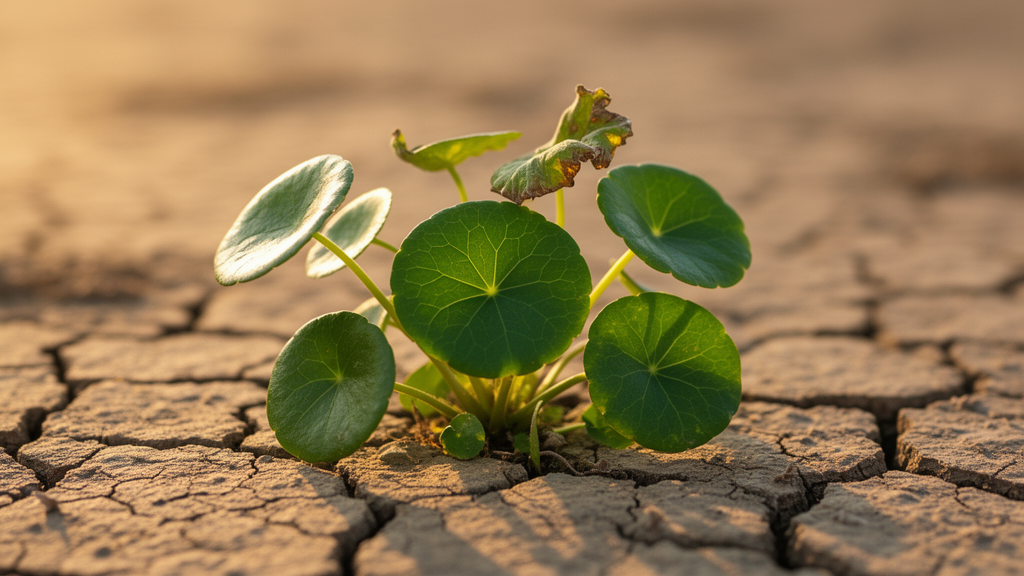
Centella asiatica, the creeping herb better known as gotu kola, has survived on the shelves of traditional medicine for centuries, but its future may depend on something far less visible: how quickly its cells can sense and respond to a drying world. A new study published in BMC Plant Biology by Feng Peng, Kun Zhang, Fengjie Wei, Lingyun Wan, Can Chen, Shugen Wei, Zhanjiang Zhang and Guiyu Tan has taken a systematic look at nine different germplasms of this medicinal plant to understand why some tolerate dehydration better than others. The answer, the researchers found, lies largely in one ancient plant hormone: abscisic acid, or ABA.
Dehydration is one of the most damaging environmental stresses any crop or medicinal plant can face. When water becomes scarce, photosynthesis slows, cell membranes destabilize, and reactive oxygen species accumulate to toxic levels. For Centella asiatica, which is cultivated for its triterpene compounds used in wound healing and cognitive health products, drought stress does not just threaten survival; it degrades the very quality of the harvest. Understanding which plant lines can withstand dry conditions, and why, is therefore a matter of both agricultural resilience and commercial value.
To tackle this question, the research team grew nine distinct C. asiatica germplasms, labeled C1 through C9, under normal conditions and then subjected them to dehydration stress induced by PEG-8000, a polyethylene glycol solution that mimics drought by lowering water potential around the roots without introducing any chemical toxicity. The researchers then measured twelve morphological, physiological and biochemical indicators across both groups, creating a comprehensive profile of how each germplasm responded at the whole-plant level.
Among all twelve indicators, one stood out with the strongest correlation to dehydration resistance: the level of abscisic acid. ABA is often described as the plant stress hormone, and for good reason. When plant cells detect water deficit, ABA is rapidly synthesized and transported to target tissues, where it triggers a cascade of cellular responses, from stomatal closure to the activation of protective proteins. The fact that ABA levels tracked dehydration resistance more closely than any other measured parameter suggested that this hormone’s signaling pathway, rather than any single structural or metabolic trait, might be the key differentiator between resistant and susceptible germplasms.
Using a combination of principal component analysis, membership function evaluation and cluster analysis, the team classified the nine germplasms into three distinct groups. C1 and C2 emerged as strongly dehydration-resistant, C3, C6 and C9 showed moderate resistance, and C4, C5, C7 and C8 proved the most vulnerable. This classification was not arbitrary; it reflected consistent patterns across the twelve measured indicators and provided a clear framework for understanding the natural variation within this species.
With the physiological landscape mapped, the researchers turned to transcriptome analysis to uncover the molecular machinery behind these differences. They selected two germplasms at opposite ends of the resistance spectrum, C2 as the strong performer and C7 as the weak one, and compared their gene expression profiles under dehydration stress. The comparison revealed 338 overlapping differentially expressed genes, or DEGs, that were consistently altered in both lines but to different degrees.
Kyoto Encyclopedia of Genes and Genomes, or KEGG, pathway analysis showed that these DEGs were primarily enriched in several critical biological pathways: plant-pathogen interaction, plant hormone signal transduction, phenylpropanoid biosynthesis, the biosynthesis of secondary metabolites, and alpha-linolenic acid metabolism. Gene Ontology classification further confirmed that the differentially expressed genes were significantly enriched in cellular processes, metabolic processes, cellular anatomical entities, binding activities and catalytic activities. Together, these results painted a picture of a coordinated molecular response that extends far beyond simple water conservation.
But the most striking finding came when the researchers focused specifically on genes involved in ABA signal transduction. These genes, which encode the receptors, transporters and downstream transcription factors that carry the ABA signal from the cell surface into the nucleus, contributed substantially to the difference in dehydration resistance between C2 and C7. In other words, it was not simply that the resistant germplasm produced more ABA; it was that its cellular machinery for interpreting and acting on the ABA signal was fundamentally more robust.
To validate their transcriptome findings, the team performed quantitative real-time polymerase chain reaction, or qRT-PCR, on selected genes. The results were consistent with the gene expression trends observed in the sequencing data, confirming that the transcriptome analysis had accurately captured the molecular differences between the two germplasms. This kind of cross-validation is essential in plant genomics research, where sequencing artifacts can sometimes produce misleading patterns.
The implications of this study extend well beyond Centella asiatica itself. By identifying ABA signal transduction as the central molecular pathway differentiating resistant from susceptible germplasms, the research provides a clear target for future breeding efforts. Rather than selecting plants based on visible traits alone, breeders can now look for molecular markers within the ABA signaling pathway to identify dehydration-resistant lines more efficiently. As climate patterns shift and water scarcity intensifies across the subtropical regions where this medicinal herb is grown, such tools may prove essential for maintaining both the yield and the therapeutic quality of one of traditional medicine’s most enduring botanical allies.
Subject of Research: Comprehensive germplasm evaluation and transcriptome analysis reveal ABA signal transduction responses to dehydration stress in Centella asiatica germplasms
Article Title: Comprehensive germplasm evaluation and transcriptome analysis reveal ABA signal transduction responses to dehydration stress in Centella asiatica germplasms
Article References: Peng, F., Zhang, K., Wei, F., Wan, L., Chen, C., Wei, S., Zhang, Z., & Tan, G. (2026). Comprehensive germplasm evaluation and transcriptome analysis reveal ABA signal transduction responses to dehydration stress in Centella asiatica germplasms. BMC Plant Biology. https://doi.org/10.1186/s12870-026-10164-x
Image Credits: AI Generated
DOI: 10.1186/s12870-026-10164-x
Keywords: Comprehensive, germplasm, evaluation, transcriptome, analysis, reveal, signal, transduction, responses, dehydration, stress, Centella
News Source: Alan Morgan. (October 17, 2026). How Abscisic Acid Drives Dehydration Survival in Centella asiatica. Scienmag.