For more than a decade, halide perovskites have dazzled researchers with their extraordinary ability to absorb X-rays and convert them into electrical signals, promising medical scanners, security checkpoints and industrial imagers that are sharper, cheaper and gentler on patients than today’s technology. Yet the materials themselves have carried an uncomfortable secret: nearly every high-performance perovskite ever grown has been born in a bath of toxic, high-boiling-point organic solvents such as dimethylformamide and dimethyl sulfoxide. These solvents are strongly coordinating, meaning they cling to lead ions and interfere with crystal formation, and they complicate large-scale manufacturing while raising environmental and health concerns. Water, by contrast, is the solvent chemists dream about — cheap, non-toxic, abundant and easy to remove. But water has always been the sworn enemy of perovskite synthesis. Lead iodide barely dissolves in it, and the organic components of the perovskite recipe hydrolyze almost instantly, decomposing before a crystal lattice can ever form. Now a team of researchers in China has achieved what many considered impossible: they have grown dense, crack-free perovskite thick films directly from an aqueous environment, and the resulting X-ray detectors are among the most sensitive ever reported.
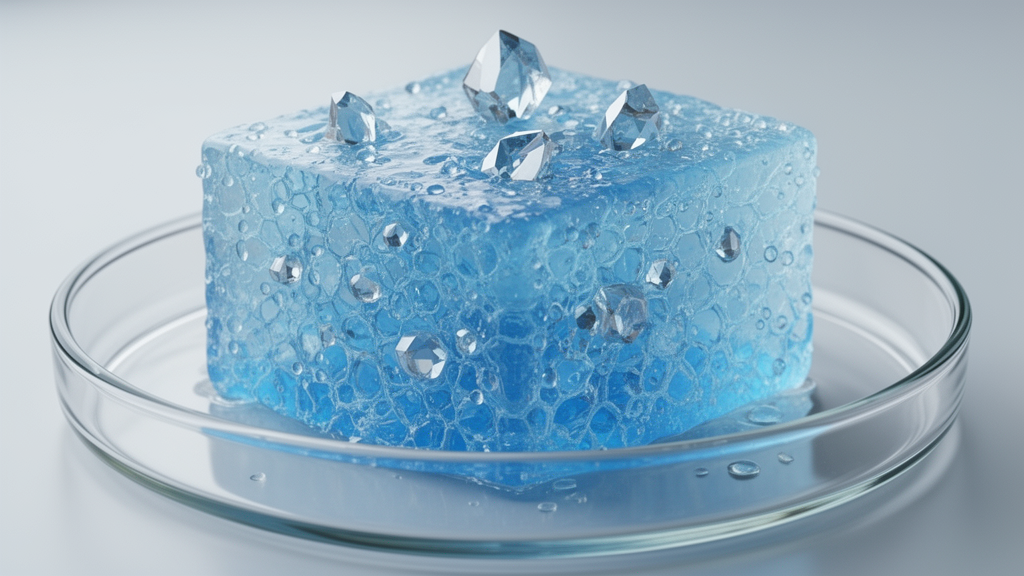
The breakthrough, published in Nature Synthesis by Aiping Zhang, Huiyi Zong, Ruihan Yuan and colleagues at the Sichuan Research Center of New Materials, Hubei University and Zhejiang University, hinges on an elegant trick borrowed from an unlikely corner of materials science: the humble hydrogel. Hydrogels — the soft, water-swollen polymer networks found in contact lenses, wound dressings and plant-based packaging — are essentially cages for water molecules. The researchers realized that if they trapped water inside a polyvinyl alcohol (PVA) hydrogen-bond network, they could fundamentally change how water behaves. Instead of acting as a free, aggressive solvent that attacks perovskite precursors, the water becomes a tamed, structured medium in which every molecule is anchored to the polymer backbone through hydrogen bonds. This confinement decouples two processes that normally collide in aqueous perovskite chemistry: precursor solvation and lattice formation.
Inside this hydrogel cage, the researchers dispersed lead iodide and organic iodide salts — the essential building blocks of the perovskite crystal. Spectroscopic analysis revealed something remarkable: within the polymer-water network, these precursors remained in a stabilized ionic state, prevented from aggregating into clumps and kinetically shielded from the water-induced decomposition that normally dooms aqueous perovskite synthesis. The polymer network simultaneously performed a second, equally critical role: it anchored the emerging crystal nuclei and imposed spatial confinement on their growth. Rather than allowing crystals to grow wildly in every direction, the hydrogel directed them into dense, ordered thick films. The team grew films up to 180 micrometers thick — substantial for X-ray detection, where thicker films absorb more radiation — and these films were remarkably free of the cracks and pinholes that typically plague thick perovskite layers.
The chemistry behind this confinement is subtle but powerful. When the perovskite crystal begins to form, the PVA polymer chains coordinate specifically with particular crystal facets — the flat faces of the growing lattice. This facet-specific coordination, confirmed through both spectroscopic measurements and computational simulations, suppresses the formation of surface defects that would otherwise trap charge carriers and degrade device performance. Equally important, the polymer matrix does not interfere with charge transport. The researchers measured charge carrier mobilities of approximately 10 square centimeters per volt-second in the hydrogel-grown films — a value comparable to high-quality perovskite crystals grown by conventional methods. This means electrons and holes generated by incoming X-rays can move efficiently through the material, preserving the signal quality that makes perovskites so attractive for detection.
The composition the team selected, a quasi-two-dimensional perovskite denoted BA₂MA₉Pb₁₀I₃₁, blends butylammonium (BA) spacer cations with methylammonium (MA) cations in a layered structure. Quasi-two-dimensional perovskites are prized in X-ray detection because their layered architecture suppresses ion migration — the slow drift of ions through the crystal under electric field, which generates dark current and noise. By incorporating bulky BA cations as interlayer spacers, the researchers created a material that resists this degradation mechanism while maintaining the strong X-ray absorption of the lead iodide framework. The hydrogel environment proved equally compatible with this complex multi-cation composition, directing the assembly of all components into the correct layered structure without the phase segregation that often plagues mixed-cation perovskites.
When the team integrated their hydrogel-grown thick films into pixelated X-ray imaging sensors, the performance exceeded expectations. The devices achieved a sensitivity-to-noise ratio of 25,000 microcoulombs per gray-centimeter squared per picoampere — a metric that captures how efficiently the detector converts X-ray dose into usable signal relative to its own internal noise. More striking still, the ultralow detection limit of 19.8 nanograys per second means the sensors can register X-ray signals at doses far below what is needed for medical imaging, opening possibilities for ultra-low-dose diagnostics that minimize radiation exposure to patients. In imaging tests, the pixelated sensors delivered high-fidelity images with negligible signal crosstalk between neighboring pixels — a critical requirement for sharp, artifact-free medical and security imagery.
The implications extend far beyond X-ray detectors. This hydrogel-confined strategy represents a fundamental rethinking of how perovskites can be synthesized. For years, the field has pursued green solvents — alternatives like acetonitrile, ethyl acetate and even solvent-free melt processing — to reduce the environmental footprint of perovskite manufacturing. But water has remained the ultimate prize, both because it is the greenest solvent imaginable and because water-based processing would simplify manufacturing lines, reduce costs and eliminate the need for expensive solvent recovery systems. Previous attempts at aqueous perovskite processing have been stymied by the fundamental incompatibility between water and perovskite chemistry. By taming water within a polymer cage, the researchers have opened a pathway that could eventually extend to solar cells, LEDs, photodetectors and other perovskite devices, transforming a laboratory curiosity into an industrially viable manufacturing route.
The hydrogel approach also offers a fresh perspective on crystallographic control — the ability to dictate precisely how crystals form, orient and grow. Traditional solution-based perovskite synthesis relies on coordinating solvents and additives to modulate supersaturation and crystal growth kinetics, but these additives often leave behind residues that degrade device performance. The hydrogel environment, by contrast, imposes confinement through physical structure rather than chemical additives, and the PVA polymer coordinates with the perovskite in a way that passivates defects rather than contaminating the lattice. This distinction — structural confinement versus chemical coordination — could inspire a new generation of synthesis strategies across materials chemistry, where soft polymer networks are used to direct the assembly of functional inorganic crystals with atomic-level precision.
There remain challenges to address before hydrogel-grown perovskites reach commercial production. The 180-micrometer films demonstrated here were grown on a laboratory scale, and scaling the hydrogel approach to the large areas needed for flat-panel X-ray detectors or solar modules will require engineering innovations in coating and drying. The long-term stability of the polymer-perovskite interface under continuous operation, thermal cycling and humidity exposure must be rigorously validated. And while PVA is non-toxic and water-soluble, the lead content of the perovskite itself remains an environmental concern that the field continues to grapple with through encapsulation and recycling strategies. Nevertheless, the demonstration that water — the solvent long considered incompatible with perovskite chemistry — can be harnessed as a reaction medium through simple polymer confinement marks a turning point. What was once the enemy of perovskite synthesis has become its ally, and the detectors born from this unlikely partnership are already showing the world what aqueous perovskite technology can achieve.
Subject of Research: Hydrogel-confined environment for aqueous-compatible perovskite crystallization
Article Title: Hydrogel-confined environment for aqueous-compatible perovskite crystallization
Article References: Zhang, A., Zong, H., Yuan, R., Lu, X., Wang, Z., Wu, C., Qian, J., Wang, K., & Zheng, X. (2026). Hydrogel-confined environment for aqueous-compatible perovskite crystallization. Nature Synthesis. https://doi.org/10.1038/s44160-026-01182-6
Image Credits: AI Generated
DOI: 10.1038/s44160-026-01182-6
Keywords: Hydrogel-confined, environment, aqueous-compatible, perovskite, crystallization, scientific research
News Source: Bethany Barker. (October 16, 2026). Hydrogel-confined environment for aqueous-compatible perovskite crystallization. Scienmag.