A coppery gleam in the forests of Japan has finally been given a name of its own. A new study revising the hoverfly genus Ferdinandea across the Palaearctic Realm describes Ferdinandea harusawai, a species new to science that had spent decades hiding in plain sight under a borrowed European name. The work, published in the journal Evolutionary Systematics, combines classical morphology with DNA barcoding to untangle a taxonomic knot that has confused entomologists on two continents for more than a century and a half.
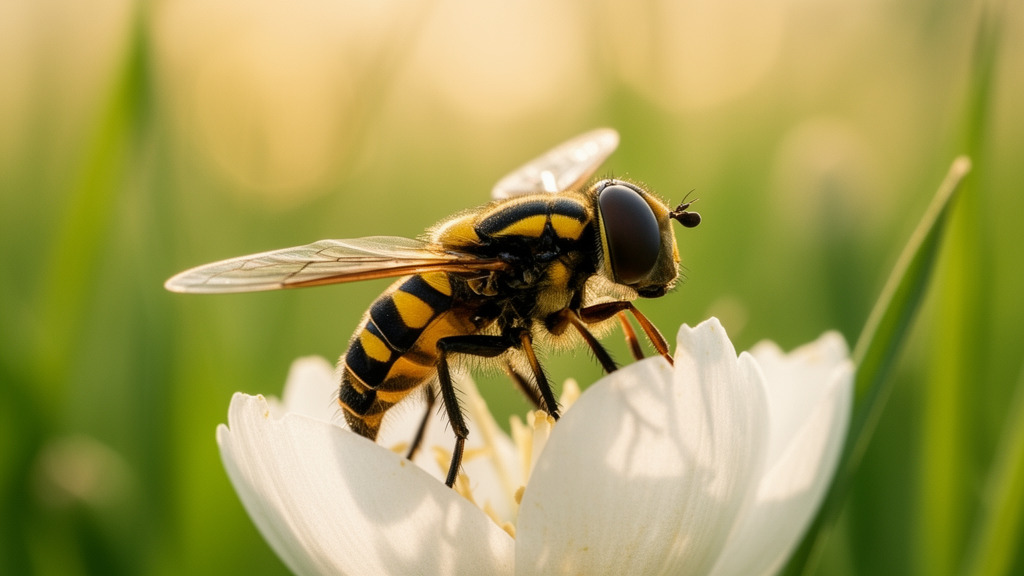
Ferdinandea is a genus of medium-sized hoverflies in the family Syrphidae, instantly recognizable to specialists by the strong black bristles on the thorax, the powdery pruinose stripes running along the scutum, dark markings on the wings, and a black abdomen that in some species shimmers with a metallic, copper-coloured iridescence. The adults patrol forest edges, particularly deciduous woods with over-mature trees, and are sometimes seen visiting orchids. Their larvae are saproxylic, living in sap runs on trees where they filter bacteria, making the genus a quiet but genuine component of forest nutrient cycling. Seventeen species were previously known worldwide, distributed across the Holarctic and Indomalayan Realms but absent from the Americas, Australasia and Africa.
The heart of the confusion lies with a name coined in Vienna. In 1861, the Austrian dipterist Johann Nepomuk Georg Egger described Chrysochlamys nigrifrons from material collected around his home city. For generations afterwards, hoverflies in the eastern Palaearctic bearing a dark abdomen and dark wing tips were labelled Ferdinandea nigrifrons, including specimens recorded from South Korea, northern China’s Gansu Province, Sichuan, and throughout Japan, where the name entered the literature as early as the work of Shiraki in 1968. Meanwhile, some European authors had already suspected that nigrifrons was nothing more than a dark variant of the widespread copper-backed species Ferdinandea cuprea, described all the way back by Scopoli in 1763, but nobody had ever formally checked Egger’s type specimens.
The research team did exactly that. Digging into the Naturhistorisches Museum Wien, they located specimens identified by Egger himself in his private collection, acquired by the museum after his death in 1866, along with additional material from the museum’s historic Old Collection. One male from Egger’s own collection was designated as the lectotype, a specimen that permanently anchors the meaning of the name nigrifrons for future taxonomists. The verdict was unambiguous: every Egger-identified specimen belonged to Ferdinandea cuprea. The name nigrifrons, which had cast a long shadow over Asian hoverfly taxonomy, was formally synonymized with cuprea, erasing a 150-year-old misidentification at its source.
That left the Asian insects formerly called nigrifrons without any valid name, and the Japanese material turned out to represent something genuinely undescribed. The new species, Ferdinandea harusawai, is distinguished from its closest relatives by a suite of concrete characters. Its wings show dark infuscation along the margin at the tips of cells r2+3 and r4+5, whereas the wings of its relatives are clear. The second abdominal tergum carries black hairs on its posterior half, where the similar Ferdinandea ruficornis usually bears only pale yellow pile, and the black hairs on the third tergum lie flat and recumbent rather than standing erect. The middle third of its scutum carries black pile exclusively, and the front protibia and first tarsal segment are black rather than yellow.
Male genitalia provided the decisive confirmation. In hoverflies, the shape of the distiphallus, the terminal structure of the male reproductive apparatus, is often species-specific, and in Ferdinandea it reliably separates every Palaearctic species. In the new species, the distal lobes of the distiphallus are longer than the basal lobes, forming an L-shaped profile in lateral view and converging into a V-shape when seen from below, a configuration distinct from the C-shaped, O-shaped and U-shaped architectures found in its congeners. Specimens were prepared by macerating dissected genitalia in potassium hydroxide solution, then drawing and photographing them under compound and focus-stacking setups to document every diagnostic detail.
DNA barcodes added a molecular dimension to the case. The team compiled mitochondrial cytochrome c oxidase subunit I sequences, the standard 658-base-pair animal barcode, for seven of the eight Palaearctic species, building a Neighbour-Joining tree with bootstrap support from a thousand replicates. All twelve barcodes of the new species clustered together with very high support at 99.8 percent, and the species grouped with Ferdinandea ruficornis in a well-supported larger cluster. Notably, ruficornis itself showed weak internal resolution at only 57.1 percent, hinting at a genetically diverse but morphologically coherent species spanning two continents. For some other pairs, such as Ferdinandea luteola and the resurrected Ferdinandea suzukii, barcodes clustered together without a clear barcoding gap, a reminder that DNA barcoding alone cannot always deliver species identifications and must be weighed alongside morphology.
The species name honours Keitaro Harusawa, a Japanese entomologist who died in 2024 and was a founding member of the Dipterist’s Club of Japan, the country’s only amateur research group devoted to flies, where he served for many years on the board. The holotype, a male collected in April 2024 on Mount Nantai-san in Ibaraki Prefecture at 654 metres elevation, is deposited at the Museum Koenig in Bonn, Germany, alongside dozens of paratypes spanning Hokkaido to Kyushu, including specimens caught in malaise traps in Nagano’s Sugadaira forests and individuals collected as far back as 1953 that had languished in museum drawers mislabelled as nigrifrons.
With the revision complete, the Palaearctic fauna now includes eight Ferdinandea species, and a striking biogeographic pattern emerges. Ferdinandea aurea, cuprea and fumipennis are confined to the western Palaearctic, while suzukii, luteola and the new harusawai are exclusive to the east. Only Ferdinandea ruficornis straddles both sides of the realm, showing a remarkable colour polymorphism: copper-bodied, yellow-pilose individuals in central and southern Europe versus shiny black, blue-tinged individuals with dark abdominal patches in northern Europe and eastern Asia. The authors argue these are one species, unified by their shared genital morphology despite their divergent appearance, a textbook example of why colour alone is a treacherous guide in fly taxonomy.
Large gaps remain on the map. Between the Ural Mountains and longitude 122 degrees east, only a handful of unidentified Ferdinandea records exist in public databases, and Ferdinandea volkovae, described from Tajikistan in 2022, is still known from a single male holotype for which no DNA barcode exists. The authors suspect that Chinese records of cuprea actually represent suzukii, based on barcode matches and published genitalia drawings, and they call for intensified fieldwork across the central Palaearctic to resolve which species truly live there. Their broader message resonates far beyond one genus: European type material and eastern Asian lookalikes bearing the same name deserve systematic re-examination, because, as this study demonstrates, a name applied faithfully for 150 years can conceal an entirely unknown species waiting in the drawers.
Subject of Research: Taxonomic revision of the Palaearctic hoverfly genus Ferdinandea, including DNA barcoding and the description of a new species from Japan
Article Title: The genus Ferdinandea Rondani, 1844 ( Diptera , Syrphidae ) in the Palaearctic Realm, with description of a new species from Japan
Article References: Mengual, X., & Ichige, K. (2026). The genus Ferdinandea Rondani, 1844 (Diptera, Syrphidae) in the Palaearctic Realm, with description of a new species from Japan. Evolutionary Systematics, 10(2), 383-402. https://doi.org/10.3897/evolsyst.10.210478
Image Credits: AI Generated
DOI: 10.3897/evolsyst.10.210478
Keywords: Ferdinandea, Syrphidae, hoverflies, taxonomy, new species, Japan, DNA barcoding, Palaearctic, lectotype, Ferdinandea cuprea, Ferdinandea harusawai, Evolutionary Systematics
News Source: Gavin Prescott. (October 16, 2026). Hidden Japanese Hoverfly Revealed as New Species After 150 Years of Mistaken Identity. Scienmag.