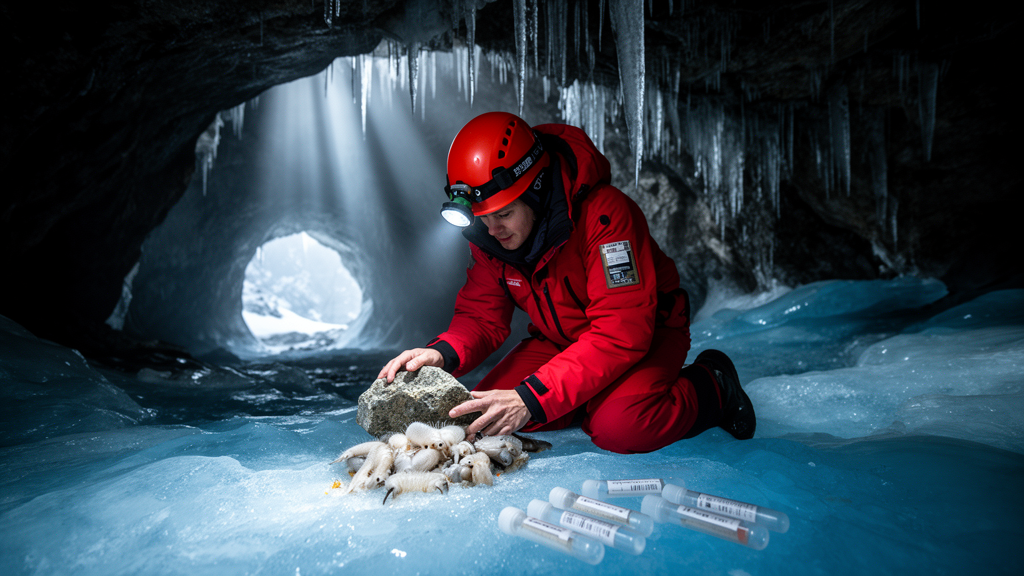
Deep beneath the forested slopes of the Bavarian Alps, two caves have told a surprising story about what biodiversity really means in the underworld. A new study published in the journal Subterranean Biology compared the invertebrate life of two karst caves separated by more than 100 kilometres and nearly 600 metres of altitude: the Angerlloch, a modest limestone cave at around 942 metres near Walchensee, and the Schrecksattel Ice Cave, a permanently cold cavity near Bad Reichenhall at roughly 1,545 metres. The outcome was striking. The low-altitude cave teemed with species, while the high-altitude ice cave hosted far fewer — but its residents were among the most specialised cave-dwellers ever recorded in the region.
The research team visited each cave twice, once in early July 2019 and again in early October 2019, deliberately capturing both summer and early winter conditions. They collected invertebrates directly with aspirators and vials, preserving specimens in 96 percent ethanol, and deployed pitfall traps filled with saline solution. Four traps were installed inside Angerlloch, two in its lower flooded section and two in the upper fossil gallery, while five traps were set in the 80-metre-long sloping corridor of the Schrecksattel Ice Cave’s old section. Bait consisting of cheese, sausage, moss and dead wood lured ground-dwelling arthropods into the traps, which were then left in place for three months and covered with stones to keep them hidden.
The results paint two very different ecological portraits. Angerlloch yielded a total of 32 identified species, including ten troglophilic species and 18 trogloxenous ones — animals that merely wander into caves without reproducing there. Not a single true troglobite, a species committed to a full subterranean life cycle, was found. Schrecksattel, by contrast, produced only 16 species, but among them were at least three troglobitic forms, alongside six troglophiles. In Angerlloch, trogloxenes accounted for 56.3 percent of the species and troglophiles for 31.3 percent. In the ice cave, trogloxenes dropped to just 18.8 percent, troglophiles rose to 43.8 percent, and troglobites made up 18.8 percent of the fauna.
Why would the richer cave be the poorer one in evolutionary terms? The answer, the researchers argue, lies in what surrounds each entrance. Angerlloch opens into a dense, species-rich mountain forest of beech and spruce, with a stream nearby and soil and leaf litter spilling into its wide, low entrance. This lush setting offers an enormous pool of surface invertebrates that can stumble, crawl or blow into the cave. Most of these accidental visitors are represented by one or a few individuals, a signature of opportunism rather than adaptation. The cave essentially functions as a biological waiting room for forest fauna rather than a cradle of subterranean specialists.
Schrecksattel presents the opposite scenario. Its entrance is narrow and elevated, limiting access for ground-dwelling species and flying insects, and the surrounding landscape is a harsh, nutrient-poor subalpine zone of mosses, lichens, grasses, dwarf shrubs and stunted trees. Sparse vegetation simply cannot sustain the large surface populations that feed accidental cave colonisation. The cave’s interior is colder still: on 10 October 2019, temperatures fell from about 2.3 degrees Celsius at the entrance to 0.2 degrees at the deepest point, compared with 5.5 to 8.8 degrees inside Angerlloch on the previous day. This combination of climatic severity, isolation and scarce resources appears to filter out generalists and favour specialists.
Among those specialists was the study’s headline discovery: the springtail Protaphorura septempapillata, a tiny soil-dwelling hexapod first described in 1986. Five specimens were recovered from a single trap in the ice cave, and they displayed pronounced troglomorphic features — elongated appendages, reduced empodia and a strongly developed terminal claw on each leg, a morphology the authors compare to the fearsome grasping claws of Troglaphorura gladiator, a troglomorphic springtail described from Crimea. Until now, P. septempapillata was known only from its type locality, the nearby Salzgrabenhöhle, so the Schrecksattel record represents only the second cave record of the species beyond where it was first found, meaningfully extending its known distribution.
Two other troglobitic residents underscore the ice cave’s specialist credentials. The cave-adapted springtail Pseudosinella vandeli, an alpine endemic, was found in great numbers, with more than 56 individuals collected in October alone alongside a single specimen in July. A mite of the family Rhagididae, likewise classified as troglobitic, appeared in the autumn samples. The remaining fauna included cold-tolerant flies of the family Trichoceridae, which dominated the trap catches, along with heleomyzid and sphaerocerid dipterans, and three species of moths that use caves as resting sites, including the herald moth Scoliopteryx libatrix and two species of Triphosa.
The study also highlights how individual life histories shape cave communities. The harvestman Amilenus aurantiacus, found in Angerlloch only in October, retreats underground to moult and hibernate during winter, explaining its summer absence. The cave spider Meta menardi spends most of its life inside caves, though juveniles disperse outdoors. The moth Triphosa dubitata uses caves year-round as resting sites and turned up in both caves, demonstrating that some troglophiles straddle the boundary between surface and subsurface life regardless of altitude. Such flexibility explains why troglophilic species appeared in both cavities despite their radically different conditions.
The broader ecological principle at work echoes findings from cave biology across Europe. Resource-rich caves connected to productive surface habitats tend to accumulate diverse communities dominated by troglophiles and trogloxenes, whereas isolated, resource-poor habitats are more likely to sustain troglobionts, which have no alternative but to persist underground. High endemism in subterranean fauna is linked to the isolation and fragmentation of karst systems, which restricts dispersal and promotes diversification. The Schrecksattel’s cold, isolated, high-altitude setting probably reduces gene flow with surface populations, allowing specialised lineages to endure where generalists cannot.
The findings also carry a deep-time message. Alpine karst systems, formed largely during the Oligocene and Miocene when the young Alps were lower, warmer and cloaked in subtropical forest, may have acted as refugia during past climatic fluctuations, permitting specialised subterranean lineages to survive in the Northern Calcareous Alps into the present. The presence of several troglobitic taxa in a single Bavarian ice cave supports that view. The authors caution, however, that a comparison of just two caves cannot settle whether the pattern — richness at low altitude, specialisation at high altitude — holds across the Alpine biogeographical region. Further surveys of additional alpine caves will be needed to determine whether altitude, isolation and resource scarcity are general architects of subterranean life, or whether each cave writes its own evolutionary story in darkness and stone.
Subject of Research: Comparative biodiversity of invertebrate cave fauna in a low- and a high-altitude cave in the Bavarian Alps
Article Title: Diversity versus endemism in cave fauna: A study of the invertebrate biodiversity in two low- and high-altitude caves in the Bavarian Alps (Germany)
Article References: Higl, U., Wanke, D., & Faille, A. (2026). Diversity versus endemism in cave fauna: A study of the invertebrate biodiversity in two low- and high-altitude caves in the Bavarian Alps (Germany). Subterranean Biology, 57, 209-220. https://doi.org/10.3897/subtbiol.57.207619
Image Credits: AI Generated
DOI: 10.3897/subtbiol.57.207619
Keywords: cave fauna, troglobites, troglophiles, trogloxenes, Bavarian Alps, karst, springtails, Collembola, ice cave, endemism, Subterranean Biology, Protaphorura septempapillata
News Source: Margaret Porter. (October 15, 2026). Fewer Species, Better Specialists: Alpine Ice Caves Reveal Hidden Trove of Cave-Adapted Fauna. Scienmag.