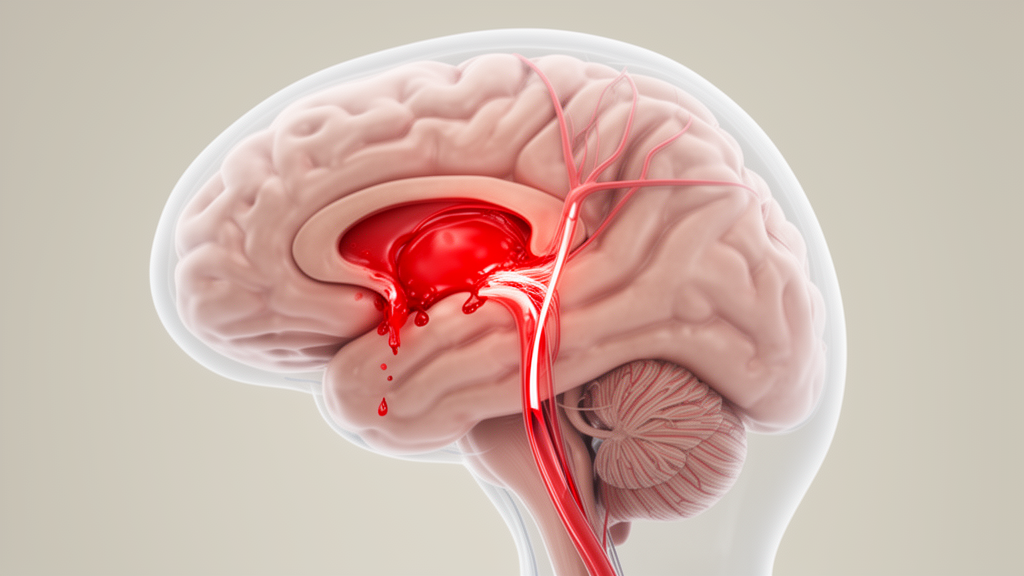
When a brain aneurysm ruptures, it unleashes a cascade of events that can devastate the brain in multiple ways. Blood floods the subarachnoid space, the fluid-filled compartments surrounding the brain, and in many patients it also invades the brain parenchyma itself, producing an intracerebral hemorrhage. Days later, a second threat emerges: cerebral vasospasm, a narrowing of the brain’s arteries that can choke off oxygen delivery and cause delayed cerebral ischemia. For decades, neuroscientists and clinicians have debated whether these two complications are directly linked or whether they simply coexist because they share a common origin. A new study published in Neurocritical Care by Babtain, Neves, Sandsmark, and Dhar now provides fresh evidence that intracerebral hemorrhage is strongly associated with vasospasm after aneurysmal rupture, adding weight to the idea that the two complications are more than coincidental neighbors.
The research team set out to answer a question that has long divided the neurocritical care community: does the presence of intracerebral hemorrhage in aneurysmal subarachnoid hemorrhage independently increase the risk of cerebral vasospasm, or does the apparent association merely reflect the fact that certain aneurysm locations are more likely to produce both complications? The distinction matters enormously for clinical practice. If intracerebral hemorrhage truly drives vasospasm, then patients with brain bleeds may need closer monitoring and more aggressive prophylactic strategies. If the association is instead an artifact of aneurysm location, then the location of the ruptured aneurysm itself may be the more important factor to consider when stratifying risk.
To investigate, the researchers analyzed a cohort of patients who had suffered aneurysmal subarachnoid hemorrhage, comparing those who developed intracerebral hemorrhage with those who did not. They then examined the incidence of cerebral vasospasm, both radiographic and symptomatic, across the two groups. The results revealed a striking pattern: patients with intracerebral hemorrhage were significantly more likely to develop vasospasm than those without brain bleeds. This finding held up even after adjusting for a range of potential confounders, suggesting that the relationship between intracerebral hemorrhage and vasospasm is not simply a byproduct of aneurysm location or clot thickness.
But the story is not quite that simple. The researchers also found that aneurysm location plays a meaningful role in shaping the risk of both complications. Aneurysms at certain sites, particularly those in the middle cerebral artery territory, are more likely to produce intracerebral hemorrhage because the blood can more easily penetrate the brain parenchyma. These same locations may also be associated with thicker subarachnoid clots, which are known to increase vasospasm risk. The team therefore conducted additional analyses to disentangle the effects of intracerebral hemorrhage from those of aneurysm location, and the results suggest that while location matters, intracerebral hemorrhage remains an independent predictor of vasospasm even after accounting for where the aneurysm ruptured.
The biological plausibility of this link is compelling. When blood invades the brain parenchyma, it releases a cocktail of vasoactive substances, including oxyhemoglobin, that can diffuse into the surrounding subarachnoid space and irritate the arterial walls. Oxyhemoglobin, in particular, has long been recognized as a key driver of vasospasm, and animal studies have shown that perivascular concentrations of this molecule rise sharply in the days following subarachnoid hemorrhage. Intracerebral hemorrhage may therefore amplify the vasospasm-inducing effects of subarachnoid blood by increasing the local concentration of these harmful substances near the arteries. Moreover, the presence of brain bleed may trigger neuroinflammatory responses that further exacerbate arterial narrowing, creating a vicious cycle of injury.
The clinical implications of these findings are significant. Patients with aneurysmal subarachnoid hemorrhage who also have intracerebral hemorrhage may represent a high-risk subgroup that warrants enhanced surveillance for vasospasm. This could involve more frequent transcranial Doppler monitoring, earlier initiation of prophylactic treatments such as nimodipine, and a lower threshold for advanced imaging studies to detect arterial narrowing. The results also underscore the importance of aneurysm location as a risk factor, reinforcing the need for clinicians to consider where the aneurysm ruptured when assessing the likelihood of vasospasm and planning follow-up care.
However, the study is not without limitations. As an observational analysis, it cannot definitively prove that intracerebral hemorrhage causes vasospasm; it can only demonstrate a statistical association. The researchers acknowledge that residual confounding may still play a role, and they call for further studies, including prospective trials and mechanistic investigations, to clarify the nature of the relationship. They also note that the findings may not generalize to all patient populations, and that variations in treatment protocols and institutional practices could influence the observed outcomes.
Despite these caveats, the study represents an important step forward in understanding the complex interplay between brain bleed and arterial narrowing after aneurysmal rupture. By demonstrating that intracerebral hemorrhage is an independent predictor of vasospasm, the researchers have provided evidence that the two complications are linked by more than just a shared aneurysm origin. This insight may help clinicians better stratify risk, tailor monitoring strategies, and ultimately improve outcomes for patients facing the devastating consequences of aneurysmal subarachnoid hemorrhage.
As the neurocritical care community continues to refine its approach to aneurysmal rupture, studies like this one highlight the value of asking fundamental questions about the relationships between seemingly distinct complications. The answer, it turns out, is neither a simple yes nor a simple no: intracerebral hemorrhage and vasospasm are indeed associated, but the nature of that association is shaped by the location of the ruptured aneurysm and the biological consequences of blood invading the brain. For patients and clinicians alike, this nuanced understanding may prove to be the key to unlocking better prevention and treatment strategies in the years ahead.
Subject of Research: Intracerebral Hemorrhage and Vasospasm After Aneurysmal Rupture: Association or Confounding by Aneurysm Location?
Article Title: Intracerebral Hemorrhage and Vasospasm After Aneurysmal Rupture: Association or Confounding by Aneurysm Location?
Article References: Qi, H. (2026). Intracerebral Hemorrhage and Vasospasm After Aneurysmal Rupture: Association or Confounding by Aneurysm Location?. Neurocritical Care. https://doi.org/10.1007/s12028-026-02685-y
Image Credits: AI Generated
DOI: 10.1007/s12028-026-02685-y
Keywords: aneurysmal subarachnoid hemorrhage, cerebral vasospasm, intracerebral hemorrhage, delayed cerebral ischemia, aneurysm location, stroke, neurocritical care, clot burden, Intracerebral, Hemorrhage, Vasospasm, Aneurysmal
News Source: Cassandra Pierce. (October 16, 2026). When a Brain Bleed and Vasospasm Collide: New Study Questions the Link. Scienmag.