Transplant medicine is quietly undergoing one of its most profound conceptual shifts in decades. Writing in Frontiers in Transplantation, a team of physicians from Geneva University Hospitals and Swisstransplant argues that abdominal normothermic regional perfusion, or A-NRP, should no longer be viewed as a mere technical step in organ retrieval but as a short, decisive phase of extracorporeal organ resuscitation. In their practice-oriented opinion piece, the authors, led by intensive care specialist Raphaël Giraud, contend that the procedure effectively applies the logic of extracorporeal life support to organs rather than to patients, and that this reframing demands a genuinely multidisciplinary model of care.
The context is a persistent and worsening shortage of transplantable organs. Controlled donation after circulatory death, known as cDCD, has become an essential strategy to expand the donor pool. It involves patients whose life-sustaining therapy is withdrawn in an intensive care setting, after which death is formally determined following circulatory arrest. The unavoidable problem is that organs retrieved this way inevitably undergo a period of warm ischemia before preservation. That warm ischemic interval exacerbates ischemia-reperfusion injury and can impair post-transplant outcomes compared with organs from donation after brain death, where circulation is maintained until procurement.
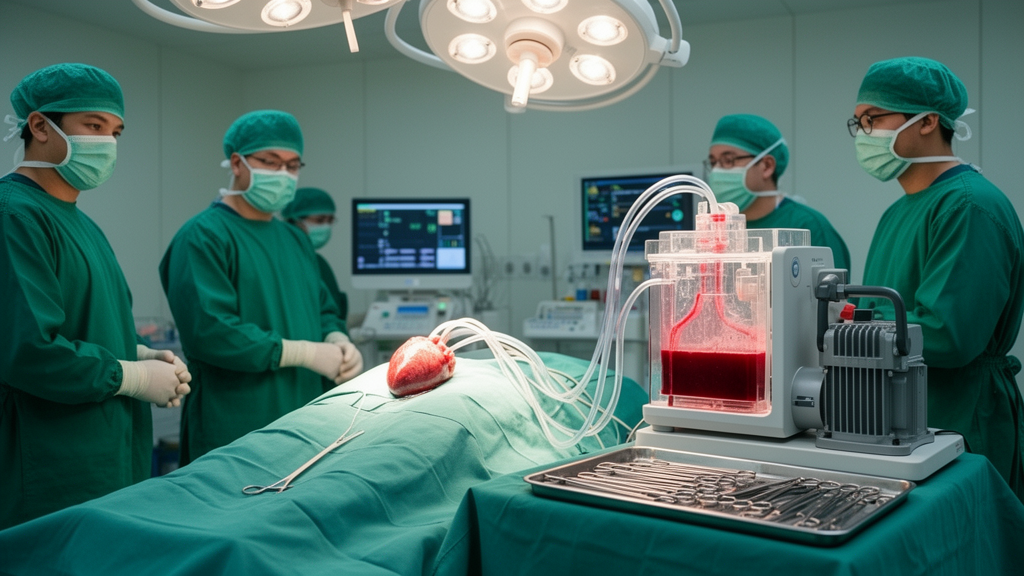
A-NRP attacks this problem at its physiological root. After withdrawal of life-sustaining therapy and formal determination of death in accordance with national requirements, femoral cannulation allows initiation of extracorporeal circulation, typically using a veno-arterial ECMO circuit. Mechanical occlusion of the thoracic aorta prevents thoracic and cerebral reperfusion, thereby restricting circulation strictly to the abdominal organs. Under these conditions, oxygenated blood is delivered at physiological temperature and pressure, allowing restoration of cellular metabolism and clearance of the ischemic metabolites that accumulated during the warm ischemic interval.
The authors emphasize that A-NRP should be conducted according to a predefined institutional protocol with explicit perfusion and safety targets. Although thresholds vary between centres, commonly reported objectives include blood-based normothermic perfusion at approximately 35 to 37 degrees Celsius, extracorporeal blood flow adapted to donor size, often in the range of 3 to 4 liters per minute, and an abdominal perfusion pressure or mean arterial pressure generally maintained around 50 to 70 mmHg. Crucially, the authors caution that both flow and pressure should be considered together to ensure effective tissue perfusion and oxygen delivery, a point they have argued forcefully in prior work. Gas exchange is adjusted to maintain adequate oxygenation and near-physiological carbon dioxide levels, while metabolic recovery is assessed through serial pH, lactate, potassium, transaminases, urine output, and hemodynamic trends. Systemic anticoagulation follows national legislation and local protocol, and effective aortic occlusion with exclusion of cerebral reperfusion must be verified throughout the procedure.
In many respects, the authors write, A-NRP can be understood as extracorporeal life support applied to organs rather than to patients. Much as ECMO is used in critical care to restore perfusion and reverse metabolic failure, A-NRP restores oxygenated circulation to ischemic organs after circulatory death. During this phase, perfusion pressure is re-established, optimized oxygen delivery is achieved, metabolic acidosis is corrected, and lactate accumulated during warm ischemia progressively clears. From this perspective, A-NRP should not be viewed simply as a technical adjunct to organ retrieval but as a short and decisive interval during which the physiological integrity of the graft is actively restored before procurement.
This interpretation is not merely semantic, and the clinical evidence behind it is substantial. Studies from Spain and the United Kingdom have shown improved organ utilization and better transplant outcomes when NRP is used for organ recovery. In liver transplantation, A-NRP has been associated with lower rates of ischemic-type biliary lesions and improved graft survival; in Spanish cohorts, it significantly reduced biliary complications and graft loss compared with rapid cold preservation. Kidney transplantation outcomes may also benefit, with reports showing reduced delayed graft function and satisfactory graft survival after NRP-assisted procurement. Taken together, these findings suggest that A-NRP not only increases organ availability but may also improve graft quality and recipient outcomes, provided it is implemented within an appropriate legal, ethical, technical, and organizational framework.
Yet the organizational model of A-NRP remains strikingly heterogeneous across Europe. Spain has incorporated cDCD and NRP into a nationally coordinated donation framework strongly supported by intensive care teams. France has developed ICU-integrated cDCD pathways in which donor management and extracorporeal support are closely linked to intensive care practice. By contrast, the United Kingdom has largely developed a retrieval-team-based model in which A-NRP is frequently initiated within an operating-theatre workflow. These differences are not merely logistical. They influence how A-NRP is framed within the donation pathway, either as an extension of donor management or as a component of organ procurement, and therefore shape both its ethical governance and its clinical leadership. The authors stress that these international experiences should not be interpreted as mutually exclusive or universally transferable models; rather, they illustrate how implementation is shaped by national legislation, ethical requirements, donor-management pathways, retrieval-team organization, and available institutional expertise.
Because A-NRP restores regional circulation after death determination, strict safeguards are required to preserve the integrity of the dead donor rule and prevent any possibility of cerebral reperfusion. In the authors’ view, the key ethical issue is not whether intensivists or transplant surgeons should lead the procedure, but whether a clear separation is maintained between professionals involved in pre-mortem end-of-life care and those involved in post-mortem organ resuscitation and procurement. Importantly, they argue, A-NRP has not created a new post-mortem role for intensivists. Intensive care expertise is already central to donor optimization after brain death, where post-mortem physiological support may continue for many hours, sometimes more than 24 hours, before procurement. A-NRP simply makes this role more concentrated, more visible, and more explicitly centered on extracorporeal organ resuscitation.
The procedure is also technically demanding, and its implementation should not be reduced to the availability of an extracorporeal circuit alone. Potential failure modes include difficult vascular access, inadequate venous drainage, insufficient abdominal perfusion, incomplete aortic occlusion, inadvertent thoracic or cerebral reperfusion, circuit-related complications, contamination, and delays that may prolong functional warm ischemia. These risks justify a protocolized approach with trained operators, standardized equipment, clear fallback strategies, strict aseptic technique, real-time documentation of key procedural time points, and continuous verification that cerebral reperfusion is excluded. In this sense, the authors conclude, safety in A-NRP depends less on any single professional group than on the reliability of the entire multidisciplinary pathway.
Ultimately, the Geneva team proposes that the most robust model is neither surgeons alone nor intensivists alone but a genuinely multidisciplinary framework. Intensivists contribute donor management, physiological interpretation, and ethical oversight; perfusionists ensure safe extracorporeal support and optimization of perfusion parameters; and transplant surgeons provide vascular and procurement expertise. The authors acknowledge that their piece is a practice-oriented opinion rather than a systematic review or comparative outcomes study, that available evidence remains largely observational, and that legal definitions of death, consent frameworks, and organizational models differ substantially between countries. Their model should therefore be understood as context-dependent and conditional on robust ethical safeguards, independent death determination, adequate expertise, transparent governance, and local feasibility. Even so, their central claim lands with force: A-NRP represents more than a technical innovation in controlled DCD. It marks the transition from passive organ preservation to active organ resuscitation before transplantation.
Subject of Research: Transplantation medicine and organ perfusion technology
Article Title: Abdominal normothermic regional perfusion in controlled DCD: toward a multidisciplinary model of organ resuscitation
Article References: Giraud, R., Assouline, B., Gasche, Y., Immer, F., Bendjelid, K., & Compagnon, P. (2026). Abdominal normothermic regional perfusion in controlled DCD: toward a multidisciplinary model of organ resuscitation. Frontiers in Transplantation, 5, Article 1930941. https://doi.org/10.3389/frtra.2026.1930941
Image Credits: AI Generated
DOI: 10.3389/frtra.2026.1930941
Keywords: abdominal normothermic regional perfusion, controlled donation after circulatory death, organ transplantation, ECMO, warm ischemia, organ resuscitation, liver transplantation, kidney transplantation, dead donor rule, intensive care, multidisciplinary model, geneva
News Source: Drew Townsend. (October 16, 2026). Resuscitating Organs After Death: How Abdominal Normothermic Regional Perfusion Is Rewriting Transplant Rules. Scienmag.