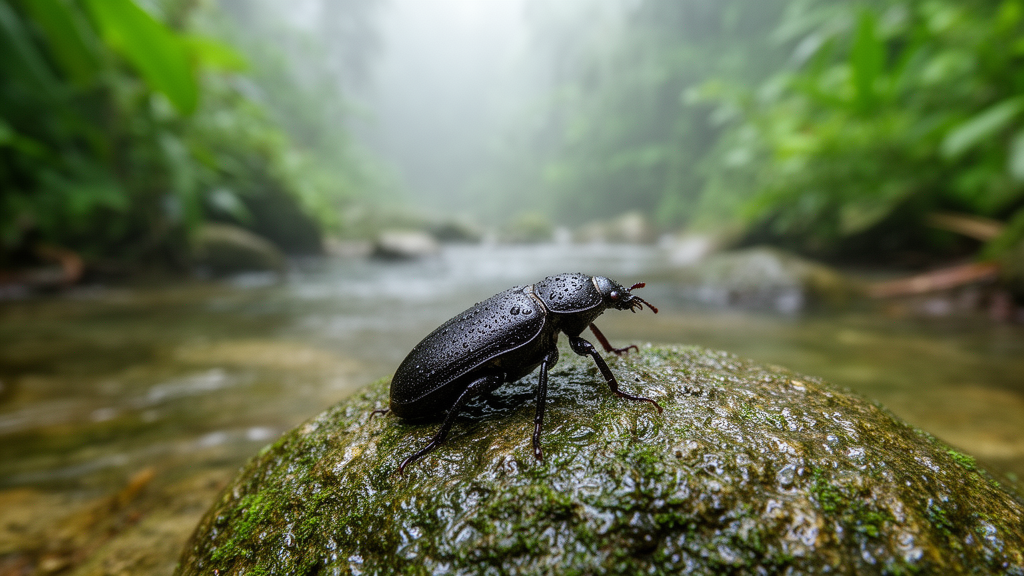
High on the forested slopes of Mount Pompangeo in Central Sulawesi, Indonesia, researchers wading through small, clear mountain streams have discovered a diving beetle that is entirely new to science. The species, now formally described as Rhantus procul in the journal Alpine Entomology, was collected at elevations of roughly 1,900 to 2,000 meters above sea level, in shallow forest streams shaded by dense montane rainforest. Measuring just over ten millimeters in length, the beetle belongs to the family Dytiscidae, the predatory water beetles whose streamlined bodies and powerful swimming legs make them formidable hunters of small aquatic animals.
The discovery is notable for more than the beetle’s novelty. Rhantus procul is only the second species of its genus ever recorded on Sulawesi, bringing the total number of Rhantus species known from Indonesia to nine. Most of those species live in the Papuan region of western New Guinea, with one additional species on Sumatra, which makes the presence of a distinct endemic lineage on Sulawesi a significant addition to the country’s aquatic beetle fauna.
What has truly surprised the researchers, however, is the identity of the new species’ closest relative. The male genital structure of Rhantus procul, specifically the median lobe of the aedeagus, is strikingly similar to that of Rhantus interclusus, a species endemic to the highlands of Sri Lanka. No other known Rhantus species anywhere in the world shares this flattened median lobe shape; all other members of the genus and related genera possess a fundamentally tubular form, which scientists consider the ancestral condition. The two islands are separated by more than 4,000 kilometers of ocean and land, and the researchers state they are not aware of any other apparent sister-species relationship between animals from Sulawesi and Sri Lanka.
Despite the deep similarity in genital morphology, the two beetles are clearly separate species. Rhantus procul can be distinguished from its Sri Lankan relative by body size, by the coloration of the pronotum, the plate-like structure covering the front of the thorax, and by a slightly different curvature of the median lobe. Rhantus interclusus is somewhat larger and broader than the new Sulawesi species. In the new beetle, the pronotum is yellow-orange with a black basal and discal patch, while the head is black with contrasting orange marks and the wing cases, or elytra, are orange with black speckling. Females of the two species can also be told apart by size and dorsal coloration.
The new species was described from a small series of specimens collected by hand with aquarium nets during a 2020 expedition to the mountain ranges of Central Sulawesi. The holotype, a male, and several paratypes were deposited in the Museum Zoologicum Bogoriense in Bogor, Indonesia, with additional material held at the Zoologische Staatsammlung München in Germany. The researchers examined the beetles under a Leica M205C stereomicroscope at magnifications from 10 to 160 times, disarticulated the male genitalia and dry-mounted them alongside the specimens, and produced high-resolution image stacks using a Canon EOS R camera with macro lenses and a Stackmaster macro rail, assembled with Helicon Focus software.
Morphologically, the holotype measures 10.3 millimeters in total length with a greatest width of 5.2 millimeters, and body length across specimens ranges from 10.2 to 10.8 millimeters. The elytra carry three longitudinal rows of deeper punctures set within irregular polygonal meshes, with fine punctation and faint microreticulation. The pronotum bears a broad lateral bead that does not reach the anterior angle, and the hind wings are fully developed, indicating the beetles can fly. The male protarsal claws are slender, evenly curved, and nearly equal in length, without the modifications seen in some relatives. The only other Rhantus on Sulawesi, the widespread Rhantus suturalis, differs markedly: its median lobe is tubular rather than flattened, and its male front claws are short and asymmetrically curved.
The habitat where the new species lives adds another layer of concern to the discovery. The beetles were found in small, shallow forest streams with sandy and gravelly substrates and clear water, shaded by montane rainforest rich in ferns, mosses, and epiphytic plants, which creates the cool and humid microclimate typical of high-elevation tropical forest. Rhantus species generally avoid the wet tropical lowlands; the vast majority of tropical species in the genus occur at higher, cooler elevations. Worldwide, 93 species of Rhantus have been described, and most live in shallow standing waters with abundant emergent vegetation, though a few inhabit streams and smaller creeks like those on Mount Pompangeo.
The survival of such a specialized mountain species is far from guaranteed. The montane forest of Mount Pompangeo, which rises to 2,590 meters, was heavily logged from around the 1970s until the 2000s, after which large-scale logging ceased. Local villagers now mainly harvest pine resin from Agathis dammara trees, and at higher elevations near the summit, forest patches are occasionally affected by fire. Crucially, the terrain of the area is completely devoid of high plateaus and larger swamps, making the discovery of an apparently highly endemic diving beetle there all the more remarkable. The patchy rainforest that remains appears to function as a refuge for endemic species, underscoring the importance of protecting this vulnerable habitat.
The biogeographic puzzle posed by the new species is considerable. A sister-species relationship spanning the distance between Sulawesi and Sri Lanka suggests a complex history of dispersal, extinction, and ancient biotic connections across the region, and the researchers note that the finding sheds light on the complex biogeographic history of Indonesia and the remarkable biodiversity of Sulawesi. The specific epithet procul, a Latin adverb meaning far away or from afar, was chosen precisely to reflect the vast geographical distance between the type locality on Mount Pompangeo and the Sri Lankan home of its closest morphological relative.
Research into the aquatic insects of Sulawesi’s highlands is still in its early stages, and the authors consider it likely that more undescribed species of diving beetle await discovery on the island. Future surveys of other remote, high-altitude areas of Sulawesi, they argue, remain crucial for understanding the island’s aquatic beetle fauna. For now, Rhantus procul stands as a vivid reminder that even well-studied insect groups can still yield surprises in the world’s remaining mountain rainforests, and that a beetle small enough to rest on a fingertip can carry a biogeographic story spanning thousands of kilometers of ocean.
Subject of Research: Description of a new endemic diving beetle species, Rhantus procul, from Central Sulawesi and its surprising sister-species relationship with a Sri Lankan endemic
Article Title: Rhantus procul sp. nov., a new diving beetle from Central Sulawesi – sister to a species from Sri Lanka ( Coleoptera , Dytiscidae , Colymbetinae )
Article References: Narakusumo, R. P., Fahri, F., Hendrich, L., & Balke, M. (2026). Rhantus procul sp. nov., a new diving beetle from Central Sulawesi – sister to a species from Sri Lanka (Coleoptera, Dytiscidae, Colymbetinae). Alpine Entomology, 10, 19-24. https://doi.org/10.3897/alpento.10.173478
Image Credits: AI Generated
DOI: 10.3897/alpento.10.173478
Keywords: diving beetle, Rhantus procul, Sulawesi, Sri Lanka, new species, Dytiscidae, biogeography, mountain streams, Indonesia, taxonomy, endemic species, Alpine Entomology
News Source: Gavin Prescott. (October 16, 2026). New Diving Beetle Species Found in Sulawesi Mountains Has a Surprising Sister 4,000 Kilometers Away in Sri Lanka. Scienmag.