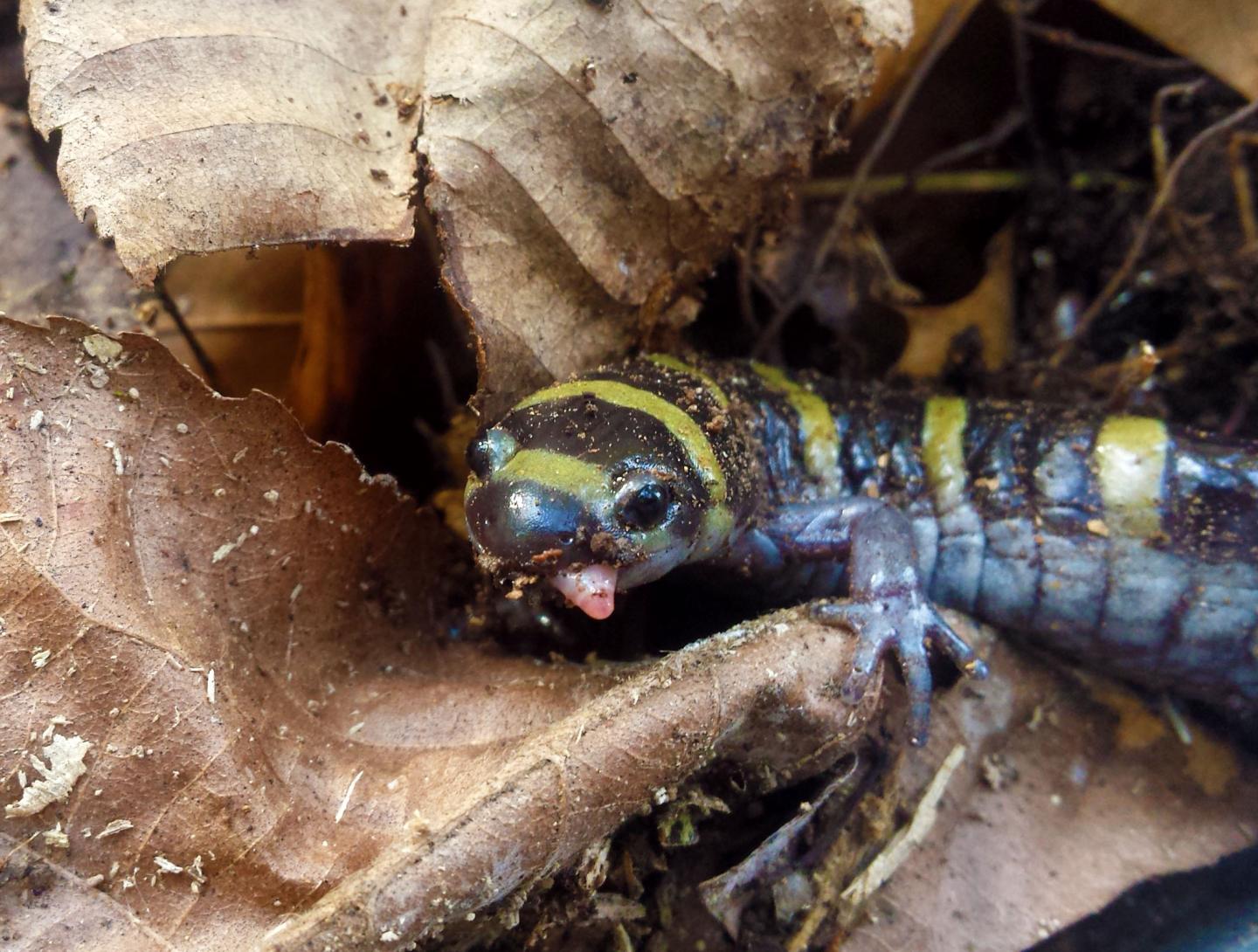

Credit: MU Division of Biological Sciences
With changing environments, pond-breeding salamanders face increasingly hazardous treks as the space between breeding ponds and their non-breeding habitat widens or is degraded. A study from the University of Missouri suggests that a salamander's success may depend more on when it breeds than on the landscape obstacles it might face. Scientists believe that knowing the patterns in which salamanders move back and forth could lead to better forest management and conservation strategies.
"Salamanders serve as vital links in forest food chains, and their population size and recovery from major disturbances can help predict the health of forest ecosystems," said Jacob Burkhart, a graduate student in the Division of Biological Sciences and lead author of the study. "It's crucial that we have a better understanding of how salamanders move, or disperse, across their landscape as well as what factors encourage or discourage their movement in order to make sound decisions about managing their populations and the forests where they live."
Burkhart and his colleagues, including Lori Eggert, an associate professor in the Division of Biological Sciences in the MU College of Arts and Science, used DNA extracted from tissue samples to estimate the movement patterns of salamanders. DNA allows the researchers to assess genetic relationships and gene flow between populations and individuals and paired those data with geographical measurements to observe how salamanders moved across the landscape.
The researchers studied four species of pond-breeding salamanders at Fort Leonard Wood, Mo.; two species breed in the spring and two in the fall. They also measured features of the landscape, including distance between ponds, the amount of tree cover, distance from ravines, and soil wetness.
DNA analysis showed that salamanders that breed in the fall move to new ponds less often than salamanders that breed in the spring. Distance between ponds and various landscape features could not fully explain the observed genetic differences.
"Even though some habitat features seemed to affect dispersal, we found that, for all four species, breeding season was a better predictor than habitat of the observed genetic differences," said Burkhart. "Practically, what this says is that landscape variables are not quite as important as the timing of the breeding season."
For those concerned with managing salamander populations as a means of managing forests, Burkhart said the study serves as a reminder that not all salamander species are alike.
"When using a particular species as a way of managing forests, conservationists should be aware of traits specific to those species, including their breeding seasons." Burkhart said. "When writing a conservation plan or when attempting to apply results from one species to related species, you need to consider the ecology of your target species, including its life history traits, in addition to its interactions with the landscape."
###
The article, titled "The influence of breeding phenology on the genetic structure of four pond-breeding salamanders," appears in the July issue of the journal Ecology and Evolution. Coauthors of the study include Ray Semlitsch, William Peterman, Emily Brocato, Kim Romine, Brittany Ousterhout, Thomas Anderson, Freya Rowland, Madeline Willis, and Dana Drake. The research was funded by the Department of Defense (Grant Number: RC2155). The content is solely the responsibility of the authors and does not necessarily represent the official views of the funding agencies.
Editor's Note: For more on the story, please see:
Media Contact
Jeff Sossamon
[email protected]
573-882-3346
@mizzounews
http://www.missouri.edu
Original Source
http://munews.missouri.edu/news-releases/2017/0809-understanding-salamander-breeding-patterns-may-lead-to-better-forest-management-conservation-strategies/