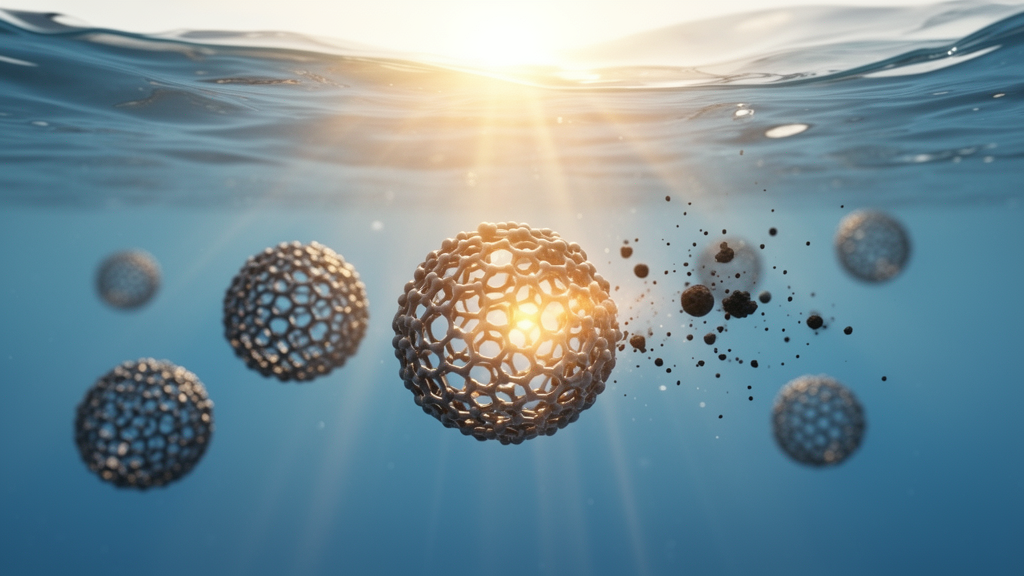
The distinction between heating water and changing its thermodynamic state lies at the heart of why this approach differs from earlier generations of solar evaporators. In conventional designs, most of the absorbed solar energy is spent overcoming the full enthalpy of vaporization of liquid water, roughly 2,400 kilojoules per kilogram at ambient temperature. When water is confined within mesoporous channels only a few nanometers across, however, the curved liquid–vapor interfaces and the proximity of pore walls disrupt the extended hydrogen-bond network that defines bulk water. Molecules in this confined environment sit in what researchers describe as intermediate states—partially ordered, energetically elevated configurations that require less energy to escape into vapor. The practical consequence is that a greater share of each photon’s energy goes directly into driving molecules across the phase boundary rather than into raising the temperature of a large thermal mass.
The plasmonic gold nanoparticles embedded along the inner walls of the carbon nanocages add a second, kinetic dimension to this picture. When illuminated, these nanoparticles support localized surface plasmon resonance, a collective oscillation of conduction electrons that concentrates electromagnetic energy into nanoscale hot zones. The resulting temperature gradients across the nanocage interior generate localized pressure differences, and it is these perturbations that drive water molecules directionally toward the evaporation front. In effect, the material functions as an array of microscopic pumps, each one converting light into both heat and a local mechanical driving force. The authors quantify this acceleration through an evaporation coefficient derived from the Hertz–Knudsen–Schrage framework, a classical treatment of molecular transport across liquid–vapor interfaces that is rarely invoked in interfacial evaporation studies, suggesting a unusually rigorous kinetic analysis behind the reported rates.
The reported evaporation figures merit comparison with the broader field. Under one sun of illumination—defined as 1 kilowatt per square meter, approximately the intensity of midday sunlight—a typical well-designed carbon-based evaporator produces between 1.3 and 2.0 kilograms of water per square meter per hour in planar form. The 2.56 kilograms per square meter per hour achieved by the two-dimensional FCC@Au device therefore represents a substantial advance, and the 6.84 kilograms per square meter per hour of the three-dimensional configuration exceeds what flat geometries can physically achieve. This is because three-dimensional architectures, such as the hydrophilic polyurethane foam support used here, present evaporation surfaces that exceed their projected footprint, decoupling water production from the area of incident light. The open porous network of the foam also serves as a wicking reservoir, continuously replenishing water at the evaporation interface without requiring external pumping.
The catalytic half of the system addresses a persistent weakness of solar evaporation as a purification strategy. Distillation and evaporation concentrate rather than destroy many organic contaminants; volatile compounds can carry over into the condensate, and non-volatile organics may foul the evaporator surface over time. By embedding atomically dispersed Fe–N₄ sites—iron atoms each coordinated by four nitrogen atoms within the carbon lattice—directly into the photothermal structure, the researchers enable a chemical degradation pathway that operates concurrently with evaporation. These single-atom sites activate peroxymonosulfate, an oxidant widely used in advanced oxidation processes, through a non-radical electron-transfer mechanism. Unlike radical-based pathways, which generate short-lived hydroxyl or sulfate radicals that can be quenched by background ions and natural organic matter, non-radical electron transfer involves direct oxidation of pollutant molecules at or near the catalyst surface. This confers greater selectivity toward electron-rich organic contaminants such as bisphenol A and greater tolerance to the complex ionic matrices characteristic of seawater and industrial effluents, which the study confirms through performance testing in the presence of different ions.
The reported mass-normalized degradation rate constant of 182.5 liters per gram per minute is notable because it normalizes catalytic performance to the amount of catalyst used, allowing fair comparison across systems with different loadings. Achieving this figure with sites that are simultaneously part of a working photothermal evaporator—rather than in a standalone catalytic reactor—underscores the degree of functional integration. The mechanistic evidence supporting the non-radical pathway came from complementary techniques: in situ Raman spectroscopy tracked changes in the surface-bound oxidant species during operation, electron paramagnetic resonance confirmed the absence of dominant free-radical signals, and electrochemical experiments demonstrated the electron-transfer process between the catalyst, the oxidant, and the pollutant.
From a materials synthesis standpoint, the combination of hollow mesoporous carbon nanocages with both embedded plasmonic nanoparticles and atomically dispersed metal sites is synthetically demanding. Hollow mesoporous structures require templating strategies that create internal voids connected through controlled pore windows, while maintaining the mesoporous channels through which water enters. Anchoring single iron atoms demands careful control of nitrogen coordination to prevent aggregation into nanoparticles, which would reduce the density of accessible active sites. Positioning gold nanoparticles specifically along the inner walls, rather than the outer surface, ensures that plasmonic heating acts on the confined water volume where it matters most. That all three features coexist in one nanoscale architecture is what allows evaporation and catalysis to proceed without the trade-offs that arise when catalysts are simply grafted onto porous evaporator substrates as separate functional layers.
The broader significance of this work lies in its reframing of the performance plateau that solar interfacial evaporation has reached. After a decade of intense development focused on solar-thermal materials—graphene oxides, carbonized polymers, plasmonic metals, and their composites—evaporation rates have clustered near theoretical limits set by the enthalpy of vaporization and the available interfacial area. Progress now depends on manipulating the water itself: reducing the energy each molecule needs to escape, and increasing the rate at which molecules arrive at the interface. The nanoconfinement and physical-field strategy reported here attacks both variables simultaneously, and the coupling of water-state regulation with catalytic oxidation suggests that future evaporators may be designed as integrated chemical reactors rather than simple distillation surfaces.
Practical deployment will depend on questions the current study does not fully resolve, including long-term stability of the Fe–N₄ sites under continuous illumination and oxidant exposure, the scalability of nanocage synthesis to the square-meter areas relevant for real devices, and the fate of degraded pollutant byproducts within the evaporation system. Nevertheless, the demonstration that a single multifunctional material can purify water through two independent mechanisms—phase change and chemical oxidation—offers a compelling template for next-generation solar water treatment, particularly for contaminated sources where evaporation alone is insufficient. As freshwater scarcity intensifies and wastewater streams grow more chemically complex, strategies that merge thermodynamic, kinetic, and catalytic functions within one photothermal architecture are likely to attract increasing attention across the materials chemistry and water-treatment communities.
Subject of Research: Evaporating water while removing pollutants: nanoconfinement and physical-field regulation enable efficient solar-driven water purification
Article Title: Evaporating water while removing pollutants: nanoconfinement and physical-field regulation enable efficient solar-driven water purification
Article References: Evaporating water while removing pollutants: nanoconfinement and physical-field regulation enable efficient solar-driven water purification. (n.d.). Original publication
Image Credits: AI Generated
DOI: Not provided
Keywords: Evaporating, water, while, removing, pollutants, nanoconfinement, physical-field, regulation, enable, efficient, solar-driven, purification
News Source: Bethany Barker. (October 16, 2026). Nanoconfined Carbon Cages Purify Water With Sunlight While Destroying Pollutants. Scienmag.