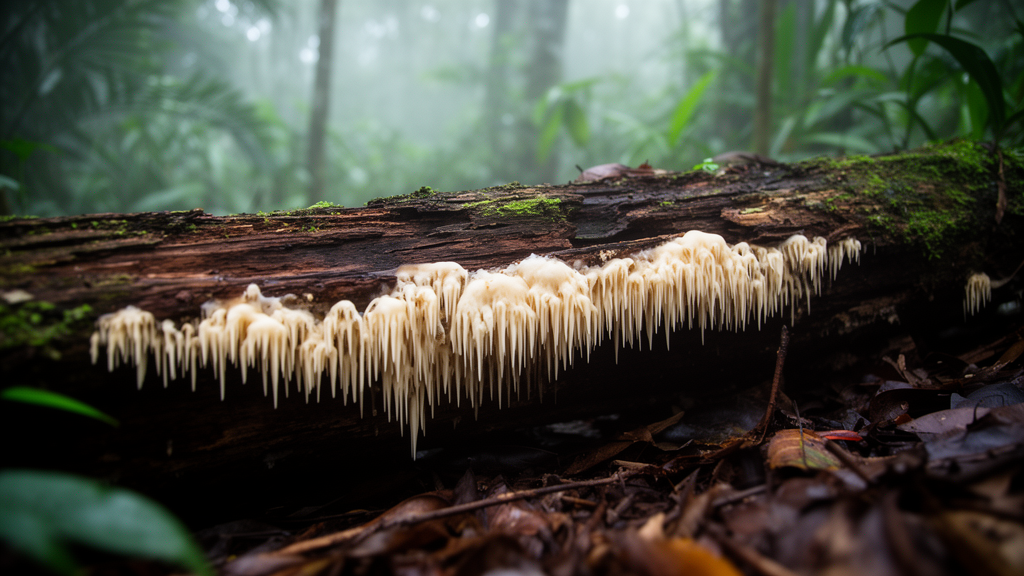
Deep in the mossy understory of Guangdong Province’s subtropical forests, mycologists have uncovered three species of stipitate hydnoid fungi that are entirely new to science. The discovery, published in the journal MycoKeys, brings the global count of the genus Neosarcodon to 16 species and dramatically reshapes what scientists thought they knew about where these fungi live. For decades, Neosarcodon was considered a predominantly Neotropical genus, with most of its known species confined to the tropical Americas. The new findings suggest that southern China may represent an overlooked diversity centre for the group, with implications for understanding the evolutionary and biogeographic history of these ectomycorrhizal fungi.
The three new species, named Neosarcodon chebalingensis, Neosarcodon nanlingensis and Neosarcodon velutinus, were identified through a combination of careful morphological examination and multigene phylogenetic analyses. The research team, led by Ming Zhang, Xinyue Yang and Caiqiong Wang, collected specimens during a survey of macrofungal diversity in Guangdong Province. Fresh samples were photographed in the field, dried at approximately 40 degrees Celsius and deposited in the Fungarium of the Institute of Microbiology at the Guangdong Academy of Sciences in Guangzhou. Colour descriptions followed standard reference charts, and microscopic observations were performed on dried tissue sections rehydrated in potassium hydroxide and stained with Congo red or Melzer’s reagent under magnifications ranging from 100 to 1000 times.
Neosarcodon chebalingensis, whose name honours the Chebaling National Nature Reserve where the holotype was collected at roughly 380 metres elevation in June 2020, is characterised by orange-grey to brownish-grey basidiomata with a glabrous to subtomentose pileus. Its spines, which are adnate, soft, conical and dense, change to bluish-black when bruised, a striking reaction that helps distinguish it from close relatives. The basidiospores are subglobose, measuring 7.5 to 10.5 by 7 to 9.5 micrometres, with tuberculate projections and slightly thickened walls. The context is orange-grey, changing to bluish-grey when exposed, and the taste is distinctly bitter with an unpleasant odour when dried. The species was found growing solitary or scattered on the moss layer under broad-leaved forests dominated by bamboos and Fagaceae trees.
Neosarcodon nanlingensis, named for the Nanling National Nature Reserve where it was collected at approximately 1370 metres elevation, presents a different appearance altogether. Its basidiomata are grey to greyish-brown with a glabrous pileus, and its dark-blond to oak-brown spines change to dark-grey when bruised. The basidiospores are subglobose, measuring 8 to 10 by 7.5 to 9.5 micrometres, slightly larger than those of N. chebalingensis. The stipe is broadly fistulose, meaning it has a hollow centre, and the context changes to dark-grey when exposed. This species was found under mixed forests dominated by bamboos with fewer Fagaceae trees, suggesting a possible ecological association with gramineous plants rather than the broad-leaved trees that most known Neosarcodon species partner with.
Neosarcodon velutinus, whose Latin epithet refers to its velvety pileus surface, is perhaps the most visually distinctive of the three. Its basidiomata are violet-grey to dark-violet with a velutinous surface, and its golden-grey to brownish-grey spines change to dull-violet to greyish-violet when bruised. The basidiospores are subglobose to broadly ellipsoid, measuring 6.5 to 8.5 by 5.5 to 8 micrometres, with tuberculate or spinose projections. The context changes to dull-violet to greyish-violet when exposed, and the stipe is solid with a swollen base. The holotype was collected in Chebaling National Nature Reserve at approximately 700 metres elevation in June 2025, with additional specimens from the same location at lower elevations. All three species are currently known only from Guangdong Province.
To confirm that these specimens represent genuinely new species rather than variations of known ones, the researchers generated 30 new DNA sequences, comprising 11 from the internal transcribed spacer regions (nrITS), 10 from the large subunit of nuclear ribosomal RNA gene (nrLSU) and 9 from the second largest subunit of RNA polymerase II (rpb2). These were combined with 119 sequences downloaded from GenBank to build a concatenated dataset of 2954 nucleotide sites. Phylogenetic analyses were conducted using both Maximum Likelihood and Bayesian Inference methods, with Amaurodon aquicoeruleus selected as the outgroup. The resulting trees showed Neosarcodon as a strongly supported monophyletic clade, with the new specimens forming five distinct monophyletic lineages within the genus. Three of these lineages correspond to the new species described here, while the other two cluster with previously known Chinese species N. melanocarpus and N. atroviolaceus.
The phylogenetic results carry significant biogeographic weight. The Asian species, including the three new ones, are nested within clades composed of Neotropical Neosarcodon species, implying that the genus may have a broader historical distribution or a more complex biogeographic history than previously assumed. This pattern could reflect historical dispersal, shared ancestry, ancient divergence or long-distance dispersal events, though the researchers caution that these hypotheses require further evaluation through expanded taxon sampling, molecular dating and formal biogeographic analyses. Before the formal establishment and circumscription of Neosarcodon in 2024, no species of the genus had been recorded from China, a knowledge gap the authors attribute to limited sampling, subtle diagnostic characteristics and a lack of molecular phylogenetic studies in the relevant regions.
Ecologically, the findings raise intriguing questions about the trophic strategies of Neosarcodon. Most known species are ectomycorrhizal fungi that form symbiotic relationships with trees in families such as Caesalpinioideae, Dipterocarpaceae, Fagaceae and Papilionoideae. However, two of the new species, N. nanlingensis and N. velutinus, along with the recently published N. atroviolaceus and N. bambusicola, were all found in bamboo forests. This leads the researchers to ponder whether there is a symbiotic relationship between Neosarcodon and bamboos, and whether the life style of this genus has undergone a transformation from forming ectomycorrhizal symbiosis with broad-leaved trees to forming symbiosis with gramineous bamboos. Meanwhile, N. carbonarius, originally reported from New Zealand, has been hypothesised to be non-ectomycorrhizal, leaving its trophic status uncertain and requiring further investigation.
The genus Neosarcodon was recently established to accommodate what had been known as the Neosarcodon clade within the broader genus Sarcodon. Species of Neosarcodon are mainly characterised by stipitate basidiomata, broadly conic to plano-convex or nearly applanate pilei, adnate to nearly free spines that are white or pallid at first and become brownish-grey or blackish with age, bitter-tasting context, subglobose brownish tuberculate basidiospores, thin-walled hyphae with abundant clamp connections and the absence of hymenial cystidia. The genus belongs to the newly-established family Sarcodonaceae within the order Thelephorales, a classification confirmed through a systematic revision published in 2025. Neosarcodon differs from Sarcodon primarily by having an adnate hymenophore, an indistinct odour and the absence of hymenial cystidia.
Together with the three previously known Chinese species, the three new species described in this study are all distributed in subtropical southern China, indicating that the occurrence of Neosarcodon in the region may have been substantially underestimated. The researchers suggest that subtropical regions of southern China may represent an important species diversity centre of the genus, though this hypothesis requires further validation through more extensive geographic sampling and more comprehensive phylogenetic analyses. To aid future identification efforts, the study also provides a dichotomous key to the Chinese Neosarcodon species, distinguishing them by pileus colour, surface texture, basidiospore dimensions and stipe features. As field surveys continue across the biodiverse subtropical forests of East Asia, it seems likely that more hidden members of this once predominantly Neotropical lineage will come to light.
Subject of Research: Taxonomy and phylogeny of three new Neosarcodon tooth fungus species from subtropical China
Article Title: Morphological and phylogenetic analyses reveal three new species of Neosarcodon ( Thelephorales , Basidiomycota ) from China
Article References: Yang, X.-Y., Deng, L.-Q., Zhang, Y.-M., Deng, W.-Q., Yue, H.-M., Wang, C.-Q., & Zhang, M. (2026). Morphological and phylogenetic analyses reveal three new species of Neosarcodon (Thelephorales, Basidiomycota) from China. MycoKeys, 141, 111-126. https://doi.org/10.3897/mycokeys.141.202277
Image Credits: AI Generated
DOI: 10.3897/mycokeys.141.202277
Keywords: Neosarcodon, Thelephorales, Basidiomycota, new species, China, Guangdong, phylogenetics, ectomycorrhizal fungi, taxonomy, subtropical forests, hydnoid fungi, MycoKeys
News Source: Roger Howard. (October 16, 2026). Three New Tooth Fungi Species Discovered in China’s Subtropical Forests. Scienmag.