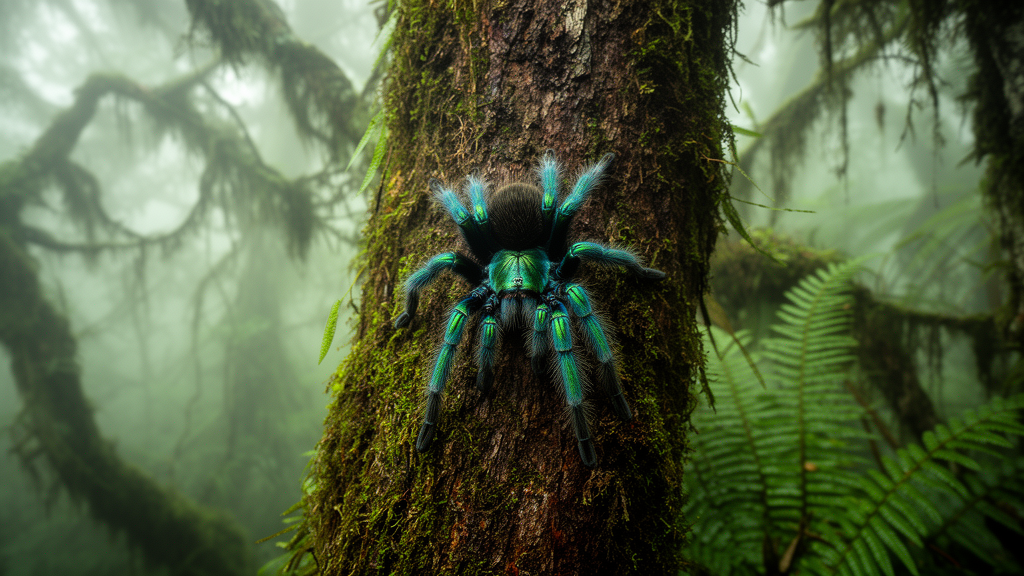
Deep in the Andean cloud forests and coastal foothills of Ecuador, tarantulas have been quietly diversifying in isolation, hidden beneath logs, inside burrows, and among leaf litter. Now, a comprehensive taxonomic review published in Evolutionary Systematics has brought five of these hidden predators into the scientific record, describing five new species across three genera and establishing an entirely new genus, Yunka, from the Ecuadorian coastal region. The work, led by N. Dupérré and E. Tapia, also describes the female of Romopelma barrigae for the first time and rejects a proposed synonymy that would have erased a Colombian species from the books. For a country recognized as one of the world’s 17 megadiverse nations, the findings suggest that Ecuador’s tarantula diversity is only beginning to be understood.
The family Theraphosidae, the true tarantulas, is the most diverse group within the infraorder Mygalomorphae, comprising 1,122 species found in tropical regions around the world. Most of this diversity, roughly 650 species, is concentrated in the Americas. Within the family, the subfamily Theraphosinae stands out with 89 genera and 614 species, accounting for 54 percent of all tarantula diversity. Members of this subfamily are recognized by two key sexual characters in males: a subtegulum extending over the tegulum, and the presence of keels on the palpal bulb, the male copulatory organ. The evolution of urticating setae, specialized barbed hairs that tarantulas flick off their abdomens as an effective anti-predator defense, has likely contributed significantly to this remarkable diversification.
Ecuador currently has 65 described tarantula species divided into four subfamilies, of which 46 belong to Theraphosinae. In recent years, a number of new genera and species have been described in the subfamily, steadily adding to the documented diversity. However, the actual diversity may still be much greater, as numerous areas in Ecuador remain inadequately explored. The new study enhances understanding of Ecuadorian Theraphosinae by describing the first species of Homoeomma from the Eastern Andean Cordillera, a second species in the genus Romopelma from the Western Andean Cordillera, and three species in the newly established genus Yunka from the coastal region.
Homoeomma josti sp. nov., named in honor of Lou Jost, mathematician, population geneticist, and orchid taxonomist for his work protecting Ecuador’s diversity through the EcoMinga foundation, was collected between 2,696 and 3,250 meters in high evergreen forest of the Eastern Cordillera in Tungurahua Province. Males are distinguished from other Homoeomma by their disconnected, slightly serrated prolateral superior keel and the presence of a small retrolateral tooth on the palpal bulb. Females are diagnosed by their uniquely comma-shaped spermathecae. The genus was previously known only from Argentina, Brazil, Chile, and Uruguay, with one doubtful record from Colombia, making this the first confirmed Ecuadorian species and dramatically extending the genus into the northwestern Andes.
Romopelma chirapa sp. nov., named from the Kichwa word meaning light rain with sun in reference to the species’ habitat, was found in the OTONGA Biological Reserve in Cotopaxi Province between 1,278 and 2,029 meters in evergreen mountain forest of the Western Cordillera. Males are distinguished from R. barrigae by the absence of a retrolateral tegular process on the palpal bulb, while females have shorter spermathecae with rounded heads and guard plates separated by less than half their length. Notably, a female was collected in November carrying a large egg sac, suggesting a potential reproductive period. The study also describes the female of Romopelma barrigae for the first time, collected in Mindo, Pichincha Province, revealing elongated spermathecae with oval heads and triangular guard plates separated by half their length.
The new genus Yunka, named from the Kichwa word for from the coastal region, comprises three species: Y. suenos sp. nov., Y. guasaganda sp. nov., and Y. baboso sp. nov. These medium to large spiders, with males ranging from 23.90 to 31.38 millimeters and females from 34.45 to 39.62 millimeters in total length, inhabit evergreen foothill forests of the Western Cordillera between 203 and 951 meters. Males are distinguished by the combination of an absent or reduced tibial apophysis on leg I, with a ventral elongated branch bearing a short apical megaspine and long basal megaspine, and a dorsal branch that is reduced. Females have short dual spermathecae that are L-shaped or barbell-shaped, with square to rectangular guard plates, distinguishing them from related genera such as Cyclosternum and Cymbiapophysa.
Yunka suenos sp. nov., named for the type locality at the Jardin de los Sueños reserve, one of the last remaining foothill Chocó forests, is distinguished by a male palpal tibia with more than five dorsal spines and a curved subapical keel seven times longer than wide. Yunka guasaganda sp. nov. has only two dorsal spines on the palpal tibia and a subapical keel four times longer than wide. Yunka baboso sp. nov., from Esmeraldas and Carchi provinces, is unique among the three in completely lacking a tibial apophysis on leg I. Females of Y. baboso have barbell-shaped spermathecae separated by 3.4 times their width, while Y. suenos females have L-shaped spermathecae separated by 2.7 times their width and Y. guasaganda females have spermathecae separated by 4 times their width.
The study employed advanced imaging techniques to document the new species, including a custom-made BK Plus lab system with a Canon EOS 5D camera and Zerene stacking software for high-resolution morphological imaging. Scanning electron microscope images were obtained using a Hitachi tabletop microscope TM4000 plus, providing detailed views of the palpal bulb and urticating setae. Specimens were examined in 70 percent ethanol under a Leica M125 dissection microscope, and female genitalia were dissected and digested with pancreatin solution following established protocols. All measurements were made using a Leica M205A stereomicroscope with Leica Application Suite X, and the percentage of cuspule coverage over the endites was measured with Fiji ImageJ software.
Beyond the descriptions, the study makes significant contributions to tarantula morphology by updating the nomenclature of palpal bulb keels and introducing a standardized, color-coded schematic system for assessing keel development. The male palpal bulb is divided by a horizontal line connecting the tip of the embolus to the mid-tegular heel, separating it into upper and lower halves. Keels are considered long if they reach the lower half of the bulb, or short if restricted to the upper half, offering a more quantitative assessment rather than relying on subjective determinations such as weakly developed or well developed. The study also defines the embolic keel, a small keel at the embolus apex made of an upper and lower branch that combine apically, and documents that in most genera examined the branches converge and diverge again, whereas in Homoeomma they overlap.
The urticating setae analysis revealed surprising diversity. Homoeomma josti possesses type III setae, while Romopelma species carry type Id and type Ib setae co-occurring in both males and females. Yunka males have types Ia and Ib, whereas females have co-occurring types Ia and I. Remarkably, the type Ia setae in Yunka are the shortest recorded to date, measuring between 0.16 and 0.19 millimeters, well below the previously reported range of 0.37 to 0.67 millimeters. The study also rejected the proposed synonymy of Homoeomma strabo from Colombia with H. familiare from Brazil, arguing that the broad distributional gap between the two taxa renders their conspecificity unlikely, particularly given the discovery of a new Homoeomma species in the Ecuadorian Andes. With Ecuador’s tarantula fauna now standing at 65 species and counting, and vast areas still unexplored, the researchers suggest that the true diversity of these ancient predators in the country may be far greater than anyone imagined.
Subject of Research: Taxonomy
Article Title: New Theraphosinae from Ecuador: description of five species ( Mygalomorphae , Theraphosidae , Romopelma , and Homoeomma ) with the establishment of a new genus
Article References: Dupérré, N., Tapia, E., & Salazar-Valenzuela, D. (2026). New Theraphosinae from Ecuador: description of five species (Mygalomorphae, Theraphosidae, Romopelma, and Homoeomma) with the establishment of a new genus. Evolutionary Systematics, 10(2), 217-261. https://doi.org/10.3897/evolsyst.10.196576
Image Credits: AI Generated
DOI: 10.3897/evolsyst.10.196576
Keywords: tarantulas, Ecuador, new species, Theraphosidae, taxonomy, biodiversity, Yunka, Homoeomma, Romopelma, SEM, Theraphosinae, description
News Source: Margaret Porter. (October 16, 2026). Five New Tarantula Species and a Brand-New Genus Emerge from Ecuador’s Cloud Forests. Scienmag.