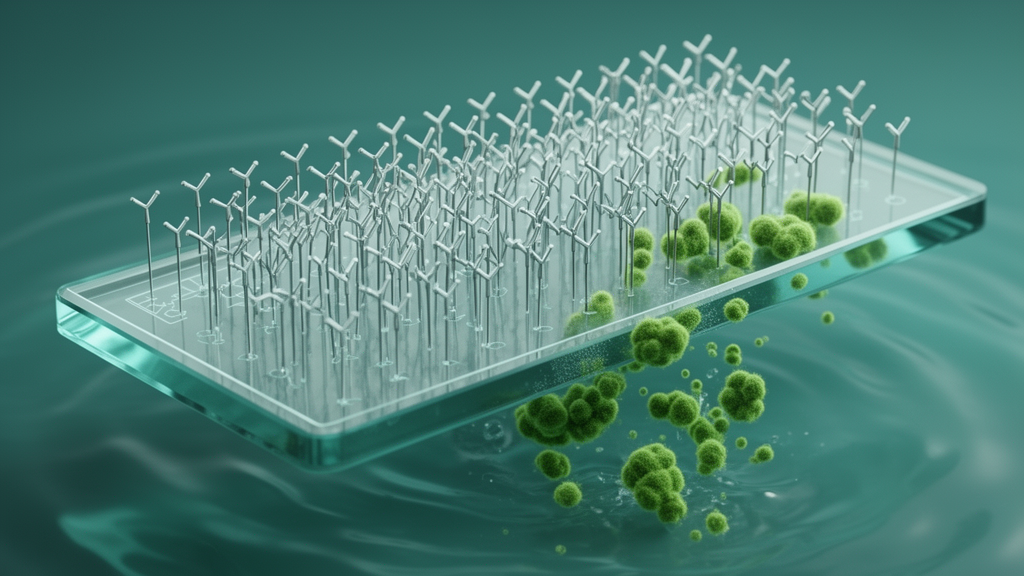
Every biosensor, from a lab-on-a-chip cancer detector to a food-safety device, faces the same fundamental challenge: how do you physically attach fragile biological recognition molecules—antibodies, peptides, aptamers—to a hard, inert transducer surface without destroying their function? A new review by Edmund Chan and Michael Thompson of the University of Toronto, published in Frontiers in Sensors, takes stock of one of the field’s most enduring answers: organosilane surface chemistry. The appraisal, appearing in the journal’s Biosensors section, walks through both the fundamental mechanism by which these molecules assemble on surfaces and the evolution of silane linkers from crude commercial workhorses to sophisticated, custom-synthesized antifouling reagents.
Organosilanes occupy a unique position in biosensor engineering because they spontaneously organize into ordered, bifunctional molecular assemblies—what the authors call adlayers—on hydroxylated surfaces of inorganic and organic materials. The architecture is elegantly modular. A silyl tail function, typically a trialkoxysilyl or trichlorosilyl group, anchors to the substrate. A distal head function dictates the surface’s chemical properties and provides the reactive handle for covalently attaching a probe of choice. Between them sits an organic backbone that spaces the head group away from the surface and reinforces the assembly through intermolecular forces. In theory, this modularity offers countless chemical permutations; in practice, the authors note, the availability of head functions compatible with the highly reactive silyl tail is severely limited, since nucleophilic groups such as alcohols, carboxylic acids, and amines interfere with adlayer formation and must be protected or introduced after assembly.
The mechanism by which these adlayers form remains an active area of debate, but a broad consensus has emerged around a multi-step process. Surface-adsorbed water molecules first hydrolyze the trichlorosilyl or trialkoxysilyl moiety into a trisilanol anchoring group. This cross-linker then diffuses to the surface-solution interface, where it undergoes reversible adsorption and desorption punctuated by multiple condensation reactions with surface hydroxyl groups. Islands nucleate across the surface, expand during a reorganization phase, and aggregate into a coherent adlayer that is further strengthened by covalent cross-linking between neighboring silanols. Van der Waals forces between adjacent organic backbones add rigidity, order, and stability to the finished film.
The commercial backbone of the field remains the bifunctional propyltrialkoxysilanes. (3-Aminopropyl)trimethoxysilane (APTMS) and (3-aminopropyl)triethoxysilane (APTES) terminate in amino head groups that can be coupled to carboxylic acid functions on probe molecules via EDC-NHS chemistry or to amino groups after pre-activation with glutaraldehyde. This flexibility has made them staples for immobilizing proteins and peptides on silicon dioxide, alumina, and aluminum nitride. Related linkers include the mercapto compounds MPTMS and MPTES, whose sulfhydryl heads form disulfide bonds with thiol-bearing probes, and the glycidoxy compounds GPTMS and GPTES, whose strained three-membered epoxide rings open readily when attacked by nucleophilic atoms on the probe, forging a new covalent bond in the process.
Yet these commercial workhorses carry significant liabilities that the review does not shy away from. The amino-terminated linkers demand costly pre-activating or coupling agents. The thiol-bearing variants suffer from cross-reactivity, in which the sulfhydryl group of one immobilized linker forms a disulfide bond with that of a neighbor, effectively shutting down the very chemistry needed to anchor thiol-bearing probes. The glycidoxy counterparts react promiscuously with a wide range of nucleophilic groups, restricting their use largely to simple organic molecules rather than complex biological probes.
These shortcomings have driven interest in functionalizable alkyltrichlorosilanes, a class of linkers synthesized by converting terminal alkene precursors into trichlorosilyl anchoring groups via the classical catalytic hydrosilylation reaction using trichlorosilane and chloroplatinic acid hexahydrate. Among the most prominent examples, developed in the Thompson laboratory, are linkers bearing pentafluorophenyl ester (PFP) and benzenethiosulfonate (BTS) head functions. The PFP moiety reacts potently with primary amine residues to form strong amide bonds, while the BTS head function exhibits regioselectivity for sulfhydryl groups, forming disulfide bonds without cross-reacting with itself. In one demonstration, PFP-modified AT-cut quartz surfaces were functionalized with nitrilotriacetic acid moieties that subsequently captured polyhistidine-tagged heat shock protein 10 via nickel(II) coordination—entirely avoiding the activating agents required by traditional APTMS and APTES chemistry. In a separate application, BTS-based adlayers were imposed onto aluminum nitride thin films, an alternative piezoelectric substrate being considered for future acoustic wave biosensors, and validated with thiolated biotin as a proof of concept.
Perhaps the most consequential advance highlighted in the review involves ethylene glycol (EG) as an organic backbone. EG moieties are well documented for their ability to reduce adsorption of proteins and cells from biological fluids, a property that directly addresses non-specific adsorption—the fouling problem that undermines biosensor selectivity and sensitivity in real-world samples. The Toronto group’s MEG-OH spacer molecule, containing a single EG unit and terminating in a hydroxyl head function, was synthesized via a trifluoroacetyl ester precursor (MEG-TFA) that is deprotected after assembly. When incorporated into acoustic wave biosensor experiments on AT-cut quartz, this single EG moiety produced a dramatic reduction in fouling from undiluted serum. Molecular dynamics calculations and neutron reflectometry experiments suggest the EG backbone facilitates formation of a distinct interfacial water barrier that imposes an energetic cost to perturbation and suppresses the protein dehydration process during adsorption.
Counterintuitively, more EG is not always better. The team synthesized trifluoroacetyl ester-bearing trichlorosilanes with seven, ten, and thirteen EG units, deprotected them to expose hydroxyl head functions, and tested the resulting adlayers against undiluted goat serum. The shortest chain, 7-OEG, exhibited substantially lower fouling than its longer counterparts, despite containing fewer EG groups. The authors attribute this to packing density: shorter molecules leave gaps that allow water to penetrate and form the protective interstitial zone, while longer, more densely packed chains obstruct this hydration layer. It is a striking example of how molecular-scale geometry, not simply chemical composition, governs macroscopic biosensor performance.
The review also showcases MEG-Cl, a sister molecule to MEG-OH that functions simultaneously as a probe-attachment linker and an antifouling spacer. MEG-Cl chemistry has been used to attach nickel-NTA groups for recombinant protein capture and to reduce fouling from serum and milk samples. Most strikingly, it has been deployed in an aptamer-based acoustic wave sensor for Escherichia coli, where the aptamer is covalently tethered to the quartz surface through the antifouling linker. That sensor achieved detection limits of 35 and 8 colony-forming units per milliliter in phosphate-buffered saline and cow’s milk, respectively—well below safety thresholds for commercial dairy products.
Looking forward, Chan and Thompson identify several unresolved challenges that will shape the next generation of silane chemistry. Transducer materials must present sufficient surface hydroxyl groups for condensation chemistry to proceed, which is straightforward for metals but difficult for polymers, where oxygen plasma treatment may be required. Achieving ideal lateral spacing of probes—dense enough for sensitivity, yet spaced enough to avoid steric interference between neighboring recognition sites—remains a delicate balancing act. And the question of probe orientation, rarely addressed in the field, looms large: attachment chemistry can inadvertently block the very recognition site a sensor depends on. Their proposed solution is a new class of head groups designed to target biologically meaningful motifs, such as polyhistidine tags terminally generated during protein expression, offering a route to immobilize virtually any protein of interest with controlled orientation. If successful, this could close the loop on decades of silane chemistry, transforming a workhorse technique into a precision tool for the biosensors of tomorrow.
Subject of Research: Organosilane surface chemistry for probe attachment to biosensor substrates
Article Title: Appraisal of organosilane surface modification for probe attachment to biosensor substrates
Article References: Chan, E., & Thompson, M. (2026). Appraisal of organosilane surface modification for probe attachment to biosensor substrates. Frontiers in Sensors, 7, Article 1774304. https://doi.org/10.3389/fsens.2026.1774304
Image Credits: AI Generated
DOI: 10.3389/fsens.2026.1774304
Keywords: biosensors, organosilane, surface chemistry, antifouling, probe immobilization, acoustic wave sensors, ethylene glycol, non-specific adsorption, Appraisal, surface, modification, probe
News Source: Sylvia Mullen. (October 16, 2026). Organosilane Chemistry Anchors Biosensor Probes While Fighting Surface Fouling. Scienmag.