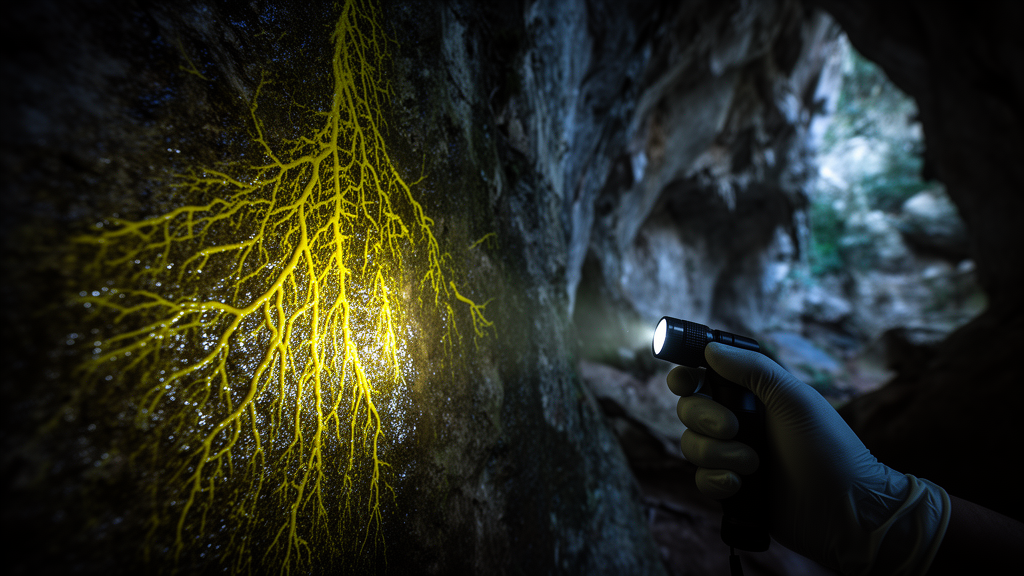
Deep inside a dolomitic cave in the Brazilian Cerrado, researchers have documented something no one has ever recorded there before: slime molds. Myxomycetes, single-celled amoeboid organisms that spend most of their lives creeping through soil and decaying matter as microscopic predators, have now been confirmed in a cave in Central Brazil for only the second time in the country’s history. The discovery, published in the journal Subterranean Biology, reveals three distinct species thriving in one of Earth’s most extreme and understudied habitats, and it hints at an entire hidden community of organisms that scientists have barely begun to explore.
Myxomycetes are among the strangest organisms on the planet. Although they were historically classified as fungi, they belong to the Amoebozoa, a group more closely related to amoebas than to mushrooms. Around 1,100 species are currently recognized worldwide, and many of them, such as Arcyria cinerea and Fuligo septica, are remarkably adaptable, occupying virtually every terrestrial ecosystem from tropical forests to deserts. During their feeding stage, they exist as plasmodia, networks of protoplasm that engulf bacteria, fungi, and protozoa, regulating microbial communities and cycling nutrients through the food web. When conditions are right, they transform into sporophores, delicate fruiting bodies that release spores and are often strikingly visible to the naked eye.
Caves, with their perpetual darkness, high humidity, and thermal stability, present a unique challenge for these organisms. Yet records from Spain, the United States, Mexico, and Puerto Rico have shown that slime molds can colonize subterranean environments, growing on rocks, speleothems, leaf litter, bones, decaying wood, and soils enriched with bat guano. In Brazil, a country with more than 26,000 registered caves, only one previous study had documented myxomycetes in caves, in the karst region of Pains in Minas Gerais, where three species of the order Trichiales were found. The scarcity of data has long highlighted the need for research into these neglected organisms in Brazilian subterranean habitats.
The new study took place in Lapa do Boqueirão, a cave approximately 300 meters long developed in dolomitic rocks in the municipality of Vila Propício, in the state of Goiás, about 205 kilometers from Goiânia and 194 kilometers from Brasília. The region sits within the Cerrado biome, a semi-humid tropical savanna with average annual temperatures between 22 and 26 degrees Celsius and rainfall of up to 1,500 millimeters. The cave features a wide opening with abundant limestone formations and stalactites, a portal roughly 2 meters high leading into a gallery where light gradually fades, and an innermost aphotic zone filled with speleothems, including stalactites, stalagmites, columns, and curtains. A second opening, formed by the partial collapse of the rock wall, is accessible only from inside the cave.
Researchers collected leaf litter and decaying wood fragments from three distinct zones of the cave: the photic zone near the main entrance and the secondary opening, the intermediate penumbra zone, and the completely dark aphotic zone. Three samples were taken from each zone and placed in humid chambers, Petri dishes lined with filter paper and kept moist with distilled water at least twice a week. Over 90 days, the chambers were monitored weekly under a stereomicroscope to detect plasmodia, sclerotia, or sporophores. Species identification relied on macroscopic and microscopic analysis of the fruiting bodies using specialized optical equipment and taxonomic literature.
Of the 22 humid chambers prepared, 45 percent were positive, showing at least one phase of the myxomycete life cycle. Notably, 80 percent of the positive results came from samples collected in the photic zone, while 20 percent came from the aphotic zone. Three species were identified across three genera and three families, along with one unidentified specimen. Arcyria cinerea, a cosmopolitan species with pale grey cylindrical sporothecae and abundant elastic capillitium, was associated with substrates from the aphotic zone. Cribraria elegans, a species with dark purplish-brown globose sporothecae and slender blackish-purple stalks, was found on decaying wood fragments in the photic zone. Perichaena depressa, characterized by strongly flattened reddish-brown plasmodiocarps and a double peridium, appeared in substrates from both zones and was the most frequent species in the sampling.
The findings are significant on several fronts. This is the first study of myxomycetes conducted in Cerrado caves, and it expands the known occurrence of these organisms in Brazilian subterranean environments. Cribraria elegans and Perichaena depressa are reported for the first time in cave habitats anywhere, and Arcyria cinerea is recorded for the first time in a Brazilian Cerrado cave. The unidentified specimen, an aborted sporophore with a short black stalk and oval black sporotheca, may belong to the family Stemonitaceae, though the material was too incomplete for definitive identification.
The presence of viable propagules in leaf litter and decaying wood suggests that these organic materials may act as vehicles for introducing myxomycete propagules into cave environments, transported by rainwater, wind, or faunal action. Once inside, propagules can germinate and give rise to plasmodia within the cavities, and development can even occur on mineral surfaces such as speleothems. However, the researchers caution that humid chamber records should be interpreted carefully, since detection in culture does not necessarily imply completion of the life cycle in the natural environment. Humid chambers provide a useful complementary approach for detecting viable propagules associated with cave substrates, but field investigations remain essential to fully understand the diversity and distribution of slime molds in subterranean systems.
Until now, records of myxomycetes in caves worldwide mainly focused on representatives of the orders Trichiales, Physarales, and Stemonitales, including species from the families Arcyriaceae, Trichiaceae, Didymiaceae, Physaraceae, and Stemonitaceae, reported in Brazil, Puerto Rico, Spain, the United States, and Mexico. The new records from Goiás reinforce the importance of surveys in different regions and types of underground environments to broaden understanding of the distribution and diversity of this group. The conservation of these environments is fundamental, as tourism and mining activities have the potential to alter habitats and compromise cave communities. The proximity of the Vila Propício caves to areas of intense mining activity raises concerns about possible impacts on cave biodiversity, including slime molds, making continuous monitoring and preventive measures essential before significant impacts occur.
Subject of Research: First records of myxomycetes in a cave in Central Brazil
Article Title: First records of myxomycetes (Amebozoa, Eumycetozoa ) in cave in Central Brazil
Article References: Moreira, I. C., Cavalcanti, L. D. H., Marley-Santos, R. L., Leonardo-Silva, L., de Lima, L. A., & Xavier-Santos, S. (2026). First records of myxomycetes (Amebozoa, Eumycetozoa) in cave in Central Brazil. Subterranean Biology, 57, 91-103. https://doi.org/10.3897/subtbiol.57.193389
Image Credits: AI Generated
DOI: 10.3897/subtbiol.57.193389
Keywords: myxomycetes, slime molds, cave biology, Cerrado, Brazil, subterranean ecology, biodiversity, speleology, First, records, Amebozoa, Eumycetozoa
News Source: Gavin Prescott. (October 16, 2026). Slime Molds Found Thriving in Central Brazilian Cave for First Time. Scienmag.