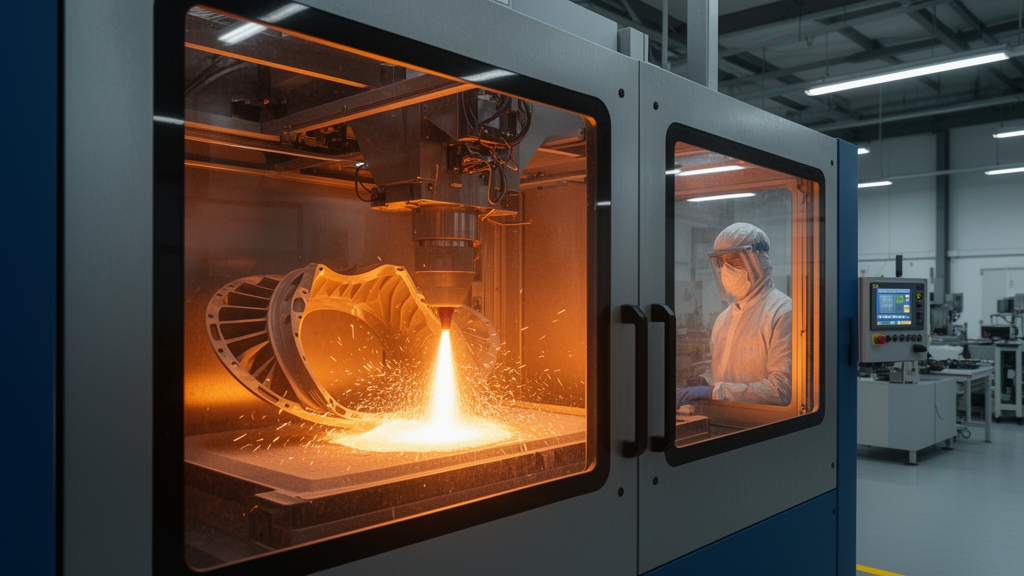
High-energy additive manufacturing, or HEAM, is quietly rewriting the rules of how complex metal components are made. Instead of carving parts out of solid billets or forcing them into molds, HEAM uses intensely concentrated heat sources—lasers, electron beams, and high-energy arcs or plasmas—to build components layer by layer from powder or wire feedstock. The approach delivers near-net shaping of intricate geometries that would be impossible, or at least prohibitively expensive, with conventional subtractive and formative techniques. For industries grappling with difficult-to-machine alloys, integrated multi-material structures, and flexible rapid fabrication of high-performance parts, the technology has moved from laboratory curiosity to industrial necessity.
Yet the physics of melting metal with a focused beam is unforgiving. During HEAM processing, steep thermal gradients, severe non-equilibrium metallurgical behavior during solidification, dynamic instabilities in the molten pool, and high as-built surface roughness continue to limit component densification, microstructural homogeneity, and in-service performance. A new research collection published in Frontiers in Materials, titled High Energy Additive Manufacturing of Advanced Materials, compiles eight original research articles and prospective contributions that confront these bottlenecks across the entire technology lifecycle—from data-driven alloy design and intelligent process monitoring to melt pool simulation, structural innovation, and advanced post-processing.
One of the most striking developments in the collection is the deep integration of machine learning with alloy design. An and colleagues constructed a 28-dimensional dataset that integrates the fundamental physical properties of 18 elements with multi-stage heat treatment regimens for high-performance titanium alloys. Using a Gaussian Process Regression model, the team achieved highly accurate prediction of ultimate tensile strength, with an R-squared value of 0.93 on the test set. An intelligent space search then screened a novel composition, Ti6Al4V0.3Si5Mo2.3Sn0.1Nd, with promising mechanical performance. The work demonstrates how artificial intelligence can compress years of trial-and-error metallurgy into a computational framework that explores composition spaces no human team could systematically cover.
Machine learning is also transforming how fabrication processes themselves are watched and controlled. In Laser Solid Forming, melt pool temperature fluctuations compromise both dimensional and mechanical accuracy of as-built parts. Wang and colleagues developed a real-time melt pool temperature prediction model based on a Particle Swarm Optimization-tuned Long Short-Term Memory network, or PSO-LSTM. Leveraging in-situ infrared thermography data, the model achieved superior predictive accuracy under sharp temperature fluctuations compared with conventional models. The researchers argue that such data-driven temperature prediction provides a reliable foundation for real-time closed-loop control systems in additive manufacturing—a step toward printers that can sense and correct their own thermal behavior mid-build.
Understanding the physical metallurgy of HEAM remains central to component quality. In laser powder bed fusion of 316L stainless steel, Wang and colleagues systematically investigated how laser energy density shapes single molten track geometry and microstructural evolution. The study established an optimal processing window of 200 to 500 joules per cubic millimeter and elucidated the micro-mechanisms governing the transition from columnar dendrites to equiaxed cellular grains, driven by Marangoni convection and thermal gradients. The finding matters because equiaxed grains generally deliver more homogeneous mechanical properties than columnar structures, and controlling that transition through energy density gives engineers a direct lever on microstructure.
Energy density also proved decisive in surface engineering. Wang and colleagues fabricated Fe-Ni-Ti low-expansion composite coatings on AISI 1045 steel via laser deposition. At an optimal energy density of 97.2 joules per square millimeter, the coatings achieved a relative density of 99.1 percent and an ultra-low porosity of 1.2 percent. Uniformly dispersed in-situ TiC reinforcements increased the coating microhardness to 2.24 times that of the substrate and markedly enhanced wear resistance. The work shows how HEAM can simultaneously build protective surfaces and engineer reinforcing phases directly into them, without the separate consolidation steps conventional coating routes require.
Feedstock recyclability is another critical piece of the industrial puzzle. Gu and colleagues conducted 12 reuse cycles in selective electron beam melting of pure copper to systematically reveal oxygen accumulation behavior. The findings indicated that rapid cooling rates and melt pool convection effectively inhibited oxide segregation at grain boundaries, yielding uniformly dispersed copper oxide nanoparticles of roughly 50 nanometers within the matrix. Remarkably, the material retained excellent ductility above 51 percent and strong electrical conductivity even at an oxygen content of 0.4341 weight percent. For a metal as oxygen-sensitive as copper, the result suggests that electron beam processing can tolerate significant powder reuse without catastrophic property degradation—a finding with direct implications for feedstock economics.
The geometric freedom of additive manufacturing is also being exploited to create mechanical metamaterials with properties no bulk solid can match. Inspired by the geometry of boomerangs, Liu and colleagues designed a double arrowhead triangular metamaterial structure with a negative Poisson’s ratio, meaning it expands laterally when stretched rather than contracting like ordinary materials. Through theoretical mechanics derivations and dynamic finite element simulations, the team identified the optimal angle parameters for maximizing the auxetic effect and low-velocity impact energy absorption. Such architectures, printable only through layer-by-layer deposition, point toward lightweight impact-absorbing structures for protective equipment, vehicles, and aerospace components.
Surface quality remains one of the most stubborn bottlenecks for as-built parts, and the collection tackles it from multiple angles. Lu and colleagues systematically compared sandblasting, electropolishing, chemical polishing, and abrasive flow machining on laser powder bed fusion-fabricated Ti6Al4V. Sandblasting demonstrated an advantage in reducing surface roughness with minimal mass loss, while abrasive flow polishing showed a unique capability to smooth step defects and unmolten powder inside complex curved channels—internal geometries no manual tool can reach. Pan and colleagues introduced shear-thickening fluids into an integrated lapping and polishing process for hard and brittle silicon carbide ceramic substrates. By modulating the dynamic response of fluid viscosity to shear rates, the team reduced surface roughness dramatically from 451 nanometers to 9.7 nanometers, providing an innovative strategy for the ultra-precision finishing of hard, brittle components.
Taken together, the eight studies in the research topic showcase collaborative innovation across the entire chain of high-energy additive manufacturing, spanning material and structural design, physical process regulation, and surface post-treatment strengthening. The editors behind the collection—Kun Li of Chongqing University, R. Devesh K. Misra of the University of Texas at El Paso, and Changjun Han of South China University of Technology—emphasize that overcoming the application bottlenecks of advanced structural and functional materials in HEAM demands comprehensive multi-dimensional investigation. From machine-learned titanium compositions to boomerang-inspired auxetic lattices and nanometer-scale ceramic polishing, the research signals that the era of intelligently controlled, high-energy beam-based manufacturing of advanced materials is no longer on the horizon. It is building itself, one layer at a time.
Subject of Research: High-energy additive manufacturing of advanced materials
Article Title: Editorial: High energy additive manufacturing of advanced materials
Article References: Li, K., Misra, R. D. K., & Han, C. (2026). Editorial: High energy additive manufacturing of advanced materials. Frontiers in Materials, 13, Article 1981379. https://doi.org/10.3389/fmats.2026.1981379
Image Credits: AI Generated
DOI: 10.3389/fmats.2026.1981379
Keywords: additive manufacturing, 3D printing, materials science, machine learning, metallurgy, metamaterials, laser powder bed fusion, post-processing, Editorial, High, energy, additive
News Source: Denise Maddox. (October 16, 2026). High-energy additive manufacturing pushes advanced materials into a new era. Scienmag.