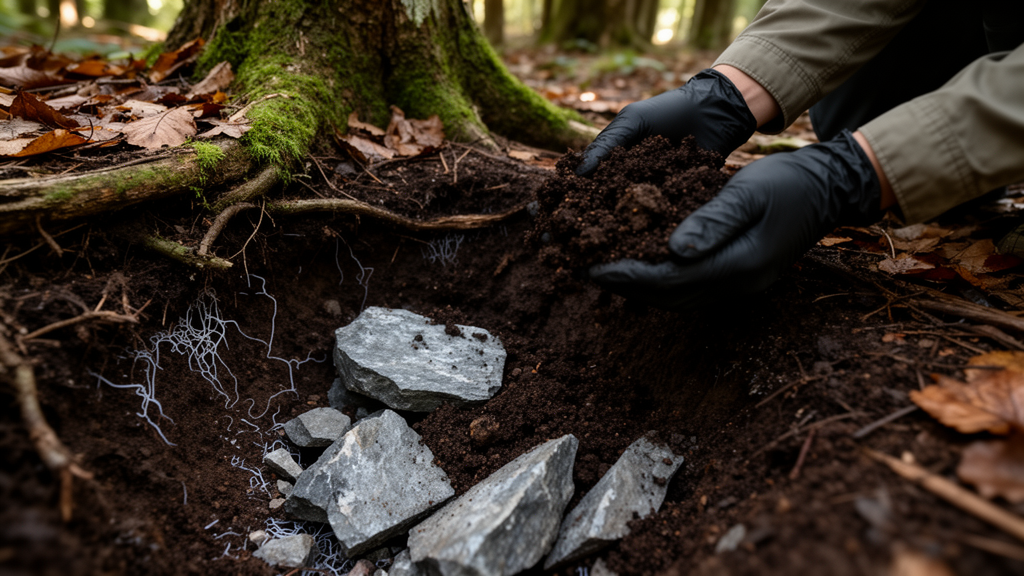
Deep beneath the forest floor, the type of bedrock quietly decides how fast carbon, nitrogen, phosphorus, and sulfur move through the soil. A new study from southwest China shows that the underlying rock, not just climate or vegetation, shapes the genomic potential of soil microbes to recycle these essential elements. The research, published in Frontiers in Ecology and Evolution, reveals that limestone soils harbor significantly higher abundances of nutrient-cycling genes than soils formed on dolostone or clasolite, a silicate-rich non-karst rock. The finding suggests that Earth system models may need to distinguish between specific carbonate rock types when predicting biogeochemical cycles in sensitive karst regions.
The study was conducted by researchers from the Institute of Subtropical Agriculture of the Chinese Academy of Sciences and partner institutions, working in the subtropical karst landscapes of southwest China. These landscapes represent one of the most extensive karst systems on Earth, characterized by high habitat heterogeneity, calcium and magnesium alkalinity, and vulnerability to environmental change. Within these terrains, the parent material, or lithology, dictates soil function, defines the structure of the critical zone, and influences the biogeochemical cycling of carbon, nitrogen, phosphorus, and sulfur.
To probe how bedrock shapes microbial function, the team employed high-throughput quantitative PCR, or HT-qPCR, to profile functional genes involved in carbon, nitrogen, phosphorus, and sulfur cycling across soils developed on limestone, dolostone, and clasolite. Functional gene abundances serve as a measure of microbial metabolic potential, linking genetic diversity to potential ecosystem function. While lithological impacts on microbial taxonomy, the identity of which species live where, are well documented, how lithology affects the functional potential for multi-element cycling had remained unresolved.
The results were striking. Limestone soils consistently harbored significantly higher abundances of carbon, nitrogen, phosphorus, and sulfur cycling genes than dolostone and clasolite soils. Limestone soils were enriched in genes encoding the degradation of both labile organic matter, such as starch and hemicellulose, and recalcitrant compounds, such as chitin and lignin. They also showed higher abundances of genes for nitrogen ammonification (ureC), mineralization (gdhA), and denitrification (nosZ), for organic phosphorus mineralization (phnK, phoD) and inorganic phosphorus solubilization (gcd, ppx), and for sulfur oxidation and reduction (apsA, dsrA, yedZ, soxY).
The researchers attribute this elevated functional potential in limestone soils to five synergistic factors. First, high calcium oxide content contributes to slightly alkaline, calcium-rich conditions favorable for microbial growth and aggregate stabilization. Second, high organic carbon, total nitrogen, and available phosphorus supply steady nutrients that support greater microbial biomass. Third, highly complex and stable microbial co-occurrence networks in limestone soils may enable stronger interspecific interactions and more efficient resource processing. Fourth, high pH and calcium ions boost phosphatase activity, mitigating potential phosphorus limitation. Fifth, higher bacterial and fungal diversity provides functional redundancy against environmental fluctuations.
To identify which environmental variables best predict the functional gene pools, the team combined random forest modeling with Mantel’s tests. The random forest models explained a substantial proportion of the variance in the gene pools, with R-squared values of 0.92 for carbon, 0.90 for nitrogen, 0.92 for phosphorus, and 0.87 for sulfur cycling genes. Three predictors consistently emerged as the most important: total dissolved nitrogen, eco-enzymatic stoichiometry expressed as the ratio BG/(LAP+NAG), and free iron and aluminum oxides, denoted (Fe+Al)d. Mantel’s tests supported the same trio, indicating that microbial functional potential is associated not only with immediate nutrient availability and metabolic limitation but also with reactive minerals.
Based on these key predictors, the researchers propose a tripartite framework they call Nitrogen availability, Microbial resource limitation, and Reactive minerals, abbreviated NMR. In this framework, total dissolved nitrogen provides the essential nitrogen microbes need for protein and nucleic acid synthesis, supporting metabolic processes and functional gene abundance. High nitrogen availability enables microbes to allocate energy toward synthesizing extracellular enzymes, thereby expanding the functional gene pool across multi-element cycles.
The second pillar, eco-enzymatic stoichiometry, reflects microbial carbon versus nitrogen acquisition strategies. The ratio BG/(LAP+NAG) compares carbon-acquiring enzyme activity to nitrogen-acquiring enzyme activity. A high ratio indicates elevated carbon investment under alleviated nitrogen limitation, which promotes overall metabolic activity and gene expression. Conversely, low ratios signify severe nitrogen limitation, which suppresses microbial metabolism and functional gene abundance. The third pillar, reactive minerals, concerns iron and aluminum oxides that regulate substrate accessibility through physical protection and mineral adsorption. Moderate levels of these oxides stabilize extracellular enzymes and extracellular DNA against enzymatic breakdown, but excessive mineral binding could restrict substrate accessibility, lowering microbial carbon use efficiency and functional gene abundances.
The implications extend beyond the karst hills of southwest China. The authors conclude that lithology is a key regulator of soil microbial functional potential in subtropical forests, driven by bedrock-mediated nitrogen availability, microbial resource limitation, and reactive mineral dynamics. They argue that lithology should be integrated into Earth system models to predict biogeochemical cycling and ecosystem functions, especially in sensitive karst regions where carbonate rock types differ sharply in their weathering behavior and soil chemistry. Differentiating specific carbonate rock types, rather than treating all carbonate soils as equivalent, could improve predictions of ecosystem resilience and carbon sink capacities under climate change.
The study also highlights the broader significance of the critical zone, the thin layer of rock, soil, water, air, and life that sustains terrestrial ecosystems. Because karst habitats differ sharply in water dynamics, nutrient status, and pH across microhabitats of rocky outcrops, fissures, and shallow soil layers, they create specialized microbial niches that respond to bedrock geochemistry. In contrast, non-karst lithologies such as clasolite yield deeper, acidic soils dominated by silicate mineral matrices. The new NMR framework offers a conceptual interpretation for how these geological differences translate into variations in microbial functional gene abundance, providing a technical foundation for future research on multi-element cycling in complex geological terrains.
Subject of Research: Soil microbial ecology and biogeochemistry in subtropical karst forests
Article Title: Lithology influences soil microbial functional potential in subtropical forests
Article References: Ling, Q., Wu, H., Hu, S., Li, S., Wan, W., Hu, P., Xiao, J., Tang, T., Du, H., Zhao, J., Zhang, W., Chen, H., & Wang, K. (2026). Lithology influences soil microbial functional potential in subtropical forests. Frontiers in Ecology and Evolution, 14, Article 1969592. https://doi.org/10.3389/fevo.2026.1969592
Image Credits: AI Generated
DOI: 10.3389/fevo.2026.1969592
Keywords: karst ecosystems, lithology, soil microbes, functional genes, carbon cycling, nitrogen cycling, phosphorus cycling, sulfur cycling, HT-qPCR, random forest, iron and aluminum oxides, eco-enzymatic stoichiometry
News Source: Bethany Barker. (October 16, 2026). Hidden Rock Chemistry Controls How Forest Soils Recycle Carbon and Nitrogen. Scienmag.