When the first four-legged animals crawled out of the Devonian waters some 375 million years ago, they carried with them one of the most consequential anatomical changes in vertebrate history: the separation of the skull from the shoulder girdle. This head–shoulder split created the first true neck, a region that has long been assumed to have granted early tetrapods newfound freedom to turn and lift their heads as they explored life on land. A new study published in Nature challenges that assumption with an unexpected experimental approach, using living lake sturgeon as a mechanical stand-in for the soft, notochord-dominated spines of the earliest landlubbers.
The research, led by Dana E. Korneisel of Carleton University and Uppsala University together with colleagues in Canada and the United States, set out to test a hypothesis that has circulated in vertebrate palaeontology for decades. Because the skulls of stem tetrapods such as Acanthostega and Tiktaalik became decoupled from the pectoral girdle, many researchers inferred that neck mobility must have increased markedly during the origin of tetrapods, potentially facilitating the ecological transition toward more terrestrial habitats. What the hypothesis lacked was a functional test, and the reason is anatomical: the vertebral components of these ancient animals were incompletely co-ossified, making their mechanical behaviour extraordinarily difficult to model from fossils alone.
The problem stems from how the axial column was built in these creatures. Stem tetrapods retained a notochord-dominated spine into adulthood, a condition inherited from their lobe-finned fish ancestors. The notochord, a fluid-filled rod of soft tissue, was surrounded by cartilaginous or bony arches that lacked bone-to-bone joints. This arrangement predates the rigid vertebral column of most modern tetrapods, in which bony centra fuse to neural arches and vertebrae articulate through inter-central and zygapophyseal joints. No living tetrapod has an anatomically or functionally comparable axial skeleton, so the team had to look elsewhere for a testable analogue.
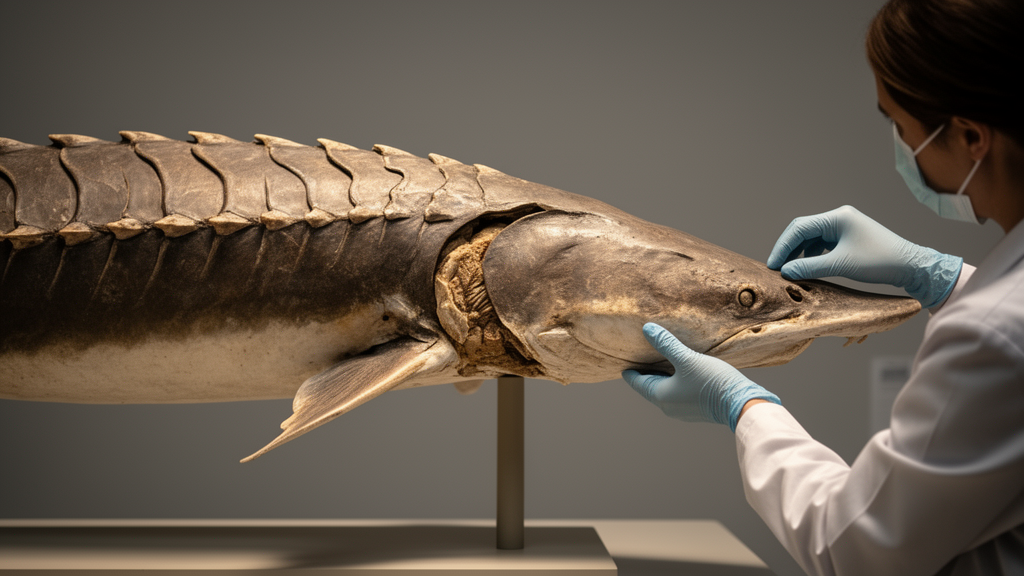
They found it in an unexpected place: the lake sturgeon, Acipenser fulvescens. Although sturgeon are ray-finned fishes only distantly related to tetrapods, they independently retained an intact notochord into adulthood, and their body dimensions closely match those of stem tetrapods. The proportions of vertebral arches to the notochordal canal in cross-section are strikingly similar, and the arches are joined by unmineralized connective tissue rather than zygapophyseal joints, just as in the extinct forms. The researchers acknowledge some differences—sturgeon possess supraneurals, and their basidorsals and basiventrals are positioned dorsoventrally across the notochord, whereas the intercentra and pleurocentra of stem tetrapods are staggered ventrolaterally—but the overall mechanical configuration is close enough to serve as a calibrated model.
The team performed a series of material tests on ten sturgeon specimens using a ZwickiLine materials testing machine. Three-point bending trials measured lateral flexion stiffness and extension stiffness, while torsion trials quantified rotational stiffness. Crucially, they tested both the isolated notochord and the whole axial column with its mineralized arches and connective tissues intact. The results were unambiguous: the whole column was considerably stiffer than the notochord alone, and this high stiffness could not be attributed to hard stops or joint interactions between the arches, which the researchers did not observe during testing. Only negligibly small forces and torques were needed to bend and twist the bare notochord. In other words, the surrounding tissues—not the notochord itself—dominate the mechanical behaviour of the column.
Applying these measured stiffness values to the reconstructed axial columns of six fossil taxa, the team produced striking estimates. For five stem tetrapods—Eusthenopteron foordi, Tiktaalik roseae, Acanthostega gunnari, Whatcheeria deltae and Greererpeton burkemorani—plus the early crown tetrapod Trimerorhachis insignis, they calculated the forces required to bend the neck and the muscle cross-sectional areas available to generate those forces, capped at half the area of an oval fitted around the occiput. The verdict: most stem tetrapods could move their heads less than 6 degrees laterally and less than 3 degrees dorsally, and could not rotate them at all. Eusthenopteron managed an estimated 8.5 degrees of lateral flexion and Tiktaalik 5.5 degrees, while Acanthostega, Greererpeton and Trimerorhachis showed even lower values, below 3 degrees of lateral flexion and under 1.5 degrees of extension.
Rotation proved even more prohibitive. Using the torsional rigidity of the sturgeon column and the polar moments of area of the fossil vertebrae, the researchers calculated the torque needed for even a modest 5-degree head turn. Tiktaalik required the least, at roughly 200 newton-metres, while all other taxa needed between 314 and 746 newton-metres—enormous figures given the short lever arms formed by the cervical ribs and associated musculoskeletal elements. Even Greererpeton, which possesses distinct atlas and axis vertebrae, could not plausibly have rotated its head. Large head turns, the model suggests, were simply infeasible across the entire tetrapod stem.
One taxon stands out as an exception. Whatcheeria, with a neck measuring nearly 20 centimetres or 89 percent of its skull length, could achieve an estimated 32 degrees of lateral flexion and 12 degrees of extension—roughly tenfold and eightfold higher, respectively, than other early tetrapods. The explanation lies in the physics of beam bending: the force required to achieve a given deflection decreases as a cubic function of the bending region’s length, so a long neck dramatically amplifies mobility. Conversely, the short-necked Trimerorhachis, with only three neck vertebrae and a neck less than 3 centimetres long, managed a mere 1 degree of lateral flexion. Geometry mattered too: taller, narrower vertebral columns were more restrictive, and the rectangular profile of Trimerorhachis limited bending even in longer column sections.
The most consequential finding is what the model did not show. Neck mobility did not increase in conjunction with the head–shoulder separation that occurred between the origin of tristichopterids, represented by Eusthenopteron, and more crownward stem tetrapods. The flexion capacities of Eusthenopteron and Tiktaalik actually exceed those of Acanthostega and Greererpeton by two- to threefold, despite comparable neck lengths. This means the separation event, documented in the common ancestors shared by Tiktaalik and Acanthostega but not with Eusthenopteron, had no detectable effect on how far the head could move. The tetrapod neck, the authors argue, appears to have evolved as a by-product of head–shoulder separation rather than as an adaptation for mobility.
If neck mobility was not the functional driver of the separation, what was? The researchers point instead to forelimb-driven locomotion. Across the tetrapod stem, the pectoral fin and girdle underwent substantial anatomical changes, including rearrangement of the long bones and loss of lepidotrichia. Eusthenopteron already possessed a stress-dissipating trabecular architecture in its humerus capable of supporting weight bearing, and derived stem tetrapods such as Ichthyostega are hypothesized to have used pectoral-powered locomotion in contact with the substrate, similar to terrestrial locomotion observed in several living fishes. The shoulder girdle’s primary function, on this view, shifted from connecting head to trunk to supporting forelimb function. A stiff neck, far from being a liability, may have been advantageous—increasing energetic efficiency during swimming and providing passive resistance to gravity on land. Substantial, independent head motion, as seen in Whatcheeria and later crown tetrapods, evolved secondarily through longer necks and mobile intervertebral joints. The findings also cast doubt on hypothesized terrestrial feeding modes for early tetrapods, since limited head mobility would preclude lateral snapping while the forelimb was planted, and instead align with aquatic feeding hypotheses in which trunk flexion contributed to overall motion.
Subject of Research: Biomechanical modelling of neck mobility in early tetrapods using lake sturgeon as an extant analogue
Article Title: Early tetrapod neck mobility modelled using an extant analogue
Article References: Korneisel, D. E., Donatelli, C. M., Han, L., Stewart, T. A., Traynor, A. L., Otoo, B. K. A., Martinez, M., Miyashita, T., Standen, E. M., & Maddin, H. C. (2026). Early tetrapod neck mobility modelled using an extant analogue. Nature. https://doi.org/10.1038/s41586-026-11158-3
Image Credits: AI Generated
DOI: 10.1038/s41586-026-11158-3
Keywords: tetrapod evolution, neck mobility, sturgeon, notochord, palaeontology, biomechanics, Tiktaalik, Acanthostega, Whatcheeria, vertebral column, Devonian, material testing
News Source: Denise Maddox. (October 16, 2026). Sturgeon experiments reveal early tetrapods had surprisingly stiff necks. Scienmag.