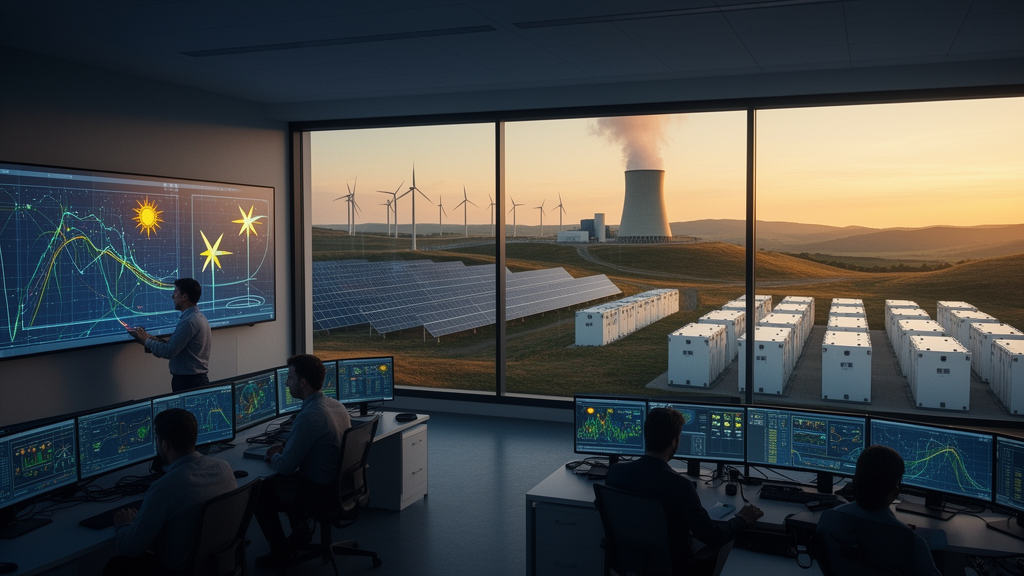
Renewable energy’s biggest headache has always been timing. The wind blows hardest when nobody needs the electricity, and the sun sets just as households switch on their evening lights. A new study published in Frontiers in Energy Research tackles this mismatch head-on, presenting a two-stage framework that links high-precision wind and solar power forecasting directly to the sizing of shared energy storage for distributed energy system clusters. The result: a storage configuration that pushes renewable energy accommodation to 90.3 percent while keeping total system costs under control.
The research, led by Zhongyuan Yan and colleagues at Henan Jiuyu Longyuan Energy Service Co., Ltd. in Zhengzhou, China, addresses a persistent blind spot in power system planning. In most existing studies, renewable power forecasting and storage planning are treated as separate problems. Forecasting researchers focus on shaving prediction errors, while storage planners simply plug in predetermined renewable power profiles as fixed inputs. The consequence is that forecasting errors propagate silently into storage sizing decisions, potentially leading to systems that are either too small to absorb surplus renewable generation or too large to justify their capital cost.
The team’s solution begins at the data level with a forecasting model they call VMD-EO-SVM, a hybrid that chains together three distinct techniques. Variational mode decomposition, or VMD, first breaks down the raw wind or solar power time series into a set of narrow-band intrinsic mode functions, each capturing fluctuations at a different frequency scale. This decomposition tames the non-stationary, erratic character of renewable output by separating fast spikes from slow trends, effectively turning one hard prediction problem into several easier ones.
Next comes the equilibrium optimizer, a nature-inspired metaheuristic that mimics the physics of mass exchange in a control-volume system seeking equilibrium. The EO searches for the optimal values of the penalty parameter C and the kernel width gamma in a support vector machine, the third component of the pipeline. SVM regression maps input samples into a high-dimensional feature space where a linear regression function is constructed, using a radial basis function kernel prized for its wide convergence region and high resolution. By letting EO tune these hyperparameters for each decomposed component, the framework avoids the guesswork that typically undermines SVM performance. The component-level forecasts are then reconstructed into a single final prediction.
The benchmark results are striking. Using 15-minute-interval measured wind and solar power data from Belgium covering 2020 to 2021, the VMD-EO-SVM model achieved a root mean square error of 42.60 for solar power with a coefficient of determination of 0.9776, and an RMSE of 71.83 for wind power with an R-squared of 0.9217. Compared against deep learning benchmarks, the hybrid model cut solar RMSE by 38.79 percent relative to LSTM and 55.09 percent relative to CNN, and reduced wind RMSE by 37.95 and 50.68 percent against the same rivals. Even more telling is the component-level ablation: for solar power, RMSE fell from 195.21 for plain SVM to 56.08 for EO-SVM and then to 42.60 for the full VMD-EO-SVM stack, demonstrating that decomposition and parameter optimization perform complementary functions rather than redundant ones.
Notably, the study found that signal decomposition alone does not guarantee improvement. For wind power, VMD-SVM actually failed to outperform the original SVM in RMSE terms. It is only when VMD is paired with EO-optimized SVM that the combination delivers its full benefit, suggesting that the two techniques must work in concert: VMD reduces the complexity of the prediction task while EO ensures the SVM parameters are properly matched to each frequency-separated component.
With reliable forecasts in hand, the second stage of the framework turns to the planning question: how big should a shared energy storage facility be? Unlike storage systems configured independently for individual distributed energy systems, shared energy storage allows multiple generation and consumption entities to draw on a common facility. Because different subsystems have partially complementary charging and discharging patterns, aggregation reduces redundant capacity and improves utilization. The capital burden is also distributed among participants rather than borne by any single user, a mechanism the authors argue is essential for making storage investment economically viable at cluster scale.
The multi-objective planning model minimizes total system cost, which includes the daily-equivalent investment cost of storage, operation and maintenance expenses, thermal generation fuel costs, and penalties for renewable curtailment, while simultaneously maximizing the renewable energy utilization ratio. Constraints enforce power balance at every time step, limit curtailment to predicted renewable output, keep the storage state of charge between 0.1 and 0.9, and respect the ramp-rate and minimum on-off-time requirements of seven thermal units ranging from 55 to 130 MW. The optimization determines both the rated power and the energy capacity of the shared storage system.
The case study results reveal a configuration of 947 MW rated power and 5,615 MWh of energy capacity, corresponding to an energy-to-power ratio of approximately 5.93 hours. That duration is significant: it indicates the storage system is not merely smoothing second-to-second fluctuations but shifting energy across several hours, absorbing midday solar surpluses and overnight wind output for release during peak demand. The optimized plan achieves a renewable energy accommodation rate of 90.3 percent with a total system cost of 66,956,684 CNY, of which 64.3 million represents the daily-equivalent storage investment. Operational simulations confirm that the storage charges during periods of renewable surplus and discharges when generation falls short or load peaks, with the state of charge never straying outside safe bounds.
The thermal fleet plays a supporting role in this choreography. Units 1 and 2 operate stably as base-load generators, while units 3 through 7 act as peaking units that shut down during high renewable generation to cut coal consumption, keeping startup and shutdown costs to just 41,720 CNY. Wind and solar output show clear temporal complementarity, with solar dominating daytime hours and wind carrying the night, allowing the combined system to maintain real-time power balance across all 96 fifteen-minute periods of the scheduling day.
The authors are candid about limitations. The forecasting model relies solely on historical power data and does not explicitly incorporate meteorological variables such as wind speed, solar irradiance, or temperature. While historical series implicitly encode past weather patterns, this indirect representation may prove inadequate when future conditions diverge sharply from historical norms, particularly during extreme weather events. Future work, they note, will integrate numerical weather prediction directly into the forecasting framework and examine how extreme conditions ripple through to storage planning decisions.
Beyond the technical achievements, the study carries a broader message for the energy transition: forecasting and storage planning should be treated as a single coupled problem, not sequential silos. Better forecasts yield more reliable storage sizing, which in turn unlocks higher renewable penetration at lower cost. As wind-solar-thermal clusters proliferate under carbon peaking and neutrality targets worldwide, frameworks that bind prediction quality directly to infrastructure investment may well become the template for how distributed grids of the future are designed.
Subject of Research: Optimal planning of shared energy storage for wind-solar-thermal distributed energy system clusters using improved renewable power forecasting
Article Title: Optimal planning of shared energy storage for wind-solar-thermal distributed energy system clusters based on improved renewable energy forecasting
Article References: Yan, Z., Xue, W., Zhang, Y., Du, X., & Zheng, X. (2026). Optimal planning of shared energy storage for wind-solar-thermal distributed energy system clusters based on improved renewable energy forecasting. Frontiers in Energy Research, 14, Article 1946325. https://doi.org/10.3389/fenrg.2026.1946325
Image Credits: AI Generated
DOI: 10.3389/fenrg.2026.1946325
Keywords: shared energy storage, renewable energy forecasting, wind power, solar power, variational mode decomposition, equilibrium optimizer, support vector machine, distributed energy systems, multi-objective optimization, renewable energy accommodation, energy storage planning, smart grids
News Source: Faith Mcneil. (October 16, 2026). Smarter Forecasts, Sharper Storage: New Framework Sizes Shared Batteries for Wind-Solar- Thermal Clusters. Scienmag.