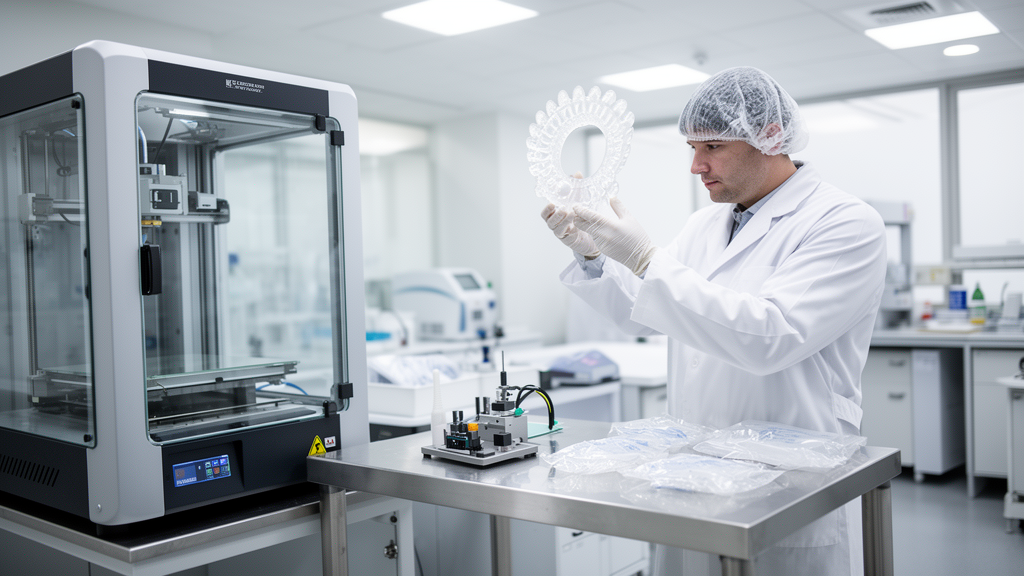
A university 3D printing laboratory in Milan has pulled off something rare in European medicine: it now operates as a fully certified manufacturer of custom-made medical devices while remaining embedded in the hospital where its products are used. The 3D Innovation Lab at Humanitas University has earned ISO 13485 certification and formal registration with the Italian Ministry of Health as a manufacturer of custom-made devices under Annex XIII of the European Medical Devices Regulation, known as the MDR. The achievement, described in a study published in Frontiers in Medical Engineering, offers one of the first documented blueprints for how academic 3D printing facilities can cross the regulatory divide between experimental point-of-care manufacturing and compliant medical device production.
The regulatory landscape for hospital-based 3D printing has long been a stumbling block. Across Europe, point-of-care printing labs have proliferated, churning out patient-specific anatomical models and surgical guides that help surgeons rehearse complex operations. Yet the Medical Devices Regulation (EU) 2017/745 imposes demanding requirements on anyone who manufactures medical devices, and the complexity of the framework has left many hospital and university laboratories stuck in an experimental limbo, unable to formalize their activities without sacrificing the clinical agility that makes them valuable in the first place.
The Milan team, led by researchers from Humanitas University, IRCCS Humanitas Research Hospital and the Politecnico di Milano, set out to resolve that tension with what they call a hybrid model. Rather than choosing between a purely in-house hospital setup and a detached industrial entity, they built a single governance structure that combines clinical proximity with the quality discipline of a regulated manufacturer. The project began in December 2024 as a deliberate transformation of a university-based printing lab into a certified production environment, guided by a top-down, regulatory-driven methodology that started with a detailed reading of the MDR, its guidance documents, and the ISO 13485:2016 quality management standard.
A crucial part of the work was untangling the regulatory categories that govern personalized devices. Under Article 2(3) of the MDR, a custom-made device is manufactured according to a written prescription from an authorized healthcare professional to address the specific anatomical or pathological condition of an individual patient. Patient-matched devices, clarified in the MDCG 2021-3 guidance, are produced from patient-specific data within a predefined design and manufacturing process, while adapted devices are existing products modified after production. The distinction matters enormously: personalized geometry alone does not make a device custom-made. Qualification depends on the clinician’s role in defining patient-specific requirements and on how individualized the design workflow remains, rather than standardized.
The team evaluated several organizational alternatives, including clinical investigations, purely hospital-based in-house configurations, fully industrial manufacturing, and CE-marked devices. The in-house pathway under Article 5(5) of the MDR, which allows health institutions to manufacture devices for their own use, carries restrictions that proved incompatible with the lab’s ambitions. In-house devices cannot be transferred to another legal entity, the institution must justify why no equivalent device exists on the market, and the pathway is limited to a single site. Because the Humanitas lab intended to supply custom-made solutions to external healthcare institutions across a wider hospital network, Annex XIII of the MDR, which governs custom-made devices, emerged as the only viable operational pathway.
Building the quality management system was the heart of the project. Rather than replicating an industrial production model, the team structured the QMS to reconcile ISO 13485 requirements with a clinician-driven, case-by-case workflow. A fully digital architecture, built on the Confluence document management platform, turned compliance from a static pile of documents into a dynamic, traceable system in which procedures, records, quality objectives, reviews and improvement actions are continuously integrated. The notified body IMQ conducted a two-stage certification audit, first reviewing all QMS documentation and then verifying on site that the system was operationally implemented. The audit concluded with zero major and zero minor non-conformities and just two recommendations.
The path to certification was not frictionless. During the first months of QMS operation, the team logged 31 non-conformities and resolved 28 before the certification audit, using a structured five-phase workflow of identification, registration, root cause analysis, corrective action and verification. Representative examples reveal the granular nature of the work: a mismatch between the lot number printed on a filament spool and its cardboard box, caught during incoming material inspection, was fixed by relabeling the material and informing the supplier. Unclear sterilization instructions that mixed multiple materials and methods in one document were rewritten to ensure unambiguous, device-specific guidance.
The lab now handles roughly 20 clinical cases per month, producing two device categories with distinct risk classifications under Annex VIII of the MDR: anatomical models fall into Class I under Rule 1, while surgical guides are Class IIa under Rule 7. Risk classification is not treated as a mere label but as a driver that determines design control requirements, risk management depth, validation protocols and documentation procedures. Technical validation covers the entire chain, from imaging segmentation and CAD design to printing parameters and post-processing quality control, with predefined acceptance criteria. Supplier qualification for patient-contact materials includes verification of biocompatibility certifications according to ISO 10993. Nine formal roles, from quality manager to medical design engineer, are defined through a RACI-like governance model, and end-to-end traceability from clinical need to device release runs through a GDPR-compliant case management system.
Clinical feedback suggests the model delivers real value. Questionnaires returned by seven surgeons for surgical guides and nine for anatomical models showed high satisfaction across communication, perceived improvement in surgical outcomes and overall surgery execution, with slightly lower, though still positive, scores for time saved in the operating room, a pattern the authors attribute to the exceptional complexity of the cases treated. Preliminary internal data from orthopedics indicate that custom-made 3D models showed about 30 percent higher agreement with intraoperative findings compared with conventional imaging, though the researchers caution that this comes from a single-center thesis study and requires further validation. Case examples illustrate the reach of the approach: a liver surgery guide tested on a 3D-printed phantom achieved 99.97 percent volumetric agreement between simulated and planned resection, a custom-made model enabled surgical rehearsal in a cadaveric cardiac oncology case that supported a successful intervention in an otherwise inoperable patient, and 3D reconstruction of a giant abdominal sarcoma contributed to a limb-preserving and organ-preserving outcome.
The economic logic of the hybrid model is equally significant. Both the in-house and custom-made pathways demand substantial investment in quality systems, validated procedures, personnel training and regulatory oversight. But while Article 5(5) restricts devices to the manufacturing institution, the Annex XIII framework opens the door to supplying third-party healthcare institutions and generating revenue streams that partially offset the initial costs. The authors argue that the model achieves a CE-ready level of regulatory preparedness, positioning the lab for possible future CE-marking pathways and even implantable product categories, while retaining the bedside agility that industrial manufacturers often lack. Replicability, they stress, is realistic but conditional: it requires a mature ISO 13485 system, stable clinician-engineer integration and a clear regulatory strategy. Without those prerequisites, institutions risk copying only the visible part of the model, the 3D printing lab itself, without the governance structure that actually makes it compliant and scalable. As point-of-care manufacturing expands worldwide, and as regulators in the United States continue to debate how healthcare institutions should be overseen when they act as manufacturers, the Milan experience offers a concrete demonstration that clinical integration and regulatory rigor need not be enemies.
Subject of Research: A hybrid organizational and regulatory model enabling a university-based 3D printing laboratory to manufacture custom-made medical devices in compliance with the EU Medical Devices Regulation
Article Title: Bridging clinical integration and regulatory compliance in 3D printing: a hybrid model for university-based manufacturing of custom-made medical devices
Article References: Oliva, P., Cereda, E., Robles, E., Cappelli, C., Micalizzi, S., Bevilacqua, A., Rescalli, A., & Mansour, N. K. (2026). Bridging clinical integration and regulatory compliance in 3D printing: a hybrid model for university-based manufacturing of custom-made medical devices. Frontiers in Medical Engineering, 4, Article 1869701. https://doi.org/10.3389/fmede.2026.1869701
Image Credits: AI Generated
DOI: 10.3389/fmede.2026.1869701
Keywords: 3D printing, custom-made medical devices, EU MDR, ISO 13485, quality management system, point-of-care manufacturing, personalized medicine, surgical guides, anatomical models, regulatory compliance, university-based manufacturing, risk management
News Source: Denise Maddox. (October 16, 2026). University Lab Becomes Certified Medical Device Manufacturer With 3D Printing. Scienmag.