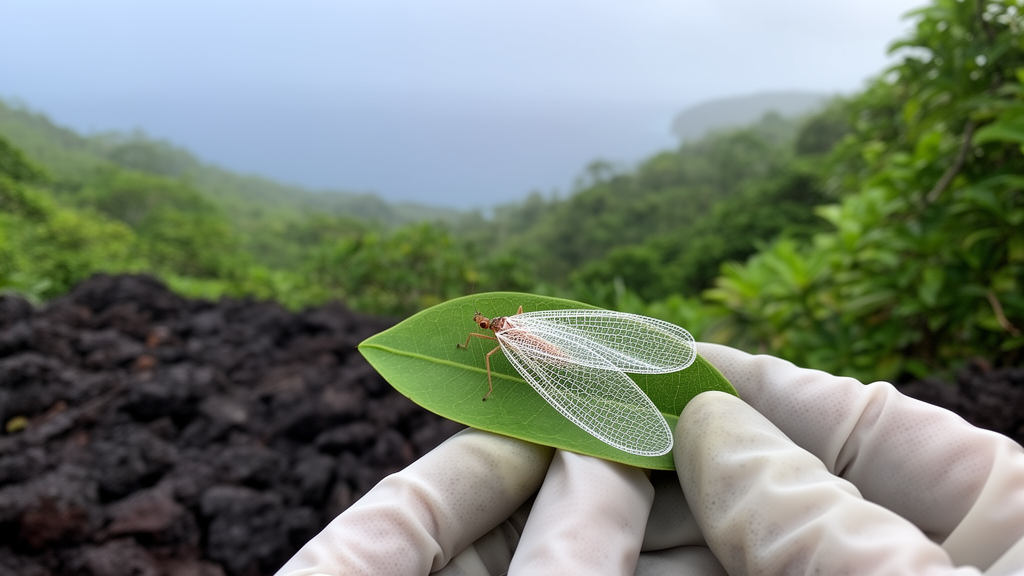
On the remote Ogasawara Islands of Japan, an archipelago of more than 100 oceanic islands and rocks lying roughly 900 to 1,000 kilometers south of Tokyo, scientists have uncovered yet another hidden branch on the tree of life. A new study published in the journal ZooKeys has used cutting-edge genome-wide sequencing to untangle the evolutionary history of the islands’ endemic lace bugs, revealing a previously unknown species and shedding light on how these tiny sap-feeding insects diversified across one of the most biologically unique places on Earth.
The research, led by entomologist Jun Souma, focused on the genus Omoplax, a group of lace bugs found nowhere else in the world outside the Ogasawara Islands. Lace bugs, belonging to the family Tingidae within the order Hemiptera, are phytophagous insects that feed on plant sap and are often highly host-specific. The Ogasawara Islands host two endemic lace bug genera, Acanthomoplax and Omoplax, and prior to this study, eight species were recognized across the archipelago. The new work brings that total to nine, with the formal description of Omoplax sandoru sp. nov., a species previously misidentified as a population of O. desecta on the Hahajima island group.
What makes this discovery particularly significant is the method behind it. Rather than relying solely on traditional morphological comparisons, the researchers employed a technique called multiplexed inter-simple sequence repeat genotyping by sequencing, or MIG-seq. This approach generates genome-wide single-nucleotide polymorphism (SNP) data, allowing scientists to examine thousands of genetic markers spread across the entire genome. In total, 52 samples from eight Japanese tingid species were analyzed, with DNA extracted from whole bodies or specific body parts and sequenced on an Illumina MiSeq platform.
The population genetic analysis focused on 41 samples of O. desecta, as identified in previous studies, using 673 filtered SNPs. A Neighbor-Net network analysis explained 99.6 percent of the variance in the pairwise distance matrix, revealing a striking pattern: the samples clustered strongly into two groups corresponding to the Chichijima and Hahajima island groups. A Principal Component Analysis confirmed this split, with the first two principal components explaining 82.4 percent of the total genetic variation. Notably, within the Chijijima Group itself, no genetic substructure was detected among populations on the islands of Anijima, Chichijima, or Ototojima, suggesting free gene flow across these closely situated landmasses.
Meanwhile, a phylogenetic analysis using 4,452 SNPs from 28 samples representing eight lace bug species produced a maximum likelihood tree with exceptionally strong statistical support. Five Omoplax species—O. hisasuei, O. karubei, O. kobugashi, O. inugusu, and O. majorcarinae—were confirmed as monophyletic with SH-aLRT support values of 99.9 to 100 percent and ultrafast bootstrap support of 100 percent. Critically, however, the monophyly of O. desecta as previously defined was not supported. Instead, the populations from the Chichijima and Hahajima groups each formed their own well-supported monophyletic clades, indicating that these two populations represent distinct species that have been conflated under a single name for over a century.
Combining the molecular evidence with careful morphological examination, the researchers determined that the population in the Hahajima Group warranted description as a new species. Omoplax sandoru sp. nov. can be distinguished from its closest relative, O. desecta, by subtle but consistent differences in the shape of the male paramere—the outer margin is roundly convex in the middle part in O. sandoru, compared to angularly convex in O. desecta. Additional diagnostic features include the coloration of antennal segment III and the pronotal disc, which are always pale brown in the new species but sometimes dark brown to black in O. desecta. The new species is also notably smaller, with males measuring 2.60 to 2.95 millimeters in body length.
The etymology of the new species name reflects its ecological specialization. The epithet sandoru derives from the Ogasawaran plant names Arekisandoru and Sandorunoki, referring to Rhaphiolepis indica var. tashiroi, a Rosaceae shrub that serves as the sole confirmed host plant of the new species. Field and captive observations suggest that O. sandoru may be monophagous, feeding exclusively on this single plant species. This stands in contrast to O. desecta, which feeds on two unrelated evergreen broad-leaved trees—Rhaphiolepis indica var. tashiroi and Calophyllum inophyllum—across different island groups.
The phylogenetic results also revealed unexpected patterns that challenge assumptions based on morphology and ecology alone. Three pairs of Omoplax species feed on the same or congeneric host plants and are allopatrically distributed across the island groups, which had led researchers to hypothesize that the genus underwent adaptive radiation in the Ogasawara Islands. However, the molecular tree showed that shared morphological characteristics and life histories do not necessarily reflect true phylogenetic relationships. For example, while O. desecta and O. karubei—both feeding on Rhaphiolepis indica var. tashiroi—were supported as sister species, the pair O. hisasuei and O. majorcarinae, which share a host plant in Neolitsea sericea var. aurata, were not recovered as sister taxa. Instead, O. hisasuei was well supported as the sister to the newly described O. sandoru, despite these two species feeding on different host plants and occurring on the same island.
These findings provide compelling insights into the mechanisms of speciation operating within Omoplax. The sister relationship between O. hisasuei and O. sandoru, which occupy the same island but feed on different host plants, suggests that a host shift drove their divergence. Conversely, the sister relationship between O. desecta and O. karubei, which feed on the same host plant but are distributed on different island groups, points to geographic isolation as the driving force. Furthermore, within O. desecta on the Chichijima Group, the researchers identified a host race feeding on Calophyllum inophyllum that formed a well-supported monophyletic clade. Because C. inophyllum is considered an introduced species in the Ogasawara Islands, this host race likely represents a very recent host shift event, analogous to the famous case of the apple maggot fly Rhagoletis pomonella, which shifted from hawthorns to apples within the past few hundred years.
The broader implications of this study extend beyond taxonomy. The Ogasawara Islands were inscribed as a UNESCO World Natural Heritage site based on criteria recognizing ongoing ecological and evolutionary processes. However, the approximately 440 endemic insect species on the islands have not been fully recognized in this context due to a lack of evolutionary biological studies. Many of these insects face severe threats from invasive predators such as the green anole Anolis carolinensis, which has been confirmed to prey on O. desecta on Anijima Island. By demonstrating that the endemic lace bugs have undergone adaptive radiation driven by both geographic isolation and host shifts, this research strengthens the scientific case for the islands’ outstanding evolutionary value. The researchers also updated the identification key for all nine lace bug species now recognized in the Ogasawara Islands and provided new distribution records, including the first record of O. karubei from Nakodojima Island. Future work incorporating ancestral state reconstruction and divergence time estimation, along with the collection of additional specimens of the rare species A. tomokunii and O. mukojimensis, will be essential to fully unravel the origins and diversification of these remarkable island endemics.
Subject of Research: Speciation and adaptive radiation of endemic lace bugs on the Ogasawara Islands revealed through genome-wide SNP phylogenetic analysis
Article Title: Genome-wide SNP data reveal phylogenetic relationships and further new species of lace bugs ( Hemiptera , Heteroptera , Tingidae ) endemic to the Japanese oceanic islands (the Ogasawara Islands), providing insight into their speciation
Article References: Souma, J., & Nakahama, N. (2026). Genome-wide SNP data reveal phylogenetic relationships and further new species of lace bugs (Hemiptera, Heteroptera, Tingidae) endemic to the Japanese oceanic islands (the Ogasawara Islands), providing insight into their speciation. ZooKeys, 1294, 175-203. https://doi.org/10.3897/zookeys.1294.205145
Image Credits: AI Generated
DOI: 10.3897/zookeys.1294.205145
Keywords: lace bugs, Ogasawara Islands, Omoplax, Tingidae, SNP genotyping, MIG-seq, adaptive radiation, host shift, new species, island biogeography, phylogenetics, speciation
News Source: Gavin Prescott. (October 16, 2026). Genome-Wide SNP Data Reveal New Lace Bug Species and Speciation Patterns on Japan’s Ogasawara Islands. Scienmag.