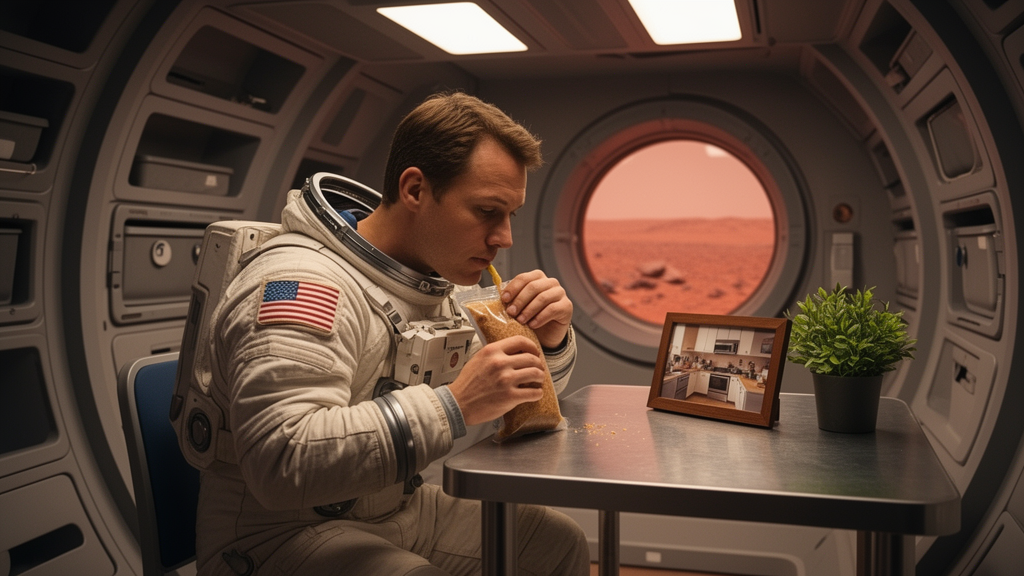
When Yuri Gagarin squeezed beef and liver paste from a toothpaste-like tube on 12 April 1961, nobody was thinking about mental resilience. Six decades later, food scientists are asking a very different question: could the flavours of home help astronauts survive the psychological ordeal of a multi-year voyage to Mars? A new narrative review published in Frontiers in Space Technologies argues that culturally familiar foods deserve a place in the design of space food systems, not as a luxury but as a potential pillar of crew mental health.
The review, led by Abelone Reuse and Sarah Baatout of KU Leuven and the Belgian Nuclear Research Centre SCK CEN, integrates evidence from space nutrition, isolated and confined environments, nutritional psychiatry and the microbiota-gut-brain axis. Its conclusion is carefully hedged: culturally familiar foods are a plausible but currently unproven contributor to mental resilience during long-duration missions. Direct evidence in astronaut populations is insufficient, so terrestrial and analogue findings should be treated as hypothesis-generating rather than confirmatory.
The stakes are high because the psychological stressors of deep space are relentless. Crews face social isolation, confinement, monotony, high operational workload, disrupted sleep, communication delays and interpersonal tension within a diverse, multicultural team. These stressors interact and can degrade mood, cognition, appetite and team cohesion. NASA has used a duration exceeding 30 days as one operational definition of a long-duration mission, but exploration-class voyages may extend for many months or years, making menu fatigue and limited resupply material behavioural-health considerations.
Existing countermeasures include psychological skills training, communication with family, virtual reality escapes such as the ANSIBLE project, meaningful work, sleep management and in-flight psychological support. Food, the authors argue, should be considered a complement to these measures rather than a replacement. Meals are recurrent events that provide pleasure, temporal structure, sensory variation, social interaction and opportunities for personal choice, and they are one of the few continuously available onboard resources that can influence both physiology and behaviour.
The review proposes two complementary pathways. In the biological pathway, dietary composition influences neuroendocrine, immune, metabolic and microbial signalling through the microbiota-gut-brain axis, a bidirectional communication network linking the gastrointestinal tract, its resident microorganisms and the central nervous system. The enteric nervous system, often called the second brain, contains nerve cells that control digestion and communicate with the brain via the vagus nerve. Remarkably, 90 to 95 percent of serotonin is produced in the gut, and gut microbiota influence neurotransmitters such as GABA, serotonin and dopamine, which affect mood, sleep, appetite and calmness.
Gut microbes also produce metabolites, most importantly short-chain fatty acids, which can cross the blood-brain barrier and influence brain development, memory and learning. Through immune and endocrine pathways, dysregulated microbiota can contribute to stress, depression and anxiety, while the gut influences the hypothalamic-pituitary-adrenal axis, the brain’s central stress machinery. Diets rich in fruits, vegetables, fibres, probiotics and fermented foods are associated with diverse and healthy intestinal microbiota, and eating vegetables, fruit, fish and whole grains has been linked to lower depression rates.
In the psychosocial pathway, cultural familiarity acts through memory, emotion, identity, belonging, perceived control and social connection. Studies of U.S. minority college students living away from their families found that lack of cultural foods caused a loss of identity and feelings of anxiety and sadness, while access to familiar meals created nostalgia, happiness and calm. Research on immigrants in Western societies similarly found that traditional meals strengthen identity and belonging while reducing stress. Punjabi immigrants in Canada confirmed the benefits of traditional meals like roti and subjee, and a multidimensional tool called the Culinary Comfort and Connection Index suggests that preparing and eating home-cooked meals may reduce stress, improve focus and support self-esteem.
Even NASA recognises the value of comfort foods during difficult situations, and the Italian Space Food initiative illustrates an effort to bring nationally familiar cuisine aboard the International Space Station. ISS menus already include foods from multiple culinary traditions, such as tortillas, curries, kimchi, teriyaki dishes, pasta, borscht and noodles. Astronauts can choose from around 200 options for their standard menu. But future Mars missions will sharply constrain individualised menus, with no fresh food resupply, packaging designed to minimise weight and waste, and food possibly produced or packaged before final crew selection.
The review proposes treating cultural familiarity as a measurable design attribute of space food systems alongside safety, nutritional adequacy, stability, usability, resource efficiency, reliability, variety and palatability. Emerging technologies may help reconcile these requirements. Space farming has already produced lettuce, lentils, radishes and mustard plants aboard the ISS through NASA’s Vegetable Production System, while 3D food printing could prepare varied meals on demand that meet personal preferences with less waste. Both approaches, however, require behavioural, biomedical and engineering validation under mission-relevant conditions.
The authors outline three testable hypotheses: nutritionally matched culturally familiar meals will improve intake and short-term affect relative to unfamiliar meals; co-designed multicultural menus will increase perceived inclusion and shared-meal participation; and psychosocial effects of familiarity will be partly independent of microbiome and nutrient-mediated effects. Priority studies should progress from controlled terrestrial feeding studies to high-fidelity analogues and, where feasible, in-flight validation using predefined psychological, dietary, microbiome and team-level outcomes. The objective, they conclude, is not to reproduce an idealised meal from Earth, but to design food systems that sustain the body while preserving meaningful elements of identity, choice and human connection.
Subject of Research: Culturally familiar foods and mental resilience during long-duration space missions
Article Title: Culturally familiar foods and mental resilience during long-duration space missions: a narrative review and conceptual framework
Article References: Reuse, A., & Baatout, S. (2026). Culturally familiar foods and mental resilience during long-duration space missions: a narrative review and conceptual framework. Frontiers in Space Technologies, 7, Article 1737502. https://doi.org/10.3389/frspt.2026.1737502
Image Credits: AI Generated
DOI: 10.3389/frspt.2026.1737502
Keywords: space food, mental resilience, gut-brain axis, astronaut health, Mars missions, cultural identity, comfort food, microbiome, space nutrition, menu fatigue, crew cohesion, food systems
News Source: Glenn Wilkins. (October 16, 2026). Why Astronauts May Crave a Taste of Home on Mars Missions. Scienmag.