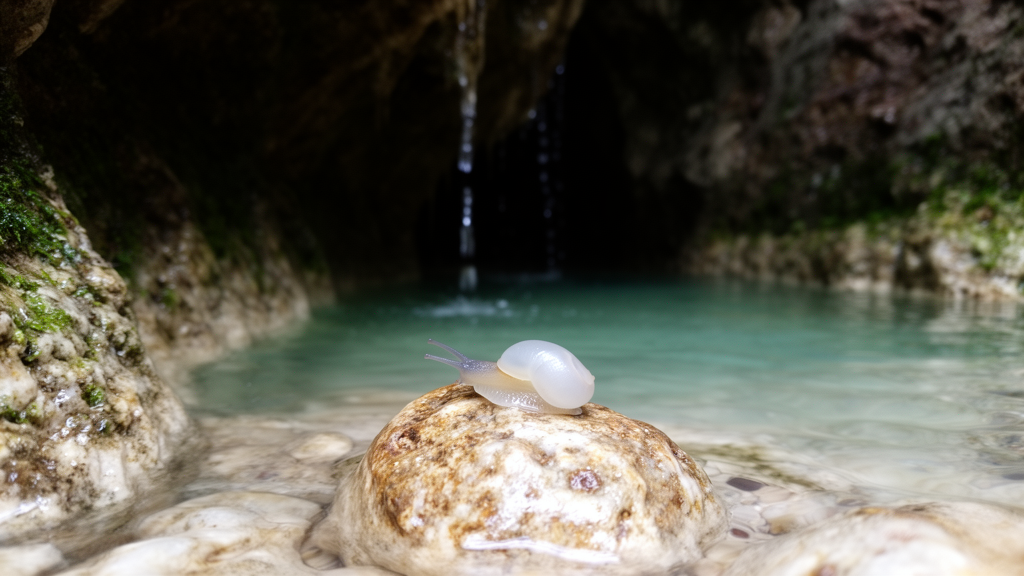
Deep inside a karst aquifer in the Zagros Mountains of western Iran, a minute snail has been quietly evolving in total darkness for millions of years. Scientists have now given it a name. Writing in the journal Subterranean Biology, an international team led by Andrzej Falniowski, Jozef Grego and Yaser Fatemi describes Iranobelgrandia persica, a tiny, translucent, completely eyeless freshwater snail that represents not only a new species but an entirely new genus within the family Hydrobiidae. Alongside it, the same seasonal spring near Tuveh village in Khuzestan Province yielded a second new species, provisionally placed in the genus Pseudamnicola and named Pseudamnicola stygopersica. The discovery is remarkable because subterranean snails from Iran were, until recently, essentially unknown to science.
The snails were collected on 30 May 2019 at Tuveh Spring, a seasonal karstic outflow that roars to life during the rainy season, typically from November through May or June, and then dries up completely in summer. Researchers gathered the specimens by hand, noticing that the animals lacked eyes and body pigmentation, classic troglomorphic traits that signal life underground. The team believes the living snails were flushed out of the subterranean aquifer by ephemeral waters and clung to grass at the spring head entrance. This makes the animals accidental ambassadors of a hidden ecosystem that scientists cannot easily access directly, arriving at the surface only when the aquifer pushes them out.
Iranobelgrandia persica is astonishingly small. The shells range from about 1.3 to 2.4 millimetres in height and less than one millimetre in breadth, formed by five and a half slowly growing whorls separated by a deep suture. The shell is thin-walled, whitish and translucent with a glossy surface. Under the microscope, the soft parts told a clearer story: no eyes, no pigment, a massive loop of the oviduct, a large bursa copulatrix, and an unusual arrangement of the seminal receptacles, one large and one dwarfed. The penis is flat, massive and broad, bearing small outgrowths. These anatomical details, particularly the female reproductive organs, proved crucial for placing the species within its family.
To determine where the new snail belongs on the tree of life, the researchers extracted DNA and sequenced three genetic markers: the mitochondrial cytochrome c oxidase subunit I gene, known as COI; the nuclear histone H3 gene; and the 28S ribosomal RNA gene. The 28S sequences were set aside for future reference because closely related sequences were lacking in public databases, but COI and H3 proved informative. Substitution saturation tests confirmed the sequences were suitable for phylogenetic reconstruction, and the team applied both maximum likelihood and Bayesian inference methods, running the latter for ten million generations to ensure the analyses converged properly.
The results were striking. The Iranian snail clustered firmly within the subfamily Belgrandiinae, a group of hydrobiid snails otherwise known from Europe and the Balkans. Its closest relatives in the molecular trees were Montenegrospeum, a Balkan cave snail genus, and Martensamnicola hissarica from Tajikistan, together forming a larger clade that also included the European genera Belgrandia and Dalmatinella. Genetic distances supported the distinctness of the new genus: the COI p-distance between Iranobelgrandia and Montenegrospeum was 0.141, well within the range separating recognized genera. Three independent species delimitation methods, PTP, ABGD and ASAP, all clearly separated the Iranian snail from its relatives.
The geography of this result is what makes it truly surprising. Belgrandiinae snails had never been recorded east of the Balkans, and Turkey, whose freshwater truncatelloid fauna has been studied fairly intensively, has yielded no members of these closely related genera. Finding a molecular relative of European Belgrandiinae in western Iran suggests an ancient distribution that once spanned much wider territory, with intervening populations lost to time. The authors also note a possible link to the Turkish genus Turcorientalia, whose reproductive anatomy resembles that of the new genus, but without DNA data for that genus, the relationship remains speculative. Morphology and molecules, they emphasize, paint a congruent picture of the phylogenetic relationships.
The second new species, Pseudamnicola stygopersica, is known only from a handful of empty shells recovered after several sampling attempts at the same spring. Its shell is small, about two millimetres high, nearly globose with four inflated whorls, a deep suture and a distinctive elongated, lemon-shaped aperture with a large open umbilicus. The shell morphology suggests the species inhabits low-flow environments underground, probably semi-stagnant cave pools, which may explain why no living specimens have ever been washed to the surface, even during peak spring discharge. Because no anatomical or molecular material is available, the species is provisionally assigned to Pseudamnicola, though its distinctive shell hints it may ultimately prove to represent yet another new genus.
Both species are considered Endangered under the IUCN criterion B1. Each is known from a single locality, a temporary spring in semi-arid mountains, with an area of occupancy of roughly thirty square metres directly at the springhead. The extent of occurrence lies within a subterranean aquifer whose boundaries are difficult to map. The principal threats are climate change, drought and declining precipitation, which alter groundwater levels, flow and the periodicity of the springs. An additional hazard comes from humans: a nearby railroad poses a risk of pollution seeping into the aquifer that these snails call home.
Perhaps the most intriguing implication of the study concerns what else might be living in the same aquifer. Tuveh Spring had already produced three species of Iranian cave fishes, described from a cave about thirty-one kilometres to the north, and a stygobiotic isopod was recently described from a spring about five kilometres to the east. Adding two new snail species to this list points to the existence of a large, shared karstic aquifer feeding multiple springs across the region, one that likely harbours far more stygobiotic animals than has yet been documented. The authors argue that wider surveys, particularly across the karstic regions of the Zagros Mountains, are essential to understanding Iranian subterranean biodiversity.
The discovery also fills a broader gap in malacological knowledge. Iranian freshwater snails have historically been studied mainly for medical and parasitological reasons, as hosts of parasitic trematodes, leaving the country’s groundwater fauna almost completely unexplored. Before this study, only one Iranian stygobiotic gastropod, Trogloiranica tashanica, had been confirmed by molecular data. With Iranobelgrandia persica now the second, and Pseudamnicola stygopersica a promising third, the region is emerging as a significant hotspot of subterranean evolution. Future fieldwork timed to the spring’s wet season may yield living specimens of the shell-only species, allowing anatomical and molecular study that could settle its true generic placement, and perhaps reveal further surprises from one of the planet’s least accessible frontiers.
Subject of Research: Stygobiotic hydrobiid gastropods from an Iranian karst spring, including a new genus and two new species
Article Title: A new genus and two new species of stygobiotic gastropods ( Truncatelloidea , Hydrobiidae ) from Iran
Article References: Grego, J., Falniowski, A., Hofman, S., Lecoquierre, N., Fatemi, Y., Flot, J.-F., Malek-Hosseini, M. J., & Jaszczyńska, A. (2026). A new genus and two new species of stygobiotic gastropods (Truncatelloidea, Hydrobiidae) from Iran. Subterranean Biology, 58, 1-25. https://doi.org/10.3897/subtbiol.58.192708
Image Credits: AI Generated
DOI: 10.3897/subtbiol.58.192708
Keywords: stygobiotic snails, Hydrobiidae, Iran, Zagros Mountains, groundwater biodiversity, karst aquifer, new species, Belgrandiinae, molecular phylogenetics, Troglomorphy, Pseudamnicola, conservation
News Source: Margaret Porter. (October 15, 2026). Blind, Eyeless Snail from Iranian Spring Reveals Hidden Underground World. Scienmag.