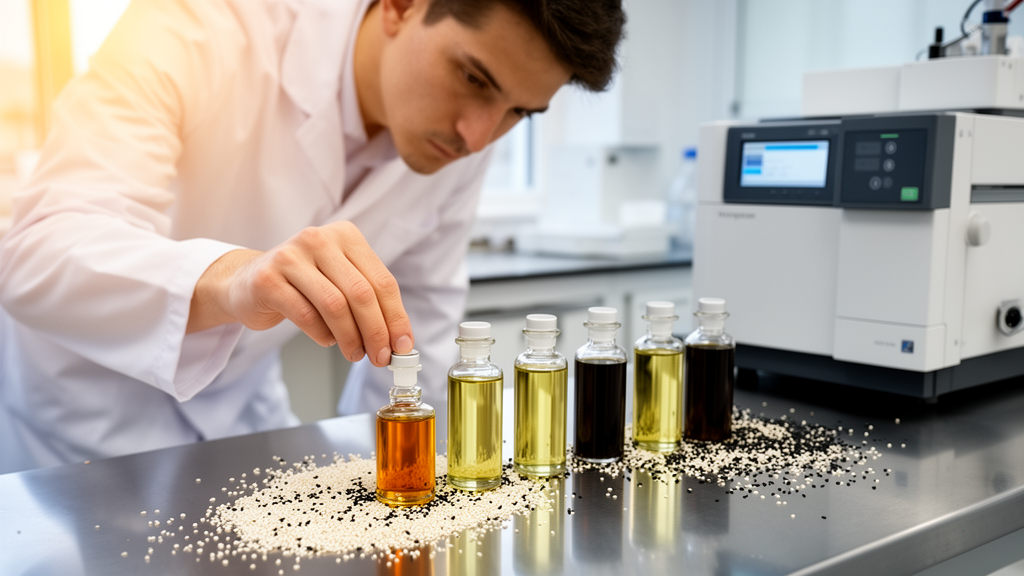
For centuries, cooks across Asia and the Middle East have reached for sesame oil to lend a toasty, nutty depth to their dishes, yet few have paused to ask why oils pressed from white and black sesame seeds, though seemingly close cousins, deliver such strikingly different aromas. A team of flavor chemists at the Beijing Key Laboratory of Flavor Chemistry, based at Beijing Technology and Business University, has now answered that question at the molecular level. In a study published in npj Science of Food, the researchers combined an advanced analytical instrument known as comprehensive two-dimensional gas chromatography time-of-flight mass spectrometry, abbreviated GC-GC-TOF-MS, with the tools of molecular sensory science to map the key aroma compounds of white sesame oil, or WSO, and black sesame oil, or BSO. Their findings offer the most detailed picture yet of what makes each oil smell the way it does, and they carry practical consequences for quality control in sesame oil production.
The analytical challenge the team faced is formidable. A single drop of sesame oil contains hundreds of volatile molecules, many of them present at vanishingly low concentrations, and many of them chemically similar enough that conventional one-dimensional gas chromatography struggles to separate them. Comprehensive two-dimensional gas chromatography solves this problem by passing the vaporized sample through two columns with different chemical selectivities, one after the other, so that compounds unresolved on the first column get a second chance to separate on the second. Coupled to a time-of-flight mass spectrometer, which records full mass spectra at high speed, the instrument can identify and semi-quantify compounds that would otherwise hide beneath the peaks of more abundant neighbors. Using this setup, the researchers identified and semi-quantified a total of 212 compounds across the two oils, an inventory that spans pyrazines, furans, aldehydes, phenols, sulfur compounds and many other chemical families.
Identifying what is present, however, is only half the story of aroma. The human nose is a highly selective detector, and not every volatile compound in a food contributes meaningfully to its perceived smell. To find the molecules that actually matter, the team turned to gas chromatography-olfactometry-mass spectrometry, or GC-O-MS, a hybrid technique in which the column effluent is split between a mass spectrometer and a sniffing port where a trained human assessor smells each separated compound as it elutes. This approach identified 105 compounds as aroma-active in the two oils. The researchers then applied aroma extract dilution analysis, known as AEDA, a method in which the aroma extract is diluted stepwise and re-sniffed until a compound’s odor disappears. The dilution factor at which each odor persists, called the flavor dilution or FD value, serves as a rough ranking of that compound’s sensory importance. AEDA revealed that 46 compounds had an FD value of at least 27, marking them as the most potent contributors to the aroma of the oils.
Ranking compounds by potency is still an inference, so the team moved to the decisive stage of molecular sensory science: recombination and omission experiments. In a recombination experiment, the chemists blend the identified key compounds in the concentrations measured in the real oil, creating an artificial aroma designed to mimic the original. When trained sensory panels judge the synthetic mixture as indistinguishable from the genuine oil, the researchers can be confident that their list of key odorants is essentially complete. In omission experiments, the logic runs in reverse: one compound at a time is removed from the complete mixture, and panelists are asked whether the resulting aroma differs from the full blend. If removing a single molecule produces a detectable difference, that molecule is confirmed as a genuine key odorant rather than a bystander.
Through this rigorous validation process, the team identified 11 compounds with highly significant effects, at a statistical threshold of p less than or equal to 0.001, in the aroma of each oil. The list includes 2,5-dimethylpyrazine, furfuryl mercaptan, (E,E)-2,4-nonadienal, guaiacol, furaneol, (E,E)-2,4-decadienal, 2-methoxy-4-ethenylphenol, methyl furfuryldisulfide, 1-octen-3-ol, 2,4-dimethylthiazole, and 2-acetylpyridine. Each of these molecules carries a distinct olfactory signature. The pyrazines, formed during the roasting of sesame seeds through Maillard reactions between amino acids and sugars, deliver the roasted, nutty notes that define toasted sesame oil. Furfuryl mercaptan and methyl furfuryldisulfide are potent sulfur compounds associated with coffee-like and roasted aromas, capable of influencing perception at extraordinarily low concentrations. The aldehydes (E,E)-2,4-nonadienal and (E,E)-2,4-decadienal contribute fatty, fried and green notes, while guaiacol, furaneol and 2-methoxy-4-ethenylphenol add smoky, caramel-like and spicy dimensions. 1-Octen-3-ol lends a mushroom-like nuance, 2,4-dimethylthiazole brings roasted and sulfurous character, and 2-acetylpyridine contributes a popcorn-like quality.
The comparison between the two oils proved revealing. Although white and black sesame oils share much of their chemical vocabulary, the relative abundance and sensory weight of individual compounds differ between them, and the omission experiments confirmed that different molecules carry the aroma of each oil. These differences in aromatic substances and their sensory perception, the authors conclude, suggest that distinct aroma precursor compositions and thermal reaction pathways may exist between white and black sesame seeds. In other words, the two seed varieties likely begin the roasting process with different inventories of amino acids, sugars and other reactive precursors, and those different starting materials funnel through different sets of Maillard reactions, lipid oxidation pathways and thermal degradations when the seeds are heated during oil pressing. The result is two oils whose aromas, though recognizably sesame, diverge in character at the level of individual odorants.
This kind of precursor-level explanation matters beyond the laboratory. Sesame oil is a high-value product whose aroma is its principal selling point, and producers have long relied on empirical craft, adjusting roasting temperature, roasting time and seed selection by trial and error. A molecular map of the key odorants, validated by human sensory panels, gives the industry a rational target. Quality control laboratories can now monitor specific marker compounds rather than relying on coarse proxies, and producers seeking to standardize or deliberately tune the aroma of white versus black sesame oil can trace differences back to precursor chemistry and thermal processing conditions. The study’s authors note that their comprehensive deciphering of the aromas of WSO and BSO informs quality control in production, a goal that becomes concrete once the decisive odorants are named and quantified.
The work also illustrates a broader trend in flavor research, in which molecular sensory science has become the standard framework for decoding the aromas of foods as diverse as coffee, chocolate, rice, tea and fermented sauces. The framework’s strength lies in its insistence on human validation: analytical instruments can catalog hundreds of volatiles, but only experiments involving trained human noses can determine which of those volatiles actually shape perception. By pairing the separating power of GC-GC-TOF-MS with the confirmatory power of recombination and omission testing, the Beijing team has applied this framework with unusual thoroughness, moving from a 212-compound inventory down to a validated set of 11 decisive odorants for each oil.
For the consumer, the study transforms an everyday culinary observation into molecular fact. The nutty warmth of white sesame oil and the deeper, earthier character of black sesame oil are not matters of tradition or marketing but the predictable outcome of different precursor compositions reacting through different thermal pathways during roasting. Each oil’s signature rests on a small ensemble of pyrazines, sulfur compounds, aldehydes and phenols, each contributing its own note to the overall chord. As flavor chemists continue to dissect the chemistry of traditional foods, studies like this one close the gap between what cooks have known for generations and what instruments can now measure, one volatile molecule at a time.
Subject of Research: Revealing differences in key aroma compounds of two sesame oils using GC-GC-TOF-MS, molecular sensory science
Article Title: Revealing differences in key aroma compounds of two sesame oils using GC-GC-TOF-MS, molecular sensory science
Article References: Feng, L., Yan, W., Liu, M., Man, Y., Zhong, R., Li, H., Zhao, Y., Wang, S., Chen, H., Sun, J., Zhang, H., Zhang, N., & Sun, B. (2026). Revealing differences in key aroma compounds of two sesame oils using GC-GC-TOF-MS, molecular sensory science. npj Science of Food. https://doi.org/10.1038/s41538-026-01137-3
Image Credits: AI Generated
DOI: 10.1038/s41538-026-01137-3
Keywords: sesame oil, aroma compounds, GC-GC-TOF-MS, molecular sensory science, flavor chemistry, food analysis, Revealing, differences, aroma, compounds, sesame, oils
News Source: Alan Morgan. (October 15, 2026). Scientists Decode Why White and Black Sesame Oils Smell So Different. Scienmag.