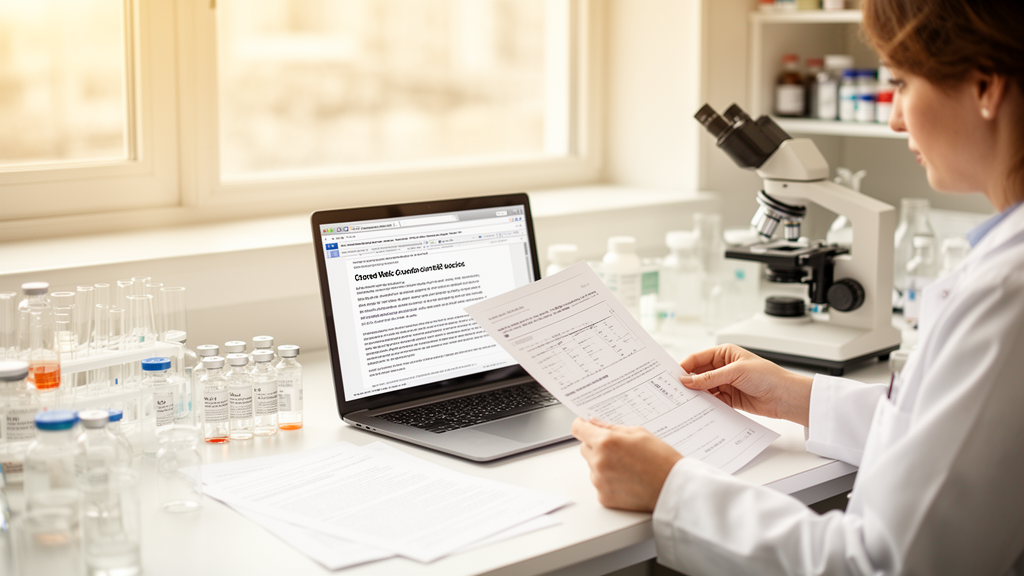
When a research paper clears the long gauntlet of peer review, the scientists behind it often want the world to see their work as quickly as possible. In pharmacology and toxicology, where findings can inform drug safety decisions, regulatory evaluations, and follow-up laboratory studies, months of delay between acceptance and formal publication can matter. That is why journals such as BMC Pharmacology and Toxicology publish accepted manuscripts as Articles in Press, an early-access stage that places a citable version of the paper online before the final production process is complete.
An Article in Press is, by definition, a formally accepted, peer-reviewed manuscript that has not yet gone through the full copy-editing, typesetting, and author-proofing stages that produce the final Version of Record. The moment a manuscript is accepted, the journal assigns it a permanent Digital Object Identifier, or DOI, a unique alphanumeric string that acts as a persistent digital fingerprint for the paper. Because the DOI exists from the outset, researchers can view, share, and cite the work immediately, and any citation will continue to resolve correctly even after the final version replaces the early one.
The technical logic behind this system rests on the distinction between acceptance and publication. Traditional publishing models treated the printed journal issue as the definitive event, which meant that a paper accepted in, say, March might not appear in a citable form until the following calendar year. Electronic publishing dissolved that constraint. Once peer review confirms that a manuscript meets the journal’s scientific standards, the remaining steps are largely editorial and typographic rather than scientific, so there is no methodological reason to keep the findings hidden while fonts and page numbers are finalized.
That does not mean the early version is identical to what will eventually stand as the record. Springer Nature, which publishes BMC Pharmacology and Toxicology, notes that an Article in Press may be subject to further editing, because errors affecting the content can surface during final production. Copy editors may catch ambiguities in the abstract, inconsistencies in units or nomenclature, or formatting problems in tables and figures. Authors then review these changes during the proofing stage, and all corrections are folded into the final Version of Record. The early version is therefore a snapshot of the accepted science, not a guarantee of polished presentation.
To prevent confusion, the Article in Press is clearly labelled online to show that it is not the final Version of Record. Readers who land on the page see an explicit notice that the document is an early version and that the legal disclaimers applying to the journal remain in force. This labeling matters for scientific integrity: a clinician or regulator citing a toxicology result needs to know whether they are reading the definitive text or a version that could still be refined. The DOI, however, stays the same throughout, so the citation chain is never broken when the final version supersedes the early one.
For fully open access journals, this service is applied to every accepted manuscript, not just to selected papers. Open access publishing removes subscription barriers so that anyone, from a graduate student in a developing country to an industry toxicologist, can read the latest evidence without paying. Extending early access to all accepted papers in such journals amplifies that mission, because the interval between acceptance and the Version of Record can otherwise stretch to weeks or months depending on the production backlog. In fast-moving areas such as drug safety pharmacology, nanotoxicology, or the assessment of emerging contaminants, that interval can determine whether a new hazard is flagged before it causes harm.
The citation mechanics deserve a closer look, because they are the part most relevant to working scientists. A DOI is registered with the International DOI Foundation’s handle system, which redirects any query for that identifier to the publisher’s current landing page for the article. When the Article in Press is replaced by the Version of Record, the redirect target is updated, but the identifier itself never changes. Reference managers, indexing databases, and preprint aggregators that have already recorded the DOI therefore continue to point to the most authoritative version available. This is the same principle that underlies preprint servers, except that Articles in Press have already passed formal peer review, giving them a stronger evidentiary status than unreviewed preprints.
There are practical implications for authors as well. Journals encourage researchers who want to organize a press release for an Article in Press to contact their production editor as early as possible. Early coordination allows the press office to time publicity so that journalists receive the story while the paper is fresh, and it ensures that any embargo or messaging reflects the fact that the manuscript is still in production. For studies with potential public health relevance, such as a newly identified interaction between a common medication and a widely used supplement, early press engagement can accelerate the transfer of knowledge from the laboratory to the clinic and to the public.
The system also changes how the scientific community tracks emerging evidence. Literature searches that index Articles in Press surface findings months earlier than searches limited to final versions, which can influence the design of ongoing experiments. A research group planning an animal study on a particular compound, for example, may discover through an early-access paper that another team has already characterized a specific dose-response relationship, allowing them to refine their protocol or avoid redundant work. Systematic reviewers and meta-analysts, meanwhile, must simply be aware that the text they retrieve may still be subject to minor editorial revision, even though the underlying data and conclusions have been peer reviewed and accepted.
None of this alters the fundamental contract of scholarly publishing: peer review remains the gate, and the Version of Record remains the definitive, corrected, and formatted statement of the work. What the Article in Press model changes is timing. By decoupling the scientific verdict of peer review from the mechanical work of production, journals in pharmacology and toxicology can deliver vetted findings to the community at the speed modern research demands, while retaining the safeguards of labeling, correction, and a stable DOI that keep the scholarly record accurate and traceable. For a field in which the stakes are often measured in patient safety, that combination of speed and reliability is not a convenience but a structural advantage.
Subject of Research: Early-access publication of accepted peer-reviewed manuscripts as Articles in Press in pharmacology and toxicology journals
Article Title: Articles in Press
Article References: Articles in Press. (n.d.). Original publication
Image Credits: AI Generated
DOI: Not provided
Keywords: Articles in Press, early access publishing, peer review, Digital Object Identifier, BMC Pharmacology and Toxicology, open access, Version of Record, scholarly publishing, citation, manuscript acceptance, Springer Nature, scientific communication
News Source: Louis Brooks. (October 15, 2026). Early Access Publishing Puts Peer-Reviewed Pharmacology Findings Online Sooner. Scienmag.