The buildings we inhabit are among the planet’s most demanding energy consumers. According to figures cited in a new study published in Scientific Reports, the construction industry accounts for roughly 36 percent of global final energy use and 39 percent of energy-related carbon dioxide emissions. Much of the debate about greener buildings has focused on how much energy a finished structure consumes once the lights are on and the heating is running. Far less attention has been paid to the energy burned during construction itself — the diesel in excavators, the electricity in curing systems, the fuel in delivery trucks. A new analysis by Jing Xu of Anhui Bozhou Vocational and Technical College in China now offers one of the most detailed quantitative portraits to date of what it actually costs, in energy terms, to build a wall two different ways.
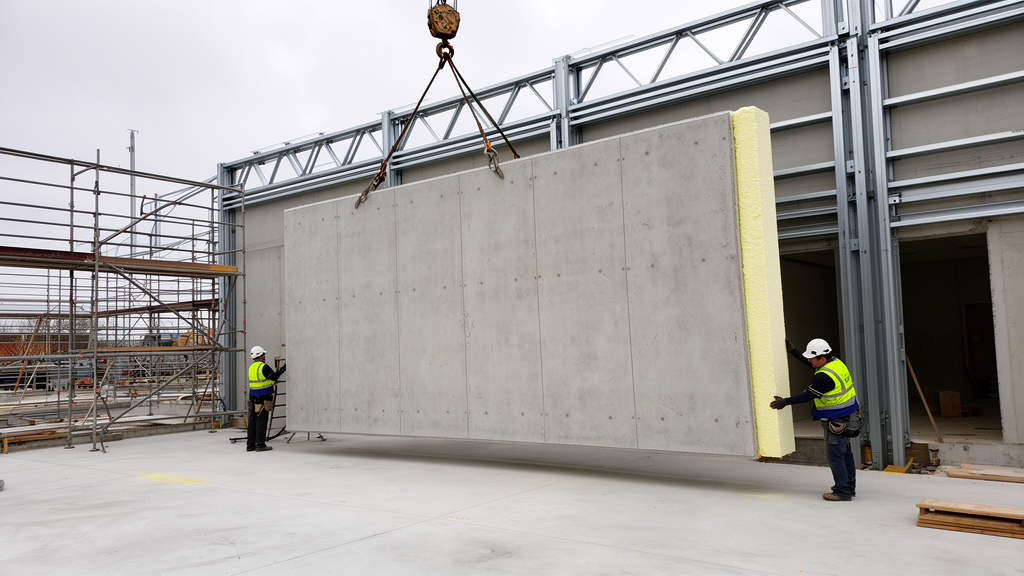
The study centers on a three-layer prefabricated composite wall panel, manufactured in a factory and then transported to site for assembly. The panel is a structural sandwich: an inner layer of structural concrete provides load-bearing capacity, a middle layer of expanded polystyrene, or EPS, delivers thermal insulation, and an outer layer made with recycled aggregate concrete closes the assembly. The recycled aggregate component is notable because it diverts construction and demolition waste back into new building elements rather than sending it to landfill. Crucially, the panel is produced using an integrated forming process, meaning the three layers are cast together in a single operation. That eliminates the need to install insulation as a separate step on site, which the study reports cuts labor time by 40 percent and avoids the thermal bridges that plague conventional retrofitted walls at every fastener, tie, and joint.
To evaluate the concept, Xu compared the prefabricated panel against a traditional cast-in-situ concrete wall — the kind poured into formwork on site — over a standardized 100 square meter wall area. The comparison covered three dimensions: mechanical performance, thermal performance, and construction-phase energy consumption. On the mechanical side, the results are solid. The structural concrete layer achieved a compressive strength of 36.2 megapascals, while the outer recycled aggregate concrete layer reached 28.5 megapascals, figures consistent with structural-grade concrete. The full composite panel recorded a flexural strength of 4.8 megapascals, indicating the sandwich holds together as a coherent structural unit rather than delaminating into separate layers.
The thermal results are where the panel truly distinguishes itself. At the center of the panel, the measured thermal transmittance, or U-value, was 0.38 watts per square meter kelvin. To put that in perspective, a conventional 200-millimeter solid concrete wall has a U-value of 2.8 watts per square meter kelvin, and a 150-millimeter solid prefabricated wall without insulation comes in at 2.5. The composite panel therefore transmits 86 percent less heat than the conventional solid wall and 85 percent less than the uninsulated prefabricated alternative. A U-value of 0.38 also falls below the 0.4 threshold recommended for passive house standards, the demanding German-origin certification for ultra-low-energy buildings. That means a wall built from these panels could, at least at its center, meet one of the strictest efficiency benchmarks in the world.
But the study is refreshingly honest about the limits of that comparison. The dramatic percentage improvements are measured against uninsulated solid walls, which are no longer typical in most climates. When the researchers equipped a conventional 200-millimeter concrete wall with 80 millimeters of external EPS insulation — the standard modern approach — its U-value dropped to 0.32 watts per square meter kelvin, actually better than the composite panel’s 0.38. The authors also caution that the passive-house-compliant figure applies only to the center-of-panel region. Real walls have edges, joints, and connections to structural elements, and these are precisely where thermal bridges form, allowing heat to leak around even the best-insulated panel core. Anyone citing the headline numbers should keep those caveats in mind.
The energy accounting is the heart of the study, and it delivers a genuinely surprising finding. On-site energy monitoring showed that the prefabricated system reduced construction-phase energy consumption by 27.3 percent, dropping from 46.9 to 34.1 kilowatt-hours per square meter of wall. The savings came overwhelmingly from two sources: machinery energy fell by 59.6 percent, because far less equipment is needed on site when panels arrive pre-made, and curing energy fell by 45.2 percent, because factory conditions allow more controlled and efficient curing than a construction site can offer. For a building industry searching for quick carbon wins, a quarter reduction in the energy of erecting walls is a significant prize.
Yet the sensitivity analysis complicates the story in an important way. The cast-in-situ baseline in the study used electric curing blankets to keep the concrete warm as it hardened. If the cast-in-situ wall had instead been cured naturally at ambient temperature, the prefabricated advantage would shrink dramatically — from 27.3 percent to approximately 7.3 percent. In other words, a large share of the reported savings depends not on prefabrication itself but on the curing method chosen for the conventional alternative. This is exactly the kind of methodological transparency that energy comparisons in construction often lack, and it gives builders and policymakers a more honest basis for deciding when prefabrication genuinely pays off.
Transportation tells the other side of the ledger. Because the panels are made in a factory, they must be hauled to site, and transportation energy rose by 68.8 percent, from 3.2 to 5.4 kilowatt-hours per square meter. In absolute terms, however, that increase amounts to just 2.2 kilowatt-hours per square meter, easily outweighed by the 13.6 kilowatt-hours per square meter saved on site. The study calculates a break-even transportation distance of approximately 320 kilometers round trip: within that radius, the on-site savings exceed the extra transport energy, and beyond it, the logistics begin to erode the environmental case. For planners, that number is a practical siting guideline — prefabrication factories serve their greenest purpose within a regional radius rather than a national supply chain.
The study also dissects where the prefabricated system’s energy actually goes, and the distribution is instructive. Factory production dominates, accounting for 42.5 percent of total construction energy, followed by on-site lifting at 27.0 percent, transportation at 15.8 percent, and joint filling and finishing at 14.7 percent. That profile suggests future optimization efforts should target the factory floor first — more efficient mixing, molding, and curing equipment would yield the largest returns — followed by crane operations and panel logistics. It also underscores that prefabrication does not eliminate energy consumption; it relocates it from a chaotic construction site to a controllable industrial environment, where efficiency improvements are easier to engineer and measure.
Taken together, the findings offer a nuanced endorsement of multi-layer composite prefabricated wall panels for low-carbon construction. The panels deliver passive-house-level thermal performance at their core, respectable structural strength, a 40 percent reduction in labor time, and meaningful on-site energy savings, all while incorporating recycled materials. The caveats — the dependence of headline savings on curing assumptions, the transportation break-even distance, and the unresolved question of thermal bridging at joints — do not undermine the concept but define its proper scope of application. As the industry confronts its outsized share of global emissions, studies like this one provide the quantitative benchmarks needed to move beyond slogans and toward evidence-based building practice, one carefully measured wall at a time.
Subject of Research: Construction-phase energy consumption and thermal performance of three-layer prefabricated composite wall panels compared with cast-in-situ concrete walls
Article Title: Energy consumption analysis of three-layer prefabricated composite wall panels: an integrated forming process and comparative study with cast-in-situ construction
Article References: Xu, J. (2026). Energy consumption analysis of three-layer prefabricated composite wall panels: an integrated forming process and comparative study with cast-in-situ construction. Scientific Reports. https://doi.org/10.1038/s41598-026-72462-6
Image Credits: AI Generated
DOI: 10.1038/s41598-026-72462-6
Keywords: prefabricated construction, composite wall panels, energy consumption, thermal performance, recycled aggregate concrete, cast-in-situ construction, EPS insulation, U-value, passive house, construction emissions, integrated forming process, low-carbon building
News Source: Denise Maddox. (October 15, 2026). Sandwich Wall Panels Cut Construction Energy Use by 27 Percent in Head-to-Head Trial. Scienmag.