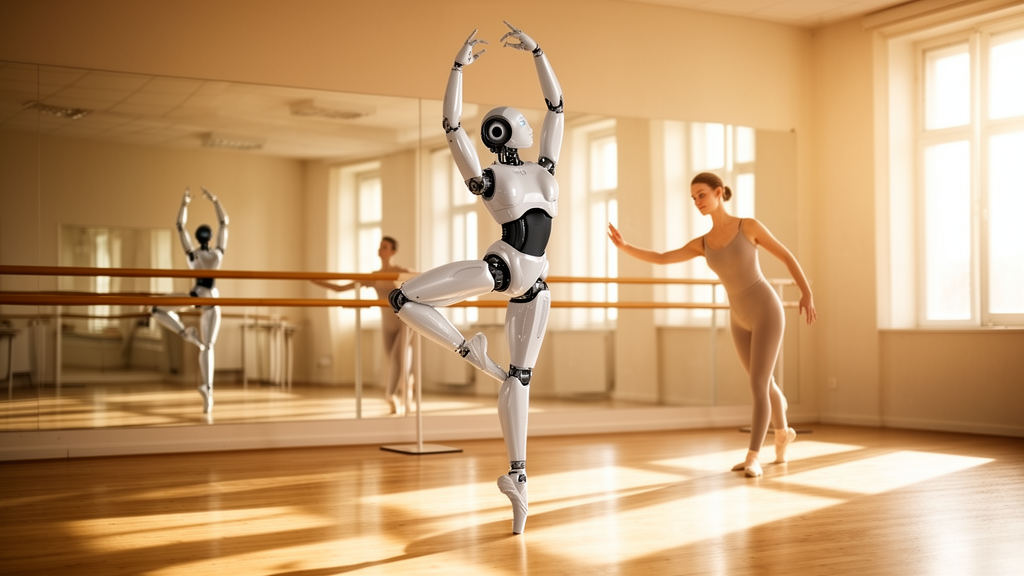
A bipedal robot that can dance without falling over is one of those problems that sounds whimsical until you look under the hood. Dance is not locomotion. It demands artistic expression, rhythmic precision, spatial continuity and physical stability all at once, under finite degrees of freedom, joint limits, torque constraints, frictional contacts and a support region that shrinks to a single foot during a spin. A new study published in Discover Artificial Intelligence by Ying Cao of Anyang Preschool Education College proposes a joint optimization framework that tackles all three pillars of robot dance — motion generation, aesthetic evaluation and dynamic balance control — inside a single unified system rather than as separate, loosely connected modules.
The core insight of the work is that existing robot dance systems tend to silo these tasks. Generative models produce plausible-looking choreography with no guarantee it can be executed; control systems keep the robot upright but indifferent to style; and aesthetic judgment, when present, is bolted on afterward. Cao’s framework instead couples a conditional Generative Adversarial Network (cGAN) for style-controlled motion synthesis, a multimodal aesthetic scoring model calibrated against human experts, and a safe deep reinforcement learning controller based on Proximal Policy Optimization (PPO). The three components feed one another: the aesthetic model scores what the generator produces, and those scores help shape the reward signal that trains the balance controller.
At the foundation sits a temporal motion representation model. The robot’s posture at any moment is encoded as a vector of joint angles, extended with angular velocities, center-of-mass trajectories, rhythm labels and style conditions. A spatiotemporal coupling mechanism jointly captures where the joints are and how they evolve in time, which is what allows the system to express rhythmicity and smoothness. Smoothness itself is formalized as a second-order difference constraint on joint trajectories — essentially penalizing jerk — while rhythm consistency measures the distance between actual joint states and a learned mapping from the musical beat signal to expected motion features.
The training data is substantial. The dataset combines publicly available human motion-capture dance sequences, manually recorded music-dance clips and robot-simulation trajectories produced through inverse kinematics retargeting, yielding 4,800 valid sequences of 6 to 12 seconds each, resampled at 30 frames per second. Six dance styles are covered: hip-hop, jazz, folk, modern, Latin and robotic dance. Human skeleton data is mapped onto a 23-degree-of-freedom bipedal humanoid through pelvis-centered coordinate normalization and inverse kinematics, with any motions violating joint ranges, causing limb overlap or exceeding torque limits filtered out. Each sequence carries five labels — style, rhythm type, motion complexity, support phase and aesthetic score interval — annotated by two trained annotators and checked by a dance expert, with disagreements re-evaluated until consensus. The data is split 7:1:2 into training, validation and test sets by sequence ID rather than by frame, a detail that prevents temporal leakage between subsets.
The generator itself is a conditional GAN with a three-module architecture. A content encoder built from fully connected layers processes the latent input, a style embedding module maps one-hot style labels into a 64-dimensional vector, and a sequence decoder of two LSTM layers with 512 hidden units, followed by temporal self-attention, produces 240-frame motion sequences. The discriminator is deliberately dual-branch: one head judges whether a motion is real or generated, while the other predicts its style category. This dual-task design gives the generator direct feedback not just on realism but on stylistic fidelity, and a gradient penalty term stabilizes adversarial training. Cao chose a cGAN over diffusion models or variational autoencoders for a practical reason: the generator produces a complete sequence in a single forward pass, which suits real-time robot control far better than iterative denoising, though diffusion-based generation is flagged as a promising future extension.
Aesthetic evaluation is where the framework gets philosophically interesting. How do you quantify beauty? The model fuses four feature streams — visual posture features, motion smoothness, spatial symmetry and acoustic rhythm features — through a weighted, gated fusion mechanism in which a sigmoid gating function adaptively adjusts each modality’s contribution. The fused vector passes through a multi-layer perceptron to produce a scalar score between zero and one. Crucially, the automated scores are validated against humans: 300 generated sequences were rated by five dance experts across five dimensions, and the model’s overall Pearson correlation with expert ratings reached 0.86, with a Spearman correlation of 0.84. Notably, the correlation for spatial symmetry was weaker than for rhythm consistency, prompting the author to argue for a novelty-tolerant scoring term so the system does not suppress creative asymmetric postures that fall outside the training distribution.
The control layer is where safety becomes non-negotiable. Unconstrained reinforcement learning exploration on a physical biped means falls, actuator overload and hardware damage, so the PPO policy is trained with a multi-objective reward combining task completion, aesthetic feedback and balance stability, plus penalties for joint limits and energy use. The balance term is anchored in the zero-moment point (ZMP): the controller is penalized for letting the ZMP stray from the center of the support region, which is the classical condition for not tipping over. A mechanical safety filter upstream constrains joint angles, torque limits, self-collision and support-region feasibility before any generated motion reaches the controller. The policy network takes a 79-dimensional state vector and outputs 23-dimensional continuous torque commands, and a hierarchical closed-loop structure assigns adaptive priorities: arm swings and small torso movements get aesthetic flexibility, while turns, strides, jumps and center-of-mass transfers trigger higher stability weights and reduced motion amplitude. A transition smoothing module blends postures over a 15-frame window between dance styles, taming the tracking-error spikes that occur when the posture distribution changes abruptly.
The results are striking. Under identical data partitions and evaluation protocols, the framework reduced the Fréchet Inception Distance (FID) — a measure of how closely generated motion distributions match real ones — to 24.8, which is 49.1 percent lower than an LSTM-GAN baseline and 21.3 percent lower than MotionGAN. Style recognition accuracy hit 91.7 percent, diversity rose to 0.83, and smoothness improved to 0.109. On the control side, ZMP deviation dropped 56.3 percent compared with PID control, the fall rate fell 69.2 percent compared with DDPG, and energy consumption was 6.7 percent lower than standard PPO, all while the overall fall rate fell to just 1.2 percent. Even in high-complexity motions, ZMP error stayed at 1.89 centimeters with a stability score of 0.87.
Robustness testing pushes the system closer to reality. The team subjected the robot to horizontal push forces of 20 to 60 newtons applied for 0.2 seconds, ground height variations of 1 to 3 centimeters, Gaussian sensor noise on joint and center-of-mass observations, and degraded visual and audio signals from lighting variation and background noise. The fall rate stayed below 4 percent under every disturbance condition, and under combined disturbances the robot recovered within 184 milliseconds. The gated fusion mechanism proved its worth here: when lighting or audio degraded, the aesthetic score shifted by no more than 0.09 because the system automatically down-weighted unreliable modalities. Ablation studies confirmed that every component earns its place — removing the ZMP constraint or safety filter sharply increased falls, and removing PPO control entirely produced the highest fall rate of all, demonstrating that motion generation alone cannot guarantee dynamic balance.
There are honest limitations. The validation rests on physics simulation and hardware-in-the-loop testing rather than a physical bipedal robot, and the computational cost of GAN generation plus reinforcement learning inference remains heavy for low-power onboard controllers, making model compression, quantization and lightweight temporal networks necessary next steps. Real-time performance is nonetheless encouraging: at a concurrency of 100, average latency was 31.2 milliseconds with throughput of 214.7 sequences per second, and the frame rate held at 51 FPS even at concurrency 200. Future work will target real-robot deployment, diffusion-based generation, uncertainty-aware control and TD3-based smooth torque optimization. But the conceptual contribution stands on its own: by refusing to treat artistry, judgment and stability as separate engineering problems, the framework offers a template for machines that do not merely move — they perform, and they stay on their feet while doing it.
Subject of Research: Joint AI framework for robot dance motion generation, aesthetic evaluation and dynamic balance control
Article Title: Joint optimization framework for robot dance motion generation, aesthetic evaluation, and dynamic balance control based on conditional gans and safe deep reinforcement learning
Article References: Cao, Y. (2026). Joint optimization framework for robot dance motion generation, aesthetic evaluation, and dynamic balance control based on conditional gans and safe deep reinforcement learning. Discover Artificial Intelligence, 6(1), Article 1463. https://doi.org/10.1007/s44163-026-02059-5
Image Credits: AI Generated
DOI: 10.1007/s44163-026-02059-5
Keywords: robot dance, conditional GAN, deep reinforcement learning, PPO, aesthetic evaluation, ZMP constraint, dynamic balance, humanoid robot, motion generation, multimodal fusion, safe reinforcement learning, motion capture
News Source: Denise Maddox. (October 15, 2026). Teaching Robots to Dance: AI Framework Balances Art, Aesthetics and Falling Over. Scienmag.