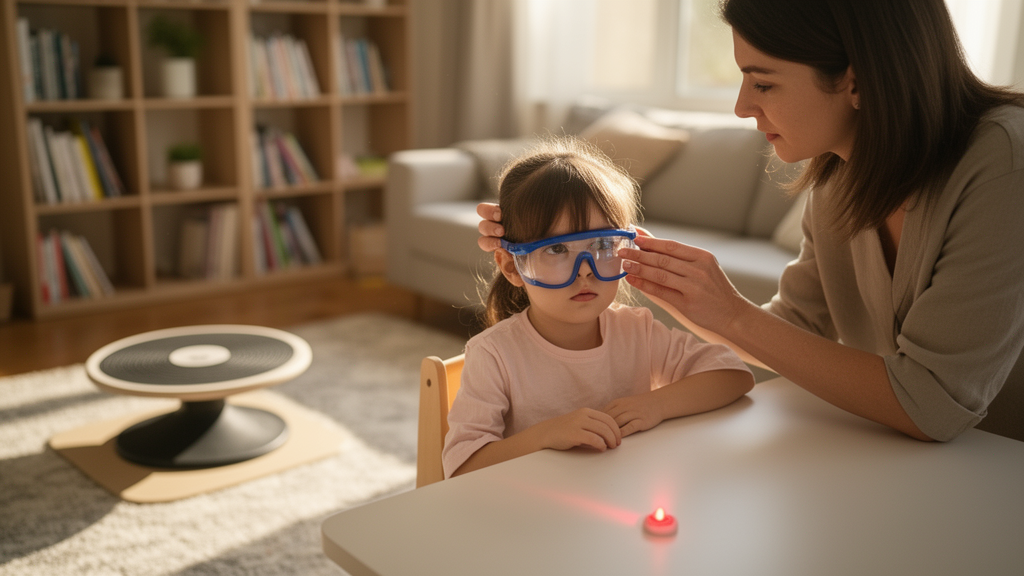
Can a few minutes of daily eye exercises, done at home in front of a video screen, actually change the way children move, balance, and see the world? A new pilot study from Japan suggests that the answer is a cautious and intriguing partial yes. Researchers led by Yasuhiro Suzuki of the University of Tsukuba report in BMC Pediatrics that a 24-week, home-based eye movement training program was feasible for community-dwelling school-aged children and produced measurable improvements in several visual and motor functions, even though its effects on postural balance turned out to be far more limited than the training’s underlying theory might predict.
The idea behind eye movement training, often abbreviated ET, rests on a simple observation of human physiology: vision is not a passive process but an active one, deeply intertwined with the body’s control of posture and movement. Three distinct oculomotor systems are at play whenever we look around. Smooth pursuit allows the eyes to track a moving object fluidly, as when following a ball across a field. Saccades are the rapid, ballistic jumps the eyes make from one fixation point to another, essential for scanning a scene or reading a page. And the vestibulo-ocular reflex, or VOR, stabilizes gaze by counter-rotating the eyes when the head moves, keeping the visual world steady during locomotion. Because balance depends on the continuous integration of visual, vestibular, and proprioceptive signals, researchers have long speculated that sharpening these eye movement systems might also sharpen the body’s ability to stay upright.
Testing that idea rigorously in children, however, has been difficult. Most prior work on eye movement training has focused on adults, older adults, or clinical populations, and questions about whether children would adhere to a long training program, and whether such training would produce lasting effects in a developing nervous system, remained open. The Japanese team set out to address the feasibility question directly by designing an intervention that children could perform entirely at home, guided by an instructional video delivered through a system called SUKUBARA, and monitored automatically through recorded playback times.
The study enrolled 30 community-dwelling school-aged children in Japan, of whom 28 completed the full 24-week program. The participants had a mean age of 10 years, with an age spread of roughly one year, and 12 of the 28 completers, or 43 percent, were girls. Each child performed a daily training routine combining three types of exercises: smooth pursuit tasks, saccadic eye movement tasks, and exercises based on the vestibulo-ocular reflex at a doubled gain, sometimes written as VOR x2, which challenges the reflex to work harder than it naturally does. While performing these exercises, the children watched an instructional video at home, and the system automatically logged how long the video was played, giving the researchers an objective measure of adherence rather than relying on self-report.
Adherence, it turned out, was respectable for a home program lasting half a year. Over the 24 weeks, the children accumulated an average of 9.2 hours of total video viewing time, with a standard deviation of 3.6 hours. Spread across the training period, that works out to about 4.6 sessions per week, or roughly 4.6 with a standard deviation of 1.8. For a daily program, that means most children completed the routine on around half of the available days, a figure the researchers treated as evidence that the intervention was feasible for this age group when delivered through a familiar video-based format at home.
To capture what changed, the team measured a battery of outcomes before and after the intervention. The primary outcome was the index of postural stability, or IPS, assessed in four different conditions, which quantifies how steadily a child can stand. Secondary outcomes included one-leg standing time with eyes both open and closed, grip strength, jump height, and two functional tests specifically designed to probe ocular motor-related visual performance: eye-hand coordination, abbreviated EHC, and horizontal moving digit identification, abbreviated HDI. In the EHC test, children must coordinate their hand movements with what their eyes are tracking, while the HDI test requires identifying digits that are moving horizontally, a task that directly loads the pursuit and saccadic systems. Statistical significance was set at a p-value below 0.05, and appropriate paired analyses were used to compare pre- and post-training measurements.
The results revealed a strikingly selective pattern. Significant improvements appeared in eye-hand coordination, which rose from an average of 33 to 36 points, with standard deviations of 5 in both cases and a p-value below 0.001, and in horizontal moving digit identification, which increased from 12 to 14 points, with standard deviations of 3 and 4 respectively and a p-value of 0.010. One-leg standing time with the eyes closed also improved substantially, rising from a median of 23 seconds to a median of 35 seconds, with a p-value of 0.004, and grip strength increased from a median of 16.5 kilograms to 18.0 kilograms, with a p-value of 0.002. In contrast, the four indices of postural stability showed no significant change, nor did jump height or one-leg standing time with the eyes open.
That selectivity is scientifically telling. The tasks that improved, eye-hand coordination and moving digit identification, are precisely the ones that depend most directly on the oculomotor systems being trained, suggesting that the exercises did what they were designed to do at the level of visual function. The improvement in one-leg standing with eyes closed is more puzzling at first glance, since removing vision makes balance harder, not easier, and the researchers note it alongside grip strength gains that could reflect general growth and maturation over six months in children around 10 years old. Because the study used a single-group design without a control arm, natural development, seasonal activity changes, and practice effects on the tests cannot be ruled out as contributors to any of the observed changes. The absence of improvement in the formal postural stability indices, meanwhile, indicates that the training did not translate into steadier standing under the conditions measured.
Perhaps the most informative analysis came from correlating each child’s change scores with their training frequency. Only one outcome showed a significant positive correlation with how often the children trained: eye-hand coordination, with a correlation coefficient of 0.570 and a p-value of 0.003. This dose-response relationship is meaningful because it suggests that the improvement in eye-hand coordination was not merely noise or maturation but was linked to the amount of training actually performed. Children who watched and followed the instructional video more often tended to gain more in the visual-motor task most closely tied to the exercises. No such relationship appeared for balance measures, grip strength, or jump height, reinforcing the conclusion that the training’s clearest effect was on ocular motor-related visual function itself.
The authors are careful about what their findings do and do not establish. They conclude that the 24-week home-based eye movement training program with SUKUBARA was feasible for school-aged children and has the potential to improve ocular motor-related visual function, but they emphasize that the effects on balance were limited and require confirmation in controlled trials. The study was prospectively registered with the University Hospital Medical Information Network Clinical Trials Registry under registration number UMIN000055747 on November 4, 2024, and, at the journal’s request during editorial assessment, was additionally registered retrospectively with the Japan Registry of Clinical Trials as jRCT1032250334 on September 3, 2025. The research received support from the University of Tsukuba through a management grant and through the Advanced Research Initiative for Human High Performance and the Human Smart City Connection programs, and the authors declared no competing interests.
For a field increasingly interested in telerehabilitation, remote monitoring, and home-based training systems, the study offers a practical proof of concept. Children as young as 10 can sustain a structured, video-guided exercise program for six months when it is embedded in their home routine, and objective adherence data can be captured automatically without burdening families. The selective gains in eye-hand coordination and moving digit identification hint that oculomotor training could eventually find a place in programs aimed at visual-motor skills in developing children, whether for sport, learning, or rehabilitation. But the balance question remains open. If eye movement training is to be recommended as a tool for improving postural stability in children, randomized controlled trials with appropriate control groups will need to determine whether the limited balance effects seen here reflect a true absence of benefit, a dose too small or too brief to matter, or simply the difficulty of detecting balance changes in children whose bodies are changing rapidly anyway. Until then, the study stands as an honest first step: a feasible home program that trained the eyes, showed a clear dose-response where the eyes were tested, and left the balance question, for now, unanswered.
Subject of Research: Effects of home-based eye movement training on balance and oculomotor function in school-aged children
Article Title: Effects of eye movement training on balance and ocular motor function in community-dwelling Japanese school-aged children: a pilot study using a single-group intervention
Article References: Effects of eye movement training on balance and ocular motor function in community-dwelling Japanese school-aged children: a pilot study using a single-group intervention. (n.d.). https://doi.org/10.1186/s12887-026-07695-5
Image Credits: AI Generated
DOI: 10.1186/s12887-026-07695-5
Keywords: eye movement training, oculomotor function, balance, children, postural stability, eye-hand coordination, vestibulo-ocular reflex, saccades, smooth pursuit, home-based exercise, pilot study, pediatrics
News Source: Ophelia Keating. (October 15, 2026). Eye Movement Training at Home Sharpens Children’s Vision Skills, But Balance Gains Remain Elusive. Scienmag.