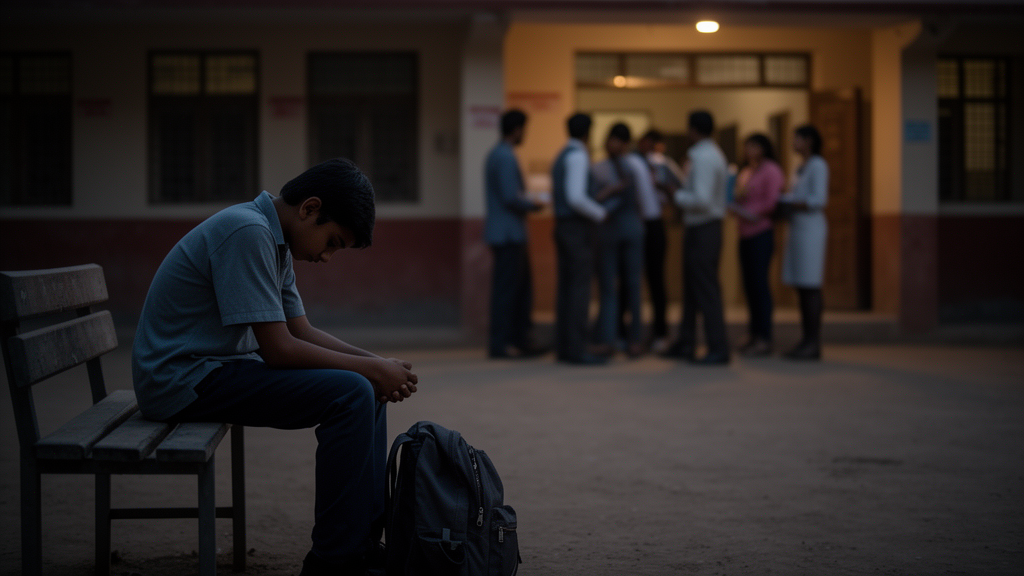
Suicide remains one of the leading causes of death among young people in India, and the numbers behind that statement are stark. According to a recent opinion analysis published in PLOS Global Public Health by Ananya Mosur Sridhar of University College London and Parth Sharma of Sangath’s Initiative for Health Equity Advocacy and Research, 71 percent of female deaths by suicide and 58 percent of male deaths in India occur between the ages of 15 and 39. India holds nearly 18 percent of the world’s population yet accounts for roughly 28 percent of global suicides, a prevalence that exceeds the global average. The authors argue that these figures expose a fundamental flaw in how suicide prevention is conceptualized: the dominant discourse treats ‘individual pathology’ as the principal target for intervention, when mental ill health explains only part of a phenomenon shaped by sociopolitical, economic, and gendered forces. Their central provocation is deceptively simple. Instead of asking what went wrong in a young person’s life, researchers, policymakers, and clinicians should be asking what systems were complicit in their death.
The framing of a youth mental health ‘epidemic’ that places the onus of suicide on the young person has, in the authors’ analysis, inadvertently siloed the entire conversation into clinical interventions. While mental health care is undeniably important, this reductionist lens obscures the structural inequities that young people in India continue to navigate: rampant militarization, caste violence, Indigenous land erasure, ableism, and anti-trans discrimination. The timing of the argument is pointed. Recent student deaths surrounding the National Eligibility-Entrance Test, or NEET, have pushed schools back into the suicide prevention discourse, alongside ongoing student protests. Data reported in 2026 indicated that NEET-linked deaths reached their highest recorded level in 2025, with 93 student suicides reported over five years, and reporting by Al Jazeera documented the despair that followed a major examination paper leak. These events, the authors contend, cannot be treated as isolated tragedies but as symptoms of an education system and a policy apparatus that have repeatedly failed their most vulnerable participants.
One of the most technically provocative sections of the analysis traces the intellectual genealogy of suicide prevention itself. The authors note that the language of global public health often presents suicide prevention as a universal, value-neutral enterprise designed for holistic well-being. Yet the foundations of this movement borrow from colonial histories, in which self-inflicted death as an act of liberation among enslaved and colonized peoples was routinely interpreted through biopolitical frameworks centered on the preservation of enslaved labor, state ownership over bodies, and the pathologization of anti-colonial resistance. Drawing on recent scholarship such as Donovan Calhoun’s The Suicide Archive, the authors show how that framing has evolved but never fully disappeared. The insistence on biomedical models to understand suicide, they argue, continues to obscure present-day structural violence. This is not merely an academic quibble; the historical framing determines which interventions receive funding, which populations are deemed at risk, and crucially, which institutions are excused from scrutiny when young people die.
India’s policy landscape illustrates the gap between legislative intent and implementation. The Mental Health Care Act of 2017 and the National Suicide Prevention Strategy launched in 2022 both emerged as public health priorities, yet their execution has remained weak due to a lack of coordinated intersectoral collaboration and, in many cases, insufficient political will at both national and regional levels. The authors point to the National Education Policy 2020 as a case study in well-intentioned failure. On paper, the policy aimed to strengthen institutional capacity to respond to youth mental health crises through counselors and targeted interventions. In practice, its rollout did not account for the absence of basic infrastructure in schools and higher education institutions across low-resource settings. Six years after its launch, entire communities remain excluded from conversations about access to education and psychosocial support, including young people who are queer, trans, disabled, currently unhoused, incarcerated, living under active armed conflict and increased militarization, forcibly displaced, or facing immediate climate crises.
The analysis is particularly sharp on the question of whose deaths register as preventable tragedies and whose do not. De-politicized narratives around youth mental health flatten identity to a single axis, age, and homogenize young people into a singular category. The authors insist that an intersectional lens is essential to understanding the heterogeneity of experience within India and the specific impact of institutional violence on particular communities. They cite two cases that became national flashpoints. S. Anitha was a 17-year-old Dalit student from a government school in a low-resource setting in Tamil Nadu who died by suicide in 2017 after resisting NEET before the Supreme Court, an examination the authors characterize as rooted in meritocracy over equity. A year earlier, Rohith Vemula, a 26-year-old Dalit PhD student, died by suicide after resisting caste injustice on his campus. Their deaths, the authors argue, are two among many examples of institutional violence that remain detached from any larger systemic accountability around youth suicides.
Into this vacuum of state responsibility, civil society organizations have stepped, and the authors document the consequences of that overextension. Youth suicides and mental health crises in India are typically met with what they describe as a ‘firefighting response,’ in which care infrastructures emerge from grassroots initiatives and civil society organizations overextend their role as de facto intermediaries, offering crisis intervention, psychosocial support, and aid. For some communities, notably LGBTQIA+ young people, these organizations fill a gap that the state refuses to acknowledge, placing the burden of care on already stretched groups, especially those heavily reliant on foreign funding. Informal care infrastructures are not new to India; during the COVID-19 pandemic, numerous collectives emerged as short-term, accessible pathways to mobilize support, from mutual aid campaigns to pro-bono psychosocial and legal aid. Today these services are re-emerging as youth suicides gain visibility, but they carry unintended costs, including burnout within organizations that were never designed to meet the scale of current demand.
The legal landscape has shifted, though not uniformly in practice. Only recently did India remove provisions criminalizing attempted suicide through the Bharatiya Nyaya Sanhita of 2023, a reform that explicitly endorses decriminalization. The authors caution, however, that decriminalization does not automatically translate into destigmatization at the grassroots level. Meanwhile, they observe, suicide prevention strategies are often created without consultation with young people themselves, deploying an individualistic conception of resilience that places the young person in a deficit position in need of correction. Recent dialog-based research on community factors shaping resilience in youth suicide prevention points in a different direction, framing resilience as action taken together rather than as a personal attribute. The distinction matters technically: interventions designed around individual deficit tend to produce clinical referral pathways, while interventions designed around collective action produce community-led, decentralized programs that can address the upstream determinants of distress.
What the authors propose instead is a systems approach with formal mechanisms of accountability, and they are explicit that a systems approach without such mechanisms risks abstraction and tokenism. Their prescription calls for young people with intersectional lived experience to stand at the forefront of change, for interventions to be community-led and decentralized, and for intersectoral collaboration spanning media, law, social work, health services, and public policy. States, they argue, must be held accountable for implementation gaps in rights-based frameworks, for caste violence in educational institutions, for anti-trans discrimination, for ableist policies, and for the routine curbing of dissent. At the same time, public health researchers and civil society organizations must ensure that the intersectionality of lived experience remains central to intersectoral collaboration, and that the dispersion of accountability in youth suicide prevention is explicitly defined and evaluated. Evidence from related work, including repeat content analyses of print media reporting on suicide in Tamil Nadu, suggests that even upstream levers such as responsible journalism can be systematically improved when treated as measurable public health targets.
The analysis closes on an unambiguous ethical claim: youth mental health is inherently political, and every death by suicide attributable to oppressive and unjust systems was avoidable. The authors, who identify as people with intersectional lived experience and acknowledge that their own perspectives are shaped by caste capital and access to education and employment, affirm the lived experiences of oppressed communities as legitimate forms of evidence. That methodological stance, treating community testimony as data rather than anecdote, is itself a departure from conventional epidemiological practice and one of the reasons the piece has drawn attention. Its lasting contribution may be the reframing it demands: accountability, not pathology, as the organizing principle of youth suicide prevention. For a country where nearly three in ten global suicides occur, and where the majority of those deaths fall within the working ages of 15 to 39, the question of where accountability lies is not rhetorical. It is, the authors argue, the most urgent public health question of the decade.
Subject of Research: Reframing youth suicide in India as a public health crisis driven by systemic and structural factors
Article Title: Reframing youth suicide as a public health crisis: Where does accountability lie?
Article References: Mosur Sridhar, A., & Sharma, P. (2026). Reframing youth suicide as a public health crisis: Where does accountability lie?. PLOS Global Public Health, 6(10), e0007368. https://doi.org/10.1371/journal.pgph.0007368
Image Credits: AI Generated
DOI: 10.1371/journal.pgph.0007368
Keywords: youth suicide, India, public health, suicide prevention, mental health, NEET, intersectionality, caste discrimination, education policy, civil society organizations, decriminalization, systemic accountability
News Source: Courtney Benton. (October 14, 2026). Youth Suicide in India Demands Systemic Accountability, Not Individual Blame. Scienmag.